
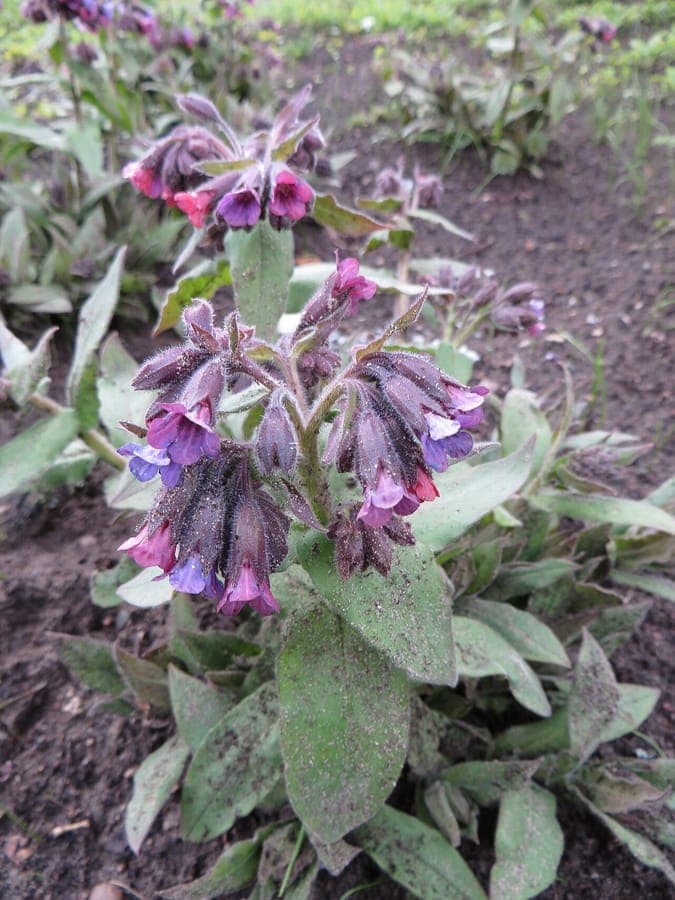
AfroBrazilian / CC BY-SA 3.0, via Wikimedia Commons
Pulmonaria mollis: complete guide
Pulmonaria mollis
Want to see Pulmonaria mollis: complete guide in your garden?
1 minute, no credit card
Overview
Pulmonaria mollis, commonly known as Soft Lungwort, is a resilient perennial that thrives in shaded, naturalistic garden settings. Native to forested regions across Eastern Europe and into Central Asia, this member of the Boraginaceae family has gained popularity among gardeners seeking early-season colour and low-maintenance ground cover. It's especially valued for its ability to brighten up dark corners from late winter into spring, making it a go-to choice for woodland gardens and underplanting beneath deciduous trees.
Appearance & bloom cycle
Soft Lungwort reaches a modest height of 25–30 cm and spreads slowly to about 40 cm wide. The leaves are broad, oval, and softly hairy - the species name 'mollis' literally means 'soft', a nod to their texture. Unlike some spotted Pulmonaria species, this one features solid green, slightly glossy foliage that stays fresh-looking through much of the year. Flowering begins in March and can last into early May. The blooms start as pink or purple buds and gradually shift to soft blue as they open, creating a two-tone effect that attracts early pollinators like bumblebees and hoverflies.
Ideal location
For best results, plant Pulmonaria mollis in partial to full shade - think beneath a canopy of birch, cherry, or under the north side of a shed. A light level of 5 out of 10 (with 10 being full sun) is ideal. Too much direct sun, especially in the afternoon, will scorch the leaves and cause them to wither. Deep shade, on the other hand, leads to leggy growth and fewer flowers. On gardenworld.app you can design a shade-friendly layout that highlights this plant's strengths alongside other spring performers.
Soil requirements
This plant prefers rich, humus-rich, well-drained soil. It thrives in slightly alkaline conditions with a pH between 7.5 and 8.0. While it will survive in average garden soil, it performs best when amended with compost or leaf mould at planting time. Avoid heavy clay unless it's been loosened with grit or coarse sand. Good organic content ensures steady growth and helps retain moisture during dry spells.
Watering
During active growth (February to June), Pulmonaria mollis needs consistent moisture. Water deeply once a week if rainfall is lacking. In summer, the plant goes dormant and requires little to no supplemental watering, especially if grown under trees where root competition and shade keep the soil cool. Overwatering in summer can lead to crown rot. Rainwater is preferred, as this species can be sensitive to the high lime content in tap water.
Free design
Want to see Pulmonaria mollis: complete guide in your garden? Make a free design now.
Pruning
After flowering, trim back the spent flower stalks to keep the plant looking tidy and prevent unwanted self-seeding. The foliage can be left in place unless it becomes tattered or diseased - in which case, remove it gently to encourage a fresh flush of growth in autumn, particularly after summer rains. Avoid cutting back too harshly; this isn't a plant that rebounds quickly from heavy pruning.
Maintenance calendar
- Jan: Check for evergreen foliage; apply a light mulch if temperatures drop below -10°C.
- Feb: Remove any damaged leaves; watch for emerging flower buds.
- Mar: Blooming begins; protect from dry spells.
- Apr: Peak flowering; inspect for slugs and snails.
- May: Flowers fade; cut back flower stems.
- Jun: Reduce watering; monitor for powdery mildew in humid air.
- Jul-Aug: Dormant period; no feeding required.
- Sep: Light soil refresh with compost; check for new leaf growth.
- Oct: Ideal time for planting or dividing; space 35–40 cm apart.
- Nov: Leave foliage for winter protection.
- Dec: Minimal care; ensure soil isn't waterlogged.
Winter hardiness
Pulmonaria mollis is reliably hardy to USDA zone 4 (-34°C), meaning it handles UK and northern European winters with ease. It often remains semi-evergreen, with foliage persisting through mild winters. In colder zones, leaves may die back but the crown survives. No special protection is needed, though young plants in their first year benefit from a thin layer of leaf litter or straw to insulate the roots.
Companion plants
Pair Soft Lungwort with Helleborus, Epimedium, Alchemilla mollis, or spring Euphorbias for a textured, layered effect. It also works well under shrubs like Cornus or under birches, where its soft colour complements early daffodils or blue Muscari. Because it dies back in summer, it's perfect to grow alongside late-emerging perennials like Geranium pratense or Persicaria amplexicaulis - they fill the gap once the lungwort retreats. On gardenworld.app, you can visualise these combinations in realistic garden plans, complete with spacing and seasonal growth cycles.
Closing
Pulmonaria mollis is a quiet achiever in the garden - unobtrusive, reliable, and full of subtle charm. It asks for little but delivers early colour, pollinator support, and textural interest. Available seasonally at most garden centres, especially in spring, look for healthy plants with firm foliage and no signs of mildew. With the right spot and a bit of care in the first season, it will naturalise over time and become a dependable part of your garden's rhythm.
Want to see Pulmonaria mollis: complete guide in your garden? Make a free design now.
Upload a photo, pick a style, and get a photorealistic design with plant list in under a minute.
No credit card required


Similar plants
Western waterleaf: complete guide
Hydrophyllum occidentale
Full growing guide for western waterleaf (Hydrophyllum occidentale): shade tolerance, soil needs, watering, winter hardiness and naturalistic garden use.
Limestone phacelia (Phacelia affinis): complete guide
Phacelia affinis
Full guide to Phacelia affinis, the limestone phacelia: sowing tips, purple-blue bee flowers, drought tolerance and uses in dry or wildlife gardens.
Pyrenean viper's bugloss: complete guide
Echium asperrimum
Echium asperrimum is a striking biennial from the western Mediterranean with rough bristly stems and vivid blue flowers. A magnet for bees and a bold border plant.