
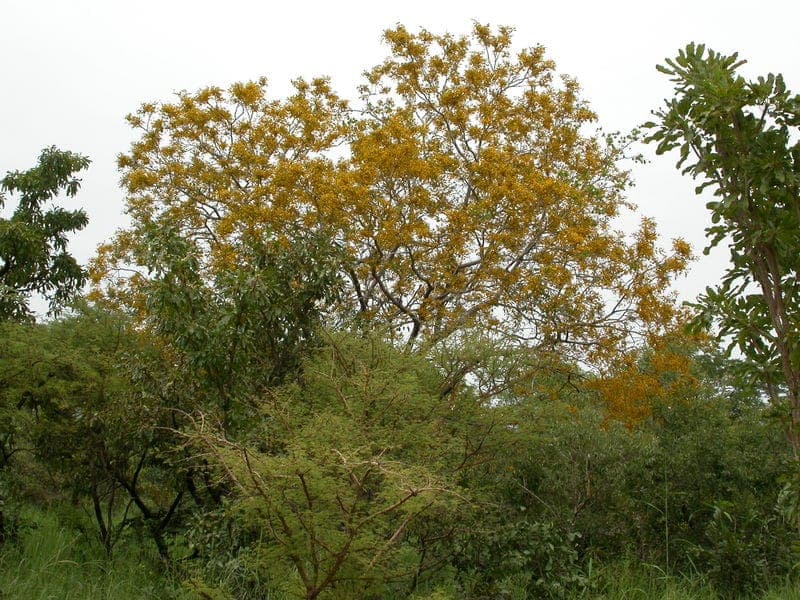
Marco Schmidt[1] / CC BY-SA 3.0, via Wikimedia Commons
African Kino: complete guide
Pterocarpus erinaceus
Want to see African Kino: complete guide in your garden?
1 minute, no credit card
Overview
Pterocarpus erinaceus, known as African kino, Senegal rosewood, West African kino, or barwood, is a valuable subtropical deciduous tree from the Fabaceae (legume) family. This tree grows wild in West Tropical Africa from Senegal to Chad, primarily in savanna and open woodland habitats. Pterocarpus erinaceus is prized for its valuable red heartwood, ornamental qualities, and multiple traditional uses.
The tree reaches 10-25 meters in native habitat. The wood is highly valuable, used for furniture, musical instruments, dyes, and medicinal purposes. For gardeners in warm-climate zones (USDA 10-11), it is primarily interesting as an ornamental tree with fine foliage structure and educational value. This is a tree of rich cultural and economic significance.
Appearance & Bloom
Pterocarpus erinaceus grows into an upright, spreading tree with a broad leafy crown. The trunk is thick and develops grey to greyish-brown bark, especially with age. Leaves are pinnate (compound), approximately 20-35 cm long, with many small elliptical leaflets (roughly 15-25 pairs), green and elegant until late autumn.
Blooming occurs in March-April (early dry season in Africa). Flowers are small, yellow to orange-yellow, in loose clusters, displaying the characteristic butterfly form of Fabaceae. They are softly fragrant and attractive to pollinators. After pollination, flat, circular seed pods (legumes) develop, 5-8 cm in diameter, with wavy margins and spiny tubercles, characteristic of the Pterocarpus genus.
Ideal Location
Pterocarpus erinaceus thrives in full sun to light part shade. Plant this tree where it receives minimum six to eight hours direct sunlight daily. In full sun, the tree achieves maximum growth and flowering.
The tree is extremely tolerant of windy situations and tropical conditions. In cooler climates (outside Zone 10), only container cultivation in warm glasshouses is feasible. Provide some protection against cold winters in marginal zones. Suitable for large tropical/subtropical gardens, parks, and landscape situations.
Soil
Pterocarpus erinaceus accepts a wide range of soils, from sandy to clayey. The tree grows better in nutrient-rich, well-drained soils than in waterlogged situations. In cases of heavy clay, improve drainage with sand and compost. Optimal pH is neutral to slightly acidic (pH 6.5-7.5).
At planting, add rich garden compost. Mulch annually with compost or leaf mould. Once yearly, a slow-release mineral fertilizer may be applied. The tree is extremely tolerant of poor, dry soils in native habitat, but cultivates better in enriched ground.
Free design
Want to see African Kino: complete guide in your garden? Make a free design now.
Watering
In the first growing year, water regularly, at least once weekly during dry spells. Once established (after 2-3 years), Pterocarpus erinaceus is extremely drought-tolerant, though regular summer watering promotes growth and leaf persistence.
In tropical zones with distinct dry/wet seasons, follow natural rainfall. During dry seasons, supplementary water is beneficial. Avoid waterlogged situations; good drainage is essential. Container trees must be kept moister than ground-planted specimens.
Pruning
Pruning is virtually unnecessary thanks to natural upright growth. Only light formative pruning may be applied if specific silhouette is desired. Dead branches must be removed. For commercial timber use, heavier pruning may be applied, but this falls outside garden use.
Young trees may be carefully pruned to encourage branching, but this is rarely necessary. Allow the tree to assume its natural form for optimal results.
Maintenance Calendar
January-February: Plant inspection, light feeding. March-April: Flowering period, regular watering. May-September: Growth, regular water during dry periods. October-December: Dry season, reduce watering. December-January: Dormancy (in Zones 10-11), minimal work.
Winter Hardiness
Pterocarpus erinaceus is hardy to USDA Zone 10-11 only (minimum 0-10 C). In cooler climates, the tree can only be grown in warm glasshouses or as a container plant. Freezing is fatal to the tree. In subtropical zones (Zone 9), growth is only possible in very protected situations against warm walls, and even then with considerable risk.
The tree is designated for tropical and subtropical gardens in warm-climate regions. Frost-winter areas are unsuitable.
Companion Plants
Pterocarpus erinaceus pairs beautifully with other tropical/subtropical trees and shrubs, such as acacias, Combretum species, and other savanna trees. Also excellent with shrubs like Lantana and other heat- and drought-tolerant plants. For underplanting, grasses and drought-tolerant herbaceous plants work well.
Use it, for example, as a specimen tree in the garden for maximum effect, or in mixed tropical borders. In habitats where it is native, it forms a valuable food and shelter tree for birds and wildlife.
Conclusion
Pterocarpus erinaceus is a valuable, understated ornament for tropical and subtropical gardens with rich cultural and economic significance. For gardeners in warm-climate zones, this tree offers architectural beauty, educational value, and connection to West African heritage. Plant now and enjoy years of tropical elegance.
Available from specialist tropical plant nurseries. For Europe: only in glasshouses or as container plant. For Africa and warm zones: local tree nurseries. Best planted at beginning of rainy season (May-June in West Africa).
Want to see African Kino: complete guide in your garden? Make a free design now.
Upload a photo, pick a style, and get a photorealistic design with plant list in under a minute.
No credit card required


Similar plants
Tall Silky Lupine: complete guide
Lupinus elatus
Tall silky lupine is a fast-growing Californian perennial with silvery foliage and blue-purple flower spikes, ideal for a prairie-style garden.
Garfield Lupine: complete guide
Lupinus garfieldensis
The Garfield lupine is a rare, fast-growing American perennial for alkaline, dry grassland gardens, with striking blue flower spikes.
Lupinus elegans: complete guide
Lupinus elegans
Lupinus elegans, the elegant lupine, is a spectacular blooming plant from Mexico with blue flower spikes. Care, cultivation and garden use.