
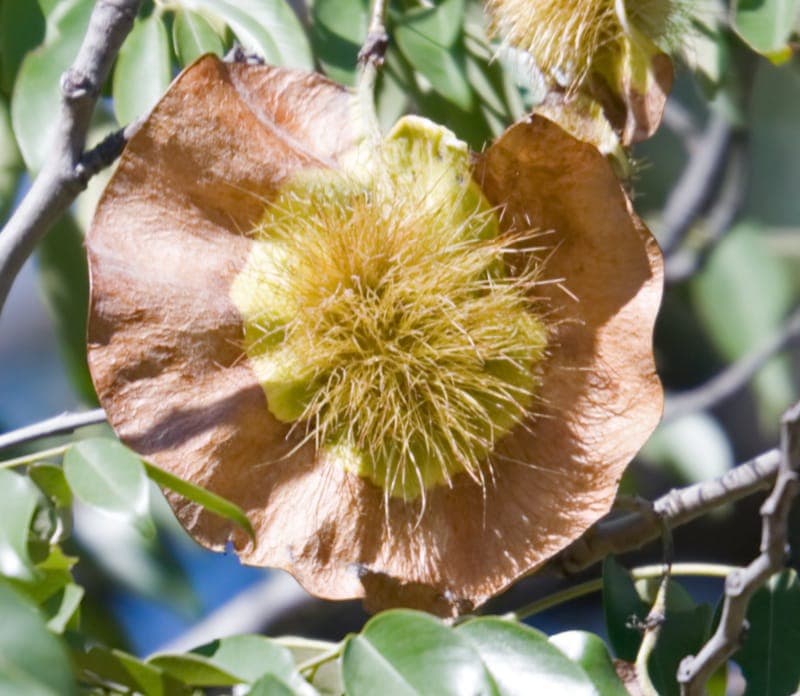
Susan Adams / CC BY-SA 2.0, via Wikimedia Commons
Transvaal-teak: complete guide
Pterocarpus angolensis
Want to see Transvaal-teak: complete guide in your garden?
1 minute, no credit card
Overview
Pterocarpus angolensis, commonly known as Transvaal-teak, Muninga, or Kiaat, is an impressive tree from southern Africa belonging to the legume family (Fabaceae). This remarkable species ranges from Congo through Tanzania to South Africa, thriving at elevations of 600-1800 meters in open woodlands and dry savannas.
The timber of Pterocarpus angolensis ranks among the world's most prized hardwoods. Its stunning red-brown wood is extensively used for fine furniture, parquet flooring, and decorative applications. Biologically, it represents a magnificent tree with deep roots and valuable flowers supporting bee populations.
Appearance and Bloom
Transvaal-teak grows as a large tree reaching 20-25 meters tall with characteristic pale brown bark. Foliage is compound (pinnate), covering the entire crown with fine, green texture. During dry seasons the tree sheds considerable foliage, regrowing vigorously when rains arrive.
Flowers are yellow, small but appearing in conspicuous clusters, typically flowering November-December in Africa before significant leaf drop. Following blooming, distinctive flat, round seed pods develop with characteristic thickened margins - typical of Pterocarpus species.
The heartwood is bright red-brown to nearly dark brown, beautifully figured with rich, warm lustre when polished. This represents the most attractive aspect for timber enthusiasts.
Ideal Location
Transvaal-teak thrives in warm, dry to semi-dry climates maintaining temperatures above 15°C year-round. Observable in North Africa and African environments. In Europe it interests primarily conservatories, greenhouses, or highly protected locations in warmer regions like southern Portugal.
The tree requires abundant sunlight and open air. In home placement, heavy roots may cause frost damage - therefore plant on solid foundations. Not suitable for small properties; this is a tree for large estates.
Soil
Pterocarpus angolensis grows on highly diverse soils: sand, gravel, light clay, even poor substrates. The critical factor is good drainage - waterlogging is not tolerated. Even in impoverished, dry soils it thrives excellently.
For pot culture in Europe, use standard potting soil with extra drainage through gravel addition. In Southern European gardens, plant in loose, well-draining soil without fertilizer amendment. The tree is not particular about nutrition.
Free design
Want to see Transvaal-teak: complete guide in your garden? Make a free design now.
Watering
Once established, Transvaal-teak is extremely drought-tolerant. During youth (first 2-3 years), water regularly until deep roots develop. After establishment, watering is rarely needed except during extreme droughts.
In containers, water regularly during growing season. In landscape settings, rainfall suffices. Never allow waterlogging - root rot results. The tree originates from drier climates and thrives in warm-dry conditions.
Pruning
Transvaal-teak requires minimal pruning. During youth, remove weak or damaged branches to encourage strong stem form. Later, pruning is rarely needed.
In frost-prone climates, remove frost-damaged portions in early spring. The tree tolerates heavy pruning poorly - recovery from major wounds is slow. Allow the tree to assume its natural form.
Maintenance Calendar
APRIL-OCTOBER: Growing season in Europe. Water during dry periods. No fertilizer. NOVEMBER-MARCH: Winter dormancy period. Water very sparingly. ALL YEAR: Frost damage risk in severe winters. Shelter recommended in hardiness zones 8-9.
Winter Hardiness
Pterocarpus angolensis is not winter-hardy in Europe. It survives only in very warm zones (USDA 9-11, European zone 9+), meaning southern Portugal, southern Spain, southern France, and only protected locations in Italy.
In all other regions the tree dies at frost temperatures. In pot culture you can bring it indoors in winter. In open ground it is suitable only for very warm, sheltered locations with rarely occurring frost days.
Companion Planting
Naturally grows in Africa with:
- Other dry-climate trees (Combretum species)
- Acacias (Acacia varieties)
- Mopane trees (Colophospermum mopane)
- Dry savanna vegetation
- Grassy understory
In Europe: combine with other warm-climate trees in protected gardens.
Closing
Pterocarpus angolensis is a majestic tree of southern Africa, celebrated for its stunning red-brown timber. For hardwood timber enthusiasts with access to warmer climates and space, it represents an impressive specimen. In northern Europe suitable only for greenhouse or conservatory. The tree embodies the richness of African woodworking and forestry.
Want to see Transvaal-teak: complete guide in your garden? Make a free design now.
Upload a photo, pick a style, and get a photorealistic design with plant list in under a minute.
No credit card required


Similar plants
Tall Silky Lupine: complete guide
Lupinus elatus
Tall silky lupine is a fast-growing Californian perennial with silvery foliage and blue-purple flower spikes, ideal for a prairie-style garden.
Garfield Lupine: complete guide
Lupinus garfieldensis
The Garfield lupine is a rare, fast-growing American perennial for alkaline, dry grassland gardens, with striking blue flower spikes.
Lupinus elegans: complete guide
Lupinus elegans
Lupinus elegans, the elegant lupine, is a spectacular blooming plant from Mexico with blue flower spikes. Care, cultivation and garden use.