
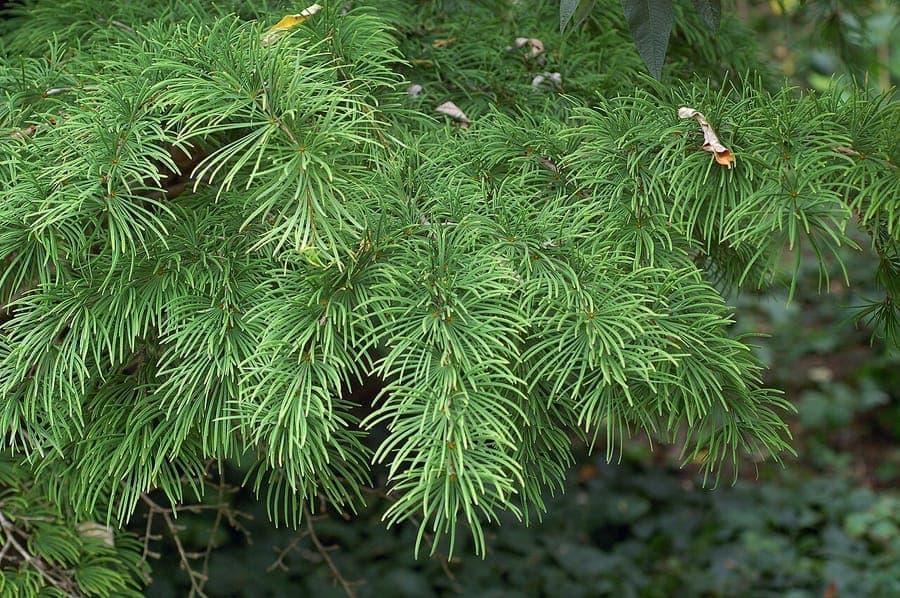
Eric Hunt / CC BY 2.5, via Wikimedia Commons
Chinese Golden Larch: complete guide
Pseudolarix amabilis
Want to see Chinese Golden Larch: complete guide in your garden?
1 minute, no credit card
Overview
Pseudolarix amabilis, better known as Chinese golden larch or golden larch, is a remarkable deciduous conifer from the Pinaceae family, native to southeastern China (Hunan to Zhejiang). What makes this tree exceptional is that despite being a conifer, it sheds its needles in autumn, much like larches. This characteristic makes it extraordinarily valuable for its spectacular golden-yellow fall colour before needle drop.
The tree reaches 15-30 meters in native habitat, but typically 10-20 meters in cultivation. It develops a conical form with spreading branches, creating an elegant silhouette. Due to its unique deciduousness and brilliant autumn colours, this is a jewel for larger gardens and landscape applications.
Appearance & Bloom
Pseudolarix amabilis grows into a conical to pyramidal form, especially when young. As the tree matures, the crown becomes fuller and slightly broader. Needles are luxuriant green in summer, arranged spirally in dense clusters at branch tips. Each needle is approximately 2-5 cm long, flat, and feather-like in appearance.
In October-November, needles transform to a magnificent golden-yellow to orange hue before dropping. This process, called abscission, makes this tree phenomenally valuable for autumn landscapes. Male flowers appear as small green to grey cones, female flowers as pointed cones. After pollination, characteristic woody cones develop, 5-7 cm long.
Ideal Location
Pseudolarix amabilis thrives in full sun. Plant this tree where it receives minimum six to eight hours of direct sunlight daily. In full sun, needles achieve their complete colour potential and growth is vigorous. Part shade is acceptable but less ideal.
The tree is fairly tolerant of wind situations, though strong winds may slow growth and form slightly. Provide some protection against extremes. Suitable for large gardens, parks, and as a specimen in landscapes. Avoid crowded planting situations.
Soil
Pseudolarix amabilis is not particularly fussy about soil type, provided drainage is good. The tree prefers nutrient-rich, humus-rich soils over poor ground. Heavy clay soils can be improved with sand and compost; sandy soils can be enriched with compost.
Optimal pH is neutral to slightly acidic (pH 6.5-7.5). Planting compost can be enriched with garden compost. Mulch annually with compost or leaf mould to maintain even moisture. The tree thrives in biologically rich soils and grows better as soil fertility increases.
Free design
Want to see Chinese Golden Larch: complete guide in your garden? Make a free design now.
Watering
In the first growing year, water regularly, at least once weekly during dry spells. Once established (after 2-3 years), Pseudolarix amabilis is fairly drought-tolerant, though regular summer watering promotes growth and colour development.
In very dry summers, supplementary water, especially for young trees, is beneficial. Winter watering is rarely necessary except during very dry winters. Avoid waterlogged situations; good drainage is essential for healthy roots.
Pruning
Pruning is virtually unnecessary thanks to natural conical growth. Only light formative pruning may be applied if a specific silhouette is desired. Dead branches must be removed. Heavy pruning should be avoided as it compromises natural form.
With young trees, one may carefully strip the central leader to promote branching, but this is rarely needed. Allow the tree to assume its natural form for optimal results.
Maintenance Calendar
March-April: Plant inspection, light feeding. April-May: Growth of young shoots, regular watering. June-September: Summer growth, consistent watering. October-November: Autumn colour shift, no watering needed. December-February: Winter dormancy, minimal work.
Winter Hardiness
Pseudolarix amabilis is hardy to USDA Zone 5 (minimum -28 C), possibly light Zone 4. In northern Europe, winter hardiness is no concern, though very cold winters may cause some twig damage. In Zones 6-7, the tree is completely secure.
The tree performs best in zones with moderate winters. Snow loading is well tolerated. Very wet winters may cause some problems in extremes, but good drainage prevents this usually. Young trees may benefit from some extra protection in their first 2-3 years.
Companion Plants
Pseudolarix amabilis pairs beautifully with other autumn-colouring trees and shrubs, such as maples (Acer), birches (Betula), and other larches. Also excellent with shrubs like viburnum and cotoneaster. For underplanting, ferns, hosta, and other shade-tolerant species work well.
Use it, for example, as a specimen tree in lawn for maximum autumn effect, or in mixed borders where its summer verdancy and autumn glory shine. The tree also works well in a grove or woodland setting.
Conclusion
Pseudolarix amabilis is a spectacular addition to larger gardens where autumn is central. With its golden-yellow needle drop and conical form, this jewel offers years of pleasure. Plant now and enjoy decades of autumn beauty and architectural value.
Available from specialist tree nurseries and large garden centres. Best planted autumn (October-November) or early spring (March-April).
Want to see Chinese Golden Larch: complete guide in your garden? Make a free design now.
Upload a photo, pick a style, and get a photorealistic design with plant list in under a minute.
No credit card required


Similar plants
Abies delavayi: complete guide
Abies delavayi
Delavayi fir is an elegant, medium-sized coniferous tree from the Pinaceae family with dark green needles. This Asian evergreen is perfect for alpine gardens and large landscapes.
Taiwan fir: complete guide
Abies kawakamii
Discover the magnificent Taiwan fir, a rare evergreen conifer from Taiwan's mountain regions. Learn growth requirements, care tips, and why this beautiful tree is perfect for collectors of unique garden specimens.
Farges fir: complete guide
Abies fargesii
Discover the majestic Farges fir, an impressive conifer from China's mountains with elegant foliage and columnar form. Ideal for large gardens.