
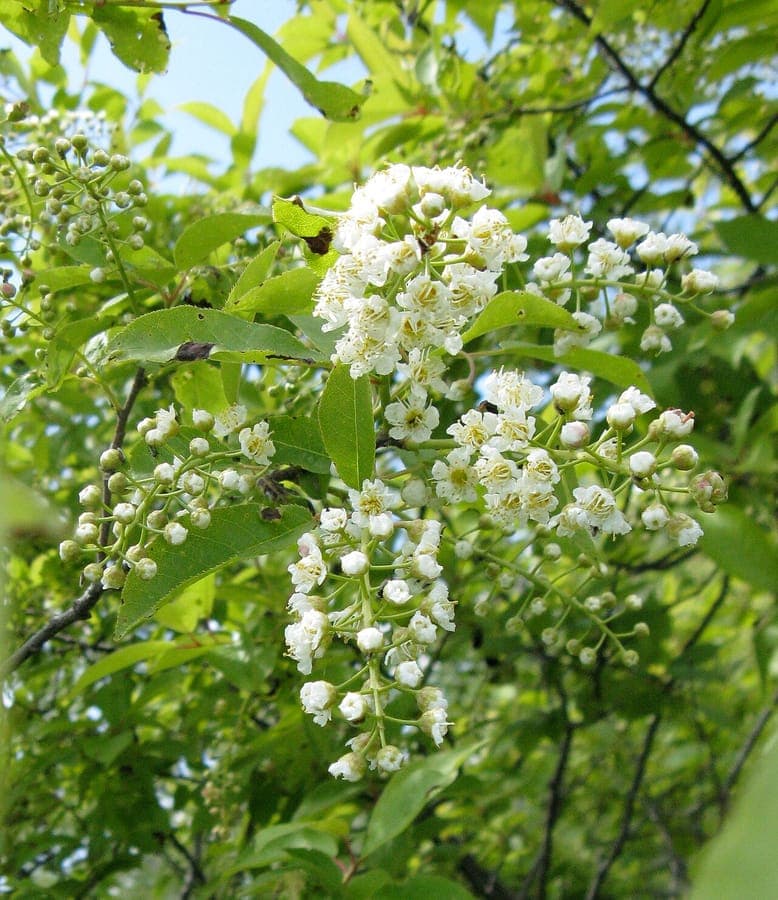
Nadiatalent / Public domain, via Wikimedia Commons
Bitter-berry: complete guide
Prunus virginiana
Want to see Bitter-berry: complete guide in your garden?
1 minute, no credit card
Overview
Prunus virginiana, commonly known as Bitter-berry or chokecherry, is a hardy native shrub or small tree that brings seasonal interest and ecological value to gardens across North America and parts of Europe. Growing between 8 and 20 feet tall with a spread of 6 to 12 feet, it fits easily into mixed borders, woodland edges, or as a specimen in larger gardens. A member of the Rosaceae family, it thrives in USDA zones 2 through 7, making it suitable for cold climates where few other fruiting shrubs survive.
This plant shines in spring with its showy flower clusters and continues to impress with dark fruit in late summer. While the berries are unpalatable raw due to their astringency, they're excellent for jams, syrups, and pies when sweetened. More importantly, they're a critical food source for birds like grosbeaks, thrushes, and waxwings.
On gardenworld.app, you can design a seasonal garden plan that integrates Prunus virginiana with complementary plants for year-round structure and wildlife support.
Appearance & bloom cycle
Bitter-berry has a multi-stemmed, upright growth habit with lance-shaped leaves 2 to 4 inches long. The foliage emerges bright green in spring, deepens in summer, and turns attractive shades of yellow, orange, or reddish-purple in autumn - adding valuable fall color.
In late April to mid-May, dense, upright racemes of small white flowers, 4 to 6 inches long, appear along the branches. Each cluster contains dozens of individual blooms, creating a frothy, fragrant display that lasts 10 to 14 days. These flowers are a magnet for pollinators, especially bees and hoverflies.
By July, green berries form and ripen to deep maroon or nearly black by late summer. They persist into early winter, providing visual interest and food for wildlife. The bark is smooth and reddish-brown on young stems, becoming gray and slightly fissured with age.
Ideal location
Plant Bitter-berry in full sun to partial shade. It produces the most flowers and fruit in full sun (at least 6 hours of direct light), but tolerates light shade, particularly in hotter regions where afternoon sun can stress young plants.
Allow at least 8 feet of space from structures or other shrubs to accommodate its mature spread. It works well in naturalized areas, windbreaks, or as part of a bird-friendly hedge. Avoid planting in low, wet areas prone to standing water.
Soil requirements
Prunus virginiana is adaptable to a wide range of soil types, including sandy, loamy, and clay soils, as long as drainage is adequate. It prefers a pH between 5.5 and 7.5 - slightly acidic to neutral.
It does not require enriched soil. In fact, overly fertile conditions can lead to excessive vegetative growth at the expense of flowering. When planting, avoid amending the planting hole with compost or fertilizer. Native plants like this one are adapted to average garden soils and respond poorly to overfeeding.
Free design
Want to see Bitter-berry: complete guide in your garden? Make a free design now.
Watering
During the first growing season, water deeply once a week, applying 3 to 5 gallons per plant. This encourages deep root development. After establishment (usually by the second year), the plant is moderately drought-tolerant and only needs supplemental watering during prolonged dry spells (three weeks or more without rain).
When irrigating, apply water slowly at the base to allow deep penetration. Avoid frequent shallow watering, which promotes weak root systems.
Pruning
Pruning is minimal. Remove dead, damaged, or crossing branches in late winter or early spring before bud break. For a more compact shape or hedge form, light pruning can be done right after flowering in June. Cut back up to one-third of the new growth to encourage bushiness.
Avoid heavy pruning in fall or winter, as this can remove flower buds formed the previous summer. Also, refrain from pruning during wet weather to reduce disease risk.
Maintenance calendar
- January: Inspect for winter damage; remove dead wood if accessible
- February: Clean and sharpen pruning tools
- March: No action needed; prepare for spring
- April: Loosen soil around base; monitor for emerging pests
- May: Peak bloom - avoid pruning or disturbing pollinators
- June: Light shaping after bloom; watch for fruit set
- July–August: Monitor for aphids or black knot; water during drought
- September: Remove fallen fruit to reduce disease pressure
- October: Enjoy fall color; leave leaf litter as mulch
- November: No maintenance
- December: Dormant period - check structural integrity
Winter hardiness
Bitter-berry is exceptionally cold-hardy, surviving temperatures as low as -35°C (USDA zone 2). It handles snow load well and requires no winter protection, even in exposed sites. Young stems may suffer minor dieback in extreme cold, but recovery is rapid in spring.
Container-grown plants need extra care - insulate pots or move to a sheltered location to prevent root freeze-thaw cycles.
Companion plants
Pair Prunus virginiana with native perennials like Echinacea purpurea, Monarda fistulosa, or Carex vulpinoidea for a cohesive, low-maintenance planting. For shrub layer diversity, combine with Cornus racemosa, Amelanchier laevis, or Viburnum lentago.
On gardenworld.app, you can visualize how these combinations evolve across seasons using interactive garden mapping tools.
Closing
Prunus virginiana is a resilient, low-input plant that rewards gardeners with seasonal beauty and ecological function. It's not flashy like hybrid ornamentals, but its quiet reliability makes it a garden staple. Available at independent garden centres and native plant nurseries in spring, look for healthy specimens with flexible stems and no signs of black knot disease.
Avoid overpriced cultivars unless you need a specific trait - the straight species performs just as well in most landscapes. With thoughtful placement and minimal care, Bitter-berry earns its place in any sustainable garden.
Want to see Bitter-berry: complete guide in your garden? Make a free design now.
Upload a photo, pick a style, and get a photorealistic design with plant list in under a minute.
No credit card required


Similar plants
Siberian crab apple: complete guide
Malus x robusta
Complete guide to the Siberian crab apple (Malus x robusta): location, soil, pruning, winter hardiness and the best companion plants for your garden.
Chinese flowering crabapple (Malus x spectabilis): complete guide
Malus x spectabilis
Meet the Chinese flowering crabapple (Malus x spectabilis): a classic spring bloomer with carmine buds and pink blossom.
Potentilla crassinervia: complete guide
Potentilla crassinervia
Potentilla crassinervia, the Corsican cinquefoil, grows wild on Corsica and Sardinia's peaks. Discover how to grow this hardy alpine rock garden gem.