
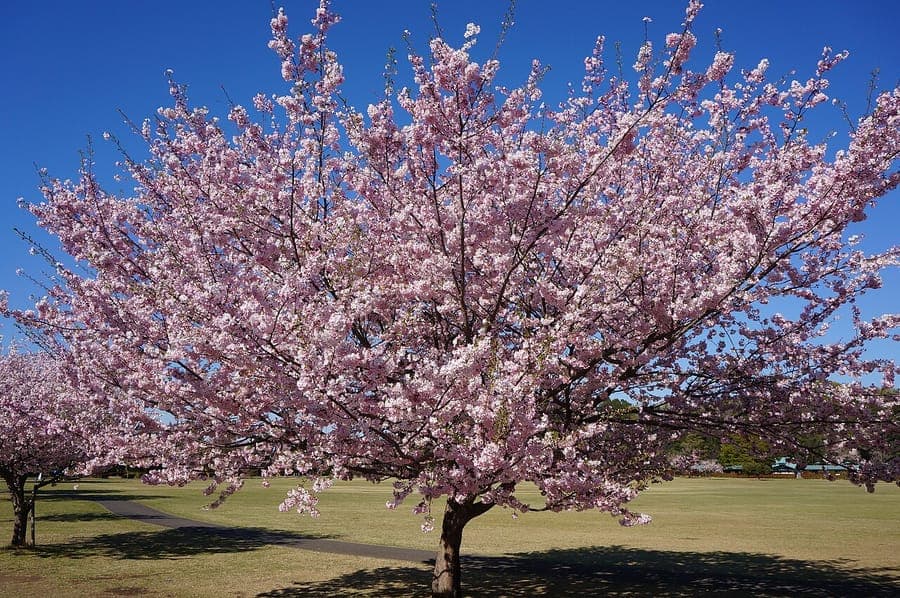
SLIMHANNYA / CC BY-SA 4.0, via Wikimedia Commons
Winter-flowering cherry: complete guide
Prunus subhirtella
Want to see Winter-flowering cherry: complete guide in your garden?
1 minute, no credit card
Overview
Prunus subhirtella, commonly known as the winter-flowering cherry, is a welcome sight when most gardens are still asleep. Native to Japan but thriving across temperate zones, this deciduous tree brings delicate pink-white blossoms as early as January in mild winters, peaking from late February to March. It's a medium-sized tree, growing slowly to 4–6 meters in height with a spread of 3–5 meters over time. Its open, airy canopy makes it ideal for small to medium gardens, courtyards, or as a focal point on the lawn.
This cherry is a member of the Rosaceae family and is cherished for its resilience and subtle beauty. Unlike flashy ornamentals, it earns its place through quiet reliability. On gardenworld.app, you can design a garden layout that highlights its seasonal rhythm, ensuring it's seen and appreciated at every stage.
Appearance & bloom cycle
The flowers of Prunus subhirtella appear before the leaves, lining the slender branches in clusters. They start as pink buds and open into soft pink or nearly white, five-petaled blooms about 2 cm wide. The flowering period typically runs from late January to March, depending on the winter's severity. A mild spell can trigger early blooming, while harsh frosts may delay it.
After flowering, narrow green leaves emerge, turning yellow to orange in autumn. The bark is smooth, reddish-brown with horizontal lenticels, adding winter texture. While not evergreen, its bare branches in winter still offer structure and anticipation.
Ideal location
Plant your winter-flowering cherry where it receives full sun-minimum 6 hours daily-for best blooming. It tolerates light shade, but flowering will be sparser. Give it at least 2.5 meters of clearance from buildings or other trees to allow for natural crown development.
A spot near a patio, path, or window lets you enjoy the blossoms up close. In urban gardens, it works well as a standalone feature or in a mixed border. Using gardenworld.app's 3D garden planner, you can preview how this tree fits into your space and how its form changes through the seasons.
Soil requirements
This cherry isn't fussy but thrives in moist, well-drained, humus-rich soil. It adapts to clay if drainage is improved, and prefers a pH between 6.0 and 7.5. Avoid waterlogged areas-root rot is a real risk. At planting, mix in compost or well-rotted manure to enrich the soil and improve structure.
For container growing, use a mix of loam-based compost and sharp sand to ensure good drainage. Repot every 3–4 years or top-dress with fresh compost annually.
Free design
Want to see Winter-flowering cherry: complete guide in your garden? Make a free design now.
Watering
Young trees need consistent watering for the first two growing seasons-about 10 liters per week during dry spells. Once established, they're moderately drought-tolerant but benefit from deep watering during prolonged dry periods, especially in containers.
Water deeply but infrequently to encourage strong root growth. Use a soaker hose or watering spike to deliver water directly to the root zone.
Pruning
Pruning should be minimal. Remove dead, damaged, or crossing branches right after flowering-ideally in March or early April. Avoid pruning in summer or autumn, as flower buds form on new growth and could be lost.
This tree has a naturally elegant shape, so heavy pruning isn't recommended. If you want a shrub-like form, plant 3–5 specimens close together and prune lightly to maintain density.
Maintenance calendar
- January: Check for frost damage. Avoid pruning.
- February: Peak bloom. Protect flowers from late frosts if needed.
- March: Prune after flowering. Apply compost around the base.
- April: New leaves emerge. Begin feeding with slow-release fertilizer.
- May–August: Low maintenance. Water during dry spells.
- September: Inspect for aphids or fungal spots.
- October: Leave fallen leaves around the base for natural mulch.
- November: Move potted trees to sheltered spots.
- December: Check branch structure. Avoid salt-laden snow near the trunk.
Winter hardiness
Prunus subhirtella is hardy in USDA zones 5–8, tolerating temperatures down to -20°C. While the tree itself is resilient, late frosts can damage open blossoms. In exposed gardens, consider planting near a wall for microclimate protection.
Young trees may benefit from fleece cover during extreme cold snaps. Avoid piling snow on branches-gently shake it off to prevent breakage.
Companion plants
Pair with early spring bulbs like snowdrops, crocus, and winter aconite. These thrive under the canopy before the leaves fully emerge. Hellebores and winter heathers (Erica carnea) add color and texture at ground level.
For summer interest, include shade-tolerant perennials like lungwort (Pulmonaria) or barrenwort (Epimedium). Evergreen shrubs such as box or mahonia provide year-round structure.
Closing
The winter-flowering cherry isn't about drama-it's about timing and tenderness. It reminds us that life stirs even in the coldest months. With little effort, it delivers reliable beauty year after year.
You can find Prunus subhirtella at garden centres across the UK and US. In the UK, check local nurseries or online suppliers; in the US, look for it in specialty nurseries. In Europe, retailers like OBI and Hornbach in Germany, and Truffaut and Jardiland in France, often stock it in late winter. When planting, choose a healthy specimen with well-spaced branches. With gardenworld.app, you can simulate growth patterns and companion pairings to create a garden that evolves beautifully with the seasons.
Want to see Winter-flowering cherry: complete guide in your garden? Make a free design now.
Upload a photo, pick a style, and get a photorealistic design with plant list in under a minute.
No credit card required


Similar plants
Siberian crab apple: complete guide
Malus x robusta
Complete guide to the Siberian crab apple (Malus x robusta): location, soil, pruning, winter hardiness and the best companion plants for your garden.
Chinese flowering crabapple (Malus x spectabilis): complete guide
Malus x spectabilis
Meet the Chinese flowering crabapple (Malus x spectabilis): a classic spring bloomer with carmine buds and pink blossom.
Potentilla crassinervia: complete guide
Potentilla crassinervia
Potentilla crassinervia, the Corsican cinquefoil, grows wild on Corsica and Sardinia's peaks. Discover how to grow this hardy alpine rock garden gem.