
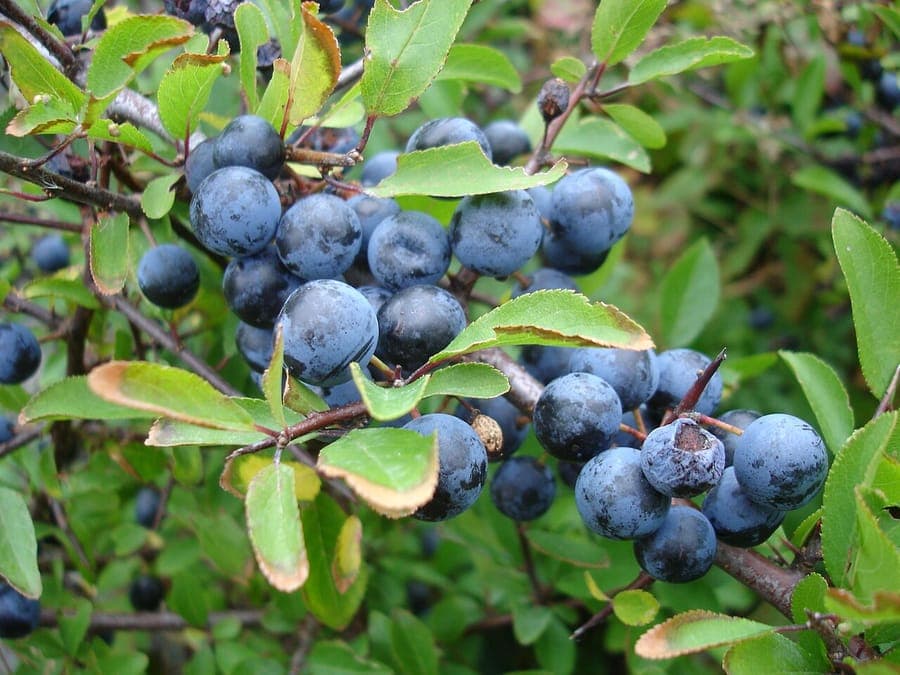
Wikimedia Commons / CC BY-SA 3.0, via Wikimedia Commons
Sloe: complete guide
Prunus spinosa
Want to see Sloe: complete guide in your garden?
1 minute, no credit card
Overview
Prunus spinosa, commonly known as sloe, is a hardy deciduous shrub or small tree that thrives in temperate climates across Europe. Native to regions including the Baltics, Central Europe, and the Mediterranean, it's a common sight along woodland edges, hedgerows, and rural boundaries. In the UK and Ireland, sloe has long been valued not just for its ornamental beauty but also for its ecological contributions and culinary use - especially its tart black berries used in sloe gin.
This member of the Rosaceae family grows 2–4 meters tall with a dense, spiny habit that makes it excellent for natural fencing. Its growth is slow to moderate, and once established, it requires little maintenance. Sloe is fully hardy, surviving temperatures as low as -25°C, making it suitable for USDA zones 5 through 8.
On gardenworld.app, you can design a native hedge layout featuring sloe paired with hawthorn and dogwood for seasonal interest and wildlife support.
Appearance & bloom cycle
Sloe blooms in April, producing clusters of small, pure white flowers about 1.5 cm wide directly on bare branches. The blossoms appear before the leaves, offering early nectar to pollinators like bees and hoverflies. Each flower has five petals and a prominent cluster of yellow stamens, creating a delicate yet noticeable display.
The leaves emerge shortly after, narrow-oval in shape, 2–4 cm long, with finely toothed margins. They turn yellow to pale brown in autumn. From late summer, small green fruits form, ripening to deep blue-black by October. These berries, known as sloes, are astringent when raw but become rich and flavorful after frost or maceration in sugar and alcohol.
The plant's long, sharp thorns - up to 3 cm - give it a formidable presence, deterring animals and foot traffic alike.
Ideal location
Sloe prefers full sun to partial shade, rating a 7 on a light scale of 1 to 10. It performs best in open areas with at least 5–6 hours of direct sunlight daily. While it tolerates some shade, reduced light leads to sparse flowering and fewer fruits.
Ideal planting sites include field boundaries, garden perimeters, or as a standalone specimen in a wildlife garden. It's also effective in mixed native hedges, where its thorny branches provide structure and protection. Avoid heavily shaded corners or areas with poor air circulation, which can encourage fungal issues.
Gardeners in the UK can use gardenworld.app to map out a sloe-based windbreak combined with spindle and guelder rose for year-round visual appeal.
Free design
Want to see Sloe: complete guide in your garden? Make a free design now.
Soil requirements
Sloe adapts well to a range of soils but prefers well-drained, slightly acidic to neutral conditions with a pH between 5.5 and 6.5. It grows successfully in loam, chalk, and even clay, provided the soil doesn't become waterlogged. Avoid planting in boggy or compacted soils, as root rot can develop.
A light mulch of compost or leaf litter in early spring helps retain moisture and suppress weeds without smothering the root collar.
Watering
Young plants need regular watering during their first growing season - about 10 liters per week during dry spells. Once established, sloe is highly drought-tolerant and rarely needs supplemental irrigation. Mature shrubs can survive extended dry periods thanks to their deep root system.
Overwatering is more dangerous than underwatering; keep the soil on the drier side, especially in winter.
Pruning
Pruning is best done in late winter or early spring before bud break. Avoid summer pruning, as it can trigger sap bleeding. For hedges, trim annually in March to maintain shape. Use thick gloves and sturdy secateurs - those thorns are no joke.
For fruit production, minimal pruning is recommended. Remove only dead, damaged, or crossing branches. Hard pruning can reduce flowering and fruiting in the following seasons.
Maintenance calendar
- Jan: Inspect for pests, prepare tools
- Feb: Prune if needed
- Mar: Shape hedges, check for dieback
- Apr: Flowering peak - avoid disturbance
- May: Leaf expansion, monitor aphids
- Jun: No action required
- Jul: No action
- Aug: Begin monitoring fruit development
- Sep: Fruits ripen; prepare for harvest
- Oct: Harvest sloes after first frost
- Nov: Apply mulch, tidy fallen leaves
- Dec: Winter inspection of branch structure
Winter hardiness
Sloe is fully winter-hardy in USDA zones 5–8. It loses its leaves in autumn and stands leafless through winter, revealing its intricate, thorny framework. The plant withstands freezing temperatures and icy winds, making it reliable even in exposed rural sites.
Companion plants
Excellent companions include hawthorn, blackthorn, dogwood, and elder. For ground cover, consider cow parsley, foxglove, and bird's-foot trefoil. These combinations support pollinators, nesting birds, and small mammals.
Closing
Sloe is a resilient, multi-purpose shrub that brings structure, seasonal interest, and ecological value to any garden. Whether you're building a wildlife hedge, a natural barrier, or harvesting berries for homemade liqueurs, it's a reliable choice. Available at garden centres across the UK, especially in autumn and early spring for best root establishment.
Want to see Sloe: complete guide in your garden? Make a free design now.
Upload a photo, pick a style, and get a photorealistic design with plant list in under a minute.
No credit card required


Similar plants
Siberian crab apple: complete guide
Malus x robusta
Complete guide to the Siberian crab apple (Malus x robusta): location, soil, pruning, winter hardiness and the best companion plants for your garden.
Chinese flowering crabapple (Malus x spectabilis): complete guide
Malus x spectabilis
Meet the Chinese flowering crabapple (Malus x spectabilis): a classic spring bloomer with carmine buds and pink blossom.
Potentilla crassinervia: complete guide
Potentilla crassinervia
Potentilla crassinervia, the Corsican cinquefoil, grows wild on Corsica and Sardinia's peaks. Discover how to grow this hardy alpine rock garden gem.