
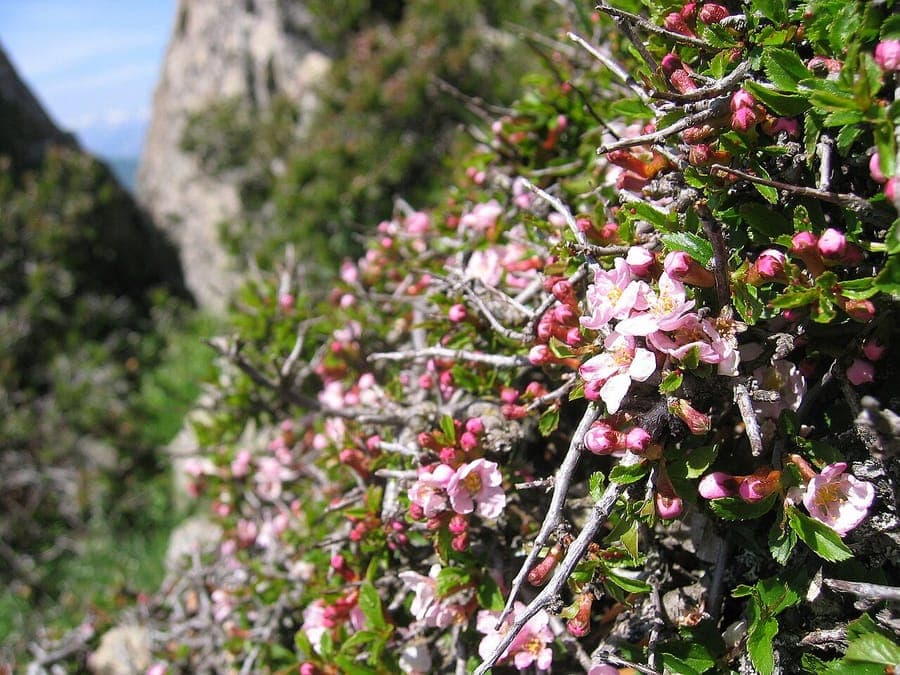
User:Tigerente / CC BY-SA 3.0, via Wikimedia Commons
Rock cherry: complete guide
Prunus prostrata
Want to see Rock cherry: complete guide in your garden?
1 minute, no credit card
Overview
Prunus prostrata, commonly known as rock cherry, isn't your typical cherry tree. Forget towering forms - this is a creeping subshrub that stays close to the ground, rarely exceeding 30 cm in height. It's a gem for gardeners who appreciate subtle, structural plants in rockeries, alpine beds, or dry stone walls. Native to rocky slopes across the Mediterranean - from Morocco and Algeria to Greece and southern France - it's evolved to thrive in harsh, well-drained conditions where few others survive. That rugged background makes it a solid performer in low-maintenance, drought-prone gardens.
If you're designing a compact, naturalistic space, this plant adds texture without dominating. It won't shade out neighbours or demand constant attention. On gardenworld.app, you can create a garden layout that maximises sun exposure and drainage, ensuring your rock cherry settles in perfectly from day one.
Appearance & bloom cycle
The rock cherry spreads horizontally, with trailing stems that root where they touch the soil. Mature plants can reach up to 1 m wide but stay under 25–30 cm tall. The bark on young stems is brown and slightly hairy; it becomes smoother and darker with age. Leaves are small - 1 to 2.5 cm long - oval to lance-shaped, with finely toothed margins. They emerge fresh green in spring and may turn a soft bronze in autumn, though fall colour is never dramatic.
Flowering happens from late March to early April in mild climates, sometimes as late as May at higher elevations. The blossoms are pale pink, about 1.5 cm across, with five petals and a cluster of golden stamens. They appear singly or in pairs at the ends of short shoots. While not showy in volume, the bloom is significant - one of the earliest signals of spring. Bees and early pollinators appreciate the nectar, adding ecological value.
After flowering, small, dark purple to black drupes form. They're edible but not palatable - dry and sour - so they're best left for birds, who may nibble them occasionally. Self-seeding is rare in cultivation, which keeps this plant well-behaved in garden settings.
Ideal location
This plant thrives in full sun - aim for a 7 or higher on a light intensity scale of 10. In shade, it becomes leggy, blooms poorly, and is more prone to fungal issues. A south- or southwest-facing slope is ideal, especially in cooler climates. Use it in rock gardens, raised beds with gravel, or tucked into crevices of dry stone walls. It's also effective as a low groundcover on banks where erosion control is needed.
Avoid damp, shaded corners. Coastal gardens work well as long as salt spray isn't excessive. If you're pairing it with other drought-tolerant species - like lavender, sedums, or cistus - consider using gardenworld.app to visualise spacing and sunlight patterns before planting.
Free design
Want to see Rock cherry: complete guide in your garden? Make a free design now.
Soil requirements
Prunus prostrata prefers slightly acidic to neutral soils (pH 5.5–6.5) that drain exceptionally well. It tolerates limestone and grows naturally in rocky, calcareous crevices. Avoid heavy clay unless you amend it heavily with grit, sand, or crushed stone. A mix of topsoil, horticultural sand, and gravel (2:1:1) works well in containers or garden beds. Do not enrich the soil with compost or manure - too much fertility leads to weak growth and fewer flowers.
Watering
Once established, this plant is highly drought-tolerant. Water regularly only during the first growing season, especially in dry springs. After that, supplemental watering is rarely needed, even in summer. Deep, infrequent watering encourages strong root development. In prolonged droughts (over 4 weeks without rain), a monthly soak helps, but avoid wetting the foliage.
Never let the plant sit in soggy soil - root rot is the main killer. In pots, use a 3–5 cm layer of broken crocks or expanded clay at the base.
Pruning
Pruning is minimal. The plant maintains a tidy, spreading habit naturally. Remove any dead, damaged, or diseased wood in early spring (March–April). Avoid cutting into old wood, as it may not re-sprout. Light shaping is okay if the plant outgrows its space, but don't prune after mid-summer - flower buds for next year are set by late summer.
Maintenance calendar
- Jan: Check for winter damage, especially on exposed sites
- Feb: Clear snow gently, inspect stem structure
- Mar: Remove dead wood, apply a thin mulch of grit if desired
- Apr: Enjoy bloom, watch for aphids or leaf spot
- May: Monitor for fungal issues in wet springs
- Jun–Aug: Low maintenance; water only in extreme drought
- Sep: Leave fallen fruit for birds or clean up if unsightly
- Oct: Check for root rot in poorly drained areas
- Nov: Protect young plants with bracken or hessian in wet regions
- Dec: No action needed
Winter hardiness
Hardy to USDA zone 6 (-20°C), possibly zone 5 with winter protection. In the UK and northern Europe, it survives most winters if planted in well-drained soil. Young plants benefit from a light mulch of gravel or bracken. Avoid covering with plastic - trapped moisture causes more harm than cold.
Companion plants
Pair with other alpine or drought-tolerant species: Thymus serpyllum, Sedum spectabile, Cistus x hybridus, or Helianthemum 'Wisley Pink'. Dwarf conifers like Juniperus communis 'Compressa' also work well. Avoid aggressive groundcovers like ivy or Vinca minor, which can smother it.
Closing
Prunus prostrata is a quiet achiever - not flashy, but reliable and elegant in the right setting. It's perfect for rock gardens, walls, or gravel beds where little else thrives. Look for it at garden centres like those stocking alpine plants, or check larger retailers for seasonal arrivals. If you're unsure about placement or companions, garden centres often carry it in spring, but for a customised plan, use gardenworld.app to map out your ideal planting scheme.
Want to see Rock cherry: complete guide in your garden? Make a free design now.
Upload a photo, pick a style, and get a photorealistic design with plant list in under a minute.
No credit card required


Similar plants
Siberian crab apple: complete guide
Malus x robusta
Complete guide to the Siberian crab apple (Malus x robusta): location, soil, pruning, winter hardiness and the best companion plants for your garden.
Chinese flowering crabapple (Malus x spectabilis): complete guide
Malus x spectabilis
Meet the Chinese flowering crabapple (Malus x spectabilis): a classic spring bloomer with carmine buds and pink blossom.
Potentilla crassinervia: complete guide
Potentilla crassinervia
Potentilla crassinervia, the Corsican cinquefoil, grows wild on Corsica and Sardinia's peaks. Discover how to grow this hardy alpine rock garden gem.