
Rasbak / CC BY-SA 3.0, via Wikimedia Commons
European bird cherry: complete guide
Prunus padus
Want to see European bird cherry: complete guide in your garden?
1 minute, no credit card
Overview
Prunus padus, commonly known as European bird cherry, is a graceful deciduous tree or large shrub that thrives in cool temperate climates. Native across much of Europe and parts of western Asia, it's a familiar sight in hedgerows, woodland edges, and rural gardens. Reaching 6 to 12 meters in height, it offers seasonal interest with fragrant spring blooms, lush green foliage, and dark berries that attract birds. It's a low-maintenance plant perfect for naturalistic planting schemes. On gardenworld.app, you can design a layout that incorporates bird cherry as a focal point or part of a mixed native hedge.
Appearance & bloom cycle
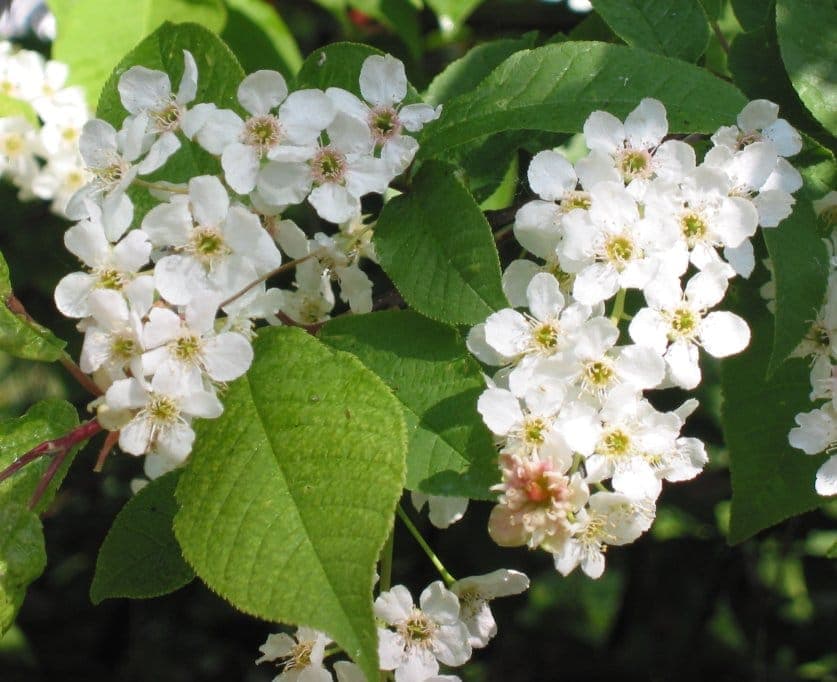
The bird cherry blooms in May with striking, pendulous racemes of white flowers, typically 8–15 cm long. Each flower cluster contains dozens of small, five-petaled blossoms with a sweet, almond-like scent that draws bees and hoverflies. The leaves are oval to lance-shaped, 6–12 cm long, emerging bronze-red in spring before maturing to dark green. In autumn, foliage may turn pale yellow, though the display is usually subtle. After pollination, the flowers develop into small, glossy black drupes, about 8 mm wide. These berries are bitter and mildly toxic to humans but are a favourite food for thrushes, blackbirds, and other songbirds. The tree can self-seed in moist, fertile soil, especially near woodlands.
Ideal location
European bird cherry prefers partial shade to full sun - aim for 5 to 7 hours of sunlight daily. It performs best in cooler microclimates, such as the edge of a woodland garden or near a stream. While it tolerates full sun, consistent soil moisture is crucial. Avoid hot, dry, south-facing spots unless the root zone is well-mulched and irrigated. Young trees benefit from shelter from strong winds. For smaller gardens, train as a single-stemmed tree by removing lower branches up to 1.8 meters. Check gardenworld.app to see if your garden's light and space conditions suit this species.
Soil requirements
This plant grows well in moist, humus-rich soil with a pH between 5.0 and 7.0. It adapts to clay, loam, or sandy soils as long as they don't dry out. Avoid shallow, chalky, or highly alkaline soils. When planting, enrich the hole with well-rotted compost or leaf mould. A 5–10 cm mulch layer of bark or leaf litter helps retain moisture and suppress weeds. The root system is shallow, so avoid compacting the soil around the base.
Free design
Want to see European bird cherry: complete guide in your garden? Make a free design now.
Watering
Water deeply once a week during the first two growing seasons, especially in dry spells. Provide 10–15 liters per tree weekly if rainfall is below 25 mm. Once established, Prunus padus is moderately drought-tolerant but will show stress - leaf scorch or early drop - in prolonged dry summers. Use rainwater when possible, as the tree can be sensitive to lime in tap water on thin soils.
Pruning
Minimal pruning is needed. Avoid winter pruning to reduce the risk of bacterial canker and silver leaf disease. The best time is immediately after flowering, from late May to early June. Remove dead, damaged, or crossing branches. For a tree form, prune lower limbs when the plant is young. Never cut back hard into old wood - recovery is slow. Use sterilised tools to prevent disease spread.
Maintenance calendar
- January: Inspect for damaged branches. No pruning.
- February: Protect young trunks from deer and rodents with tree guards.
- March: Loosen soil around base. Top up mulch.
- April: Monitor for leaf emergence. No feeding required.
- May: Peak bloom. Water if dry.
- June: Light pruning if needed. Watch for aphids.
- July: Maintain moisture during dry periods.
- August: Continue watering in drought.
- September: Birds disperse seeds. Watch for seedlings.
- October: Leaf fall. Apply fresh mulch.
- November: Check soil moisture. No pruning.
- December: Winter check. No action needed.
Winter hardiness
European bird cherry is fully hardy in USDA zones 4–8, tolerating temperatures down to -30°C. It withstands UK and northern European winters without protection. Young trees may benefit from tree wrap to prevent frost cracking on thin bark. The berries often persist into winter, providing food for birds during lean months.
Companion plants
Pair with moisture-loving, shade-tolerant species such as dog's mercury (Mercurialis perennis), wood anemone (Anemone nemorosa), or ferns like Dryopteris filix-mas. Hazel (Corylus avellana) and wild service tree (Sorbus torminalis) make excellent companions in a mixed native planting. Avoid xeric plants like lavender or sedum. On gardenworld.app, you can preview plant combinations that thrive in similar conditions.
Closing
European bird cherry is a resilient, wildlife-friendly tree that brings charm and ecological value to the garden. With its elegant blooms and bird-attracting berries, it's ideal for natural gardens, woodland edges, or as a specimen tree. Buy bare-root or container-grown plants in autumn or early spring from reputable garden centres. Remember: while the berries are toxic to humans, they're a vital food source for birds. For a tailored planting plan, visit gardenworld.app and design around this beautiful native species.
Want to see European bird cherry: complete guide in your garden? Make a free design now.
Upload a photo, pick a style, and get a photorealistic design with plant list in under a minute.
No credit card required


Similar plants
Siberian crab apple: complete guide
Malus x robusta
Complete guide to the Siberian crab apple (Malus x robusta): location, soil, pruning, winter hardiness and the best companion plants for your garden.
Chinese flowering crabapple (Malus x spectabilis): complete guide
Malus x spectabilis
Meet the Chinese flowering crabapple (Malus x spectabilis): a classic spring bloomer with carmine buds and pink blossom.
Potentilla crassinervia: complete guide
Potentilla crassinervia
Potentilla crassinervia, the Corsican cinquefoil, grows wild on Corsica and Sardinia's peaks. Discover how to grow this hardy alpine rock garden gem.