
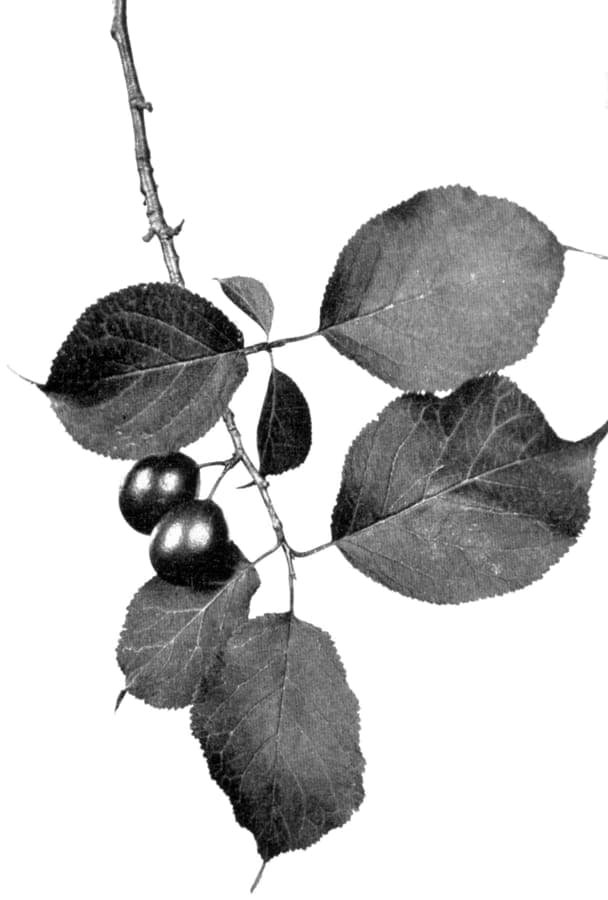
Harriet L. Keeler / Public domain, via Wikimedia Commons
Canada plum: complete guide
Prunus nigra
Want to see Canada plum: complete guide in your garden?
1 minute, no credit card
Overview
Prunus nigra, commonly known as Canada plum, black plum, or horse plum, is a native wild plum tree indigenous to eastern Canada and the northeastern United States. First described botanically by William Aiton in 1789 from specimens at Kew Gardens, this species - also known by the synonym Prunus americana var. nigra - grows naturally from Manitoba and Ontario east to Nova Scotia, and south through Wisconsin, Minnesota, Michigan, Ohio, Indiana, Kentucky, and into New England states.
In its native range, the Canada plum occupies forest edges, thickets, and hedgerows - places with variable moisture and light conditions. It is a thicket-forming tree that reaches 4 to 8 metres at maturity, with a broad, irregular crown and coarse-textured foliage that turns yellow-orange in autumn. Gardeners increasingly prize it not as a commercial fruit tree but as a structurally interesting, wildlife-supporting native species with exceptional cold tolerance.
For anyone planning a new front yard planting that incorporates native species, gardenworld.app provides design tools to help you position Prunus nigra effectively alongside complementary plants. The Canada plum works beautifully as a standalone specimen, an informal privacy screen, or as part of a mixed native hedgerow.
Appearance & bloom cycle
Prunus nigra is a deciduous tree or large multi-stemmed shrub. The bark is grey-brown to dark, becoming rough and slightly scaly with age. Leaves are broadly oval, 6 to 12 cm long, with a finely serrated margin and a notably coarse texture - the Trefle botanical database records the leaf texture as 'coarse', which distinguishes this species from the smoother-leaved Prunus americana. In autumn, the foliage turns attractive shades of yellow, orange, and occasionally red.
Bloom time falls in April to early May, typically before or simultaneously with leaf emergence. The flowers are white to pale pink, approximately 2 to 2.5 cm across, carried in small clusters of two to five along bare branches. The display is generous and brief, creating a cloud-like effect that lasts roughly ten days. This early flowering makes Prunus nigra exceptionally valuable for pollinators - honeybees, bumblebees, and early butterflies all visit the flowers in abundance before many other trees have opened their blooms.
Fruits ripen August to September. The plums are small, 2 to 3 cm in diameter, passing through yellow to orange-red when ripe. They are edible but sharply tart, generally more appealing to birds and wildlife than to humans, though they can be used for preserves and jellies when combined with sugar. The Trefle database records the fruit colour as orange.
Ideal location
Full sun is ideal for Prunus nigra: a minimum of six hours of direct sunlight per day produces the most abundant blossom and the best fruit set. The tree tolerates partial shade but blooms less spectacularly and fruits less freely. In the British Isles and northern continental Europe, prioritise the sunniest available position - typically a south- or west-facing aspect.
The Canada plum tolerates exposed, windy positions better than most fruiting trees, reflecting its origin in the open landscapes of the Canadian prairies and Great Lakes region. It suits the margins of larger gardens where it can serve as a windbreak, or in urban settings as a structural specimen on a south-facing boundary.
Allow adequate space at planting: a mature Canada plum reaches a crown spread of 4 to 6 metres. Maintain at least 5 metres from walls, foundations, and property boundaries. The roots are wide-spreading and the thicket-forming habit means suckers will appear around the base if the root system extends into undisturbed soil.
Soil requirements
Prunus nigra tolerates a remarkably wide range of soil conditions. The Trefle botanical database records a pH tolerance of 6.5 to 8.5 - from mildly acidic through strongly alkaline - which makes this tree adaptable to the diverse soil types found across northern Europe, including the calcareous soils common in parts of Belgium, the Netherlands, and the UK.
Good drainage is the single most critical requirement. The Canada plum will not tolerate waterlogged or persistently wet soil: standing water causes root rot and makes the tree susceptible to Phytophthora and canker. On heavy clay soils, incorporate 20 to 30% coarse grit and mature compost when backfilling the planting pit, and consider installing a simple rubble drainage layer at 40 to 50 cm depth. On sandy, low-fertility soils, annual mulching with 5 to 8 cm of wood chip or leaf mould significantly improves moisture retention and organic matter content over time.
Avoid planting in hollows or low-lying areas where frost also collects: the combination of waterlogging and late frost is damaging to this species.
Watering
Once established - typically from the third growing season - Prunus nigra is moderately drought-tolerant and requires little supplementary watering in normal European summers. During the first two seasons after planting, weekly deep watering is essential to encourage deep root establishment. Deliver 20 to 25 litres per tree at each watering, ensuring moisture penetrates to at least 30 to 40 cm depth.
During prolonged dry spells - three or more weeks without significant rainfall - water twice weekly from May through August, when the tree is actively flowering and fruiting. Drip irrigation or a slow-release soaker hose placed at the drip line is more effective than overhead sprinklers, which wet the foliage unnecessarily and can encourage fungal disease.
In autumn and winter, reduce watering to near zero. Overwatering during dormancy, combined with poor drainage, is a primary cause of root disease in Prunus species. Ensure the planting site drains freely over winter.
Free design
Want to see Canada plum: complete guide in your garden? Make a free design now.
Pruning
All Prunus species - including the Canada plum - are susceptible to silver leaf disease (Chondrostereum purpureum) and canker (Pseudomonas syringae), both of which enter through wounds. Timing and technique are therefore critical. Prune only in dry weather, and always with sharp, sterilised tools. Treat any cut surface larger than 3 cm in diameter with a wound sealant to minimise infection risk.
The best time for maintenance pruning is immediately after flowering in May, when the tree is in active growth and wounds close quickly. Avoid pruning in wet autumn weather, which dramatically increases canker infection rates. For young trees in the first three years, formative pruning focuses on building an open, balanced crown: remove inward-growing, crossing, and weakly attached branches. This open structure improves air circulation and reduces fungal disease pressure.
Suckers from the base and roots should be removed promptly and as close to the point of origin as possible. Left unchecked, they can develop into a dense thicket that competes with the main tree for water and nutrients. In larger naturalistic garden schemes, controlled suckering can be allowed to create a multi-stem grove effect, which is attractive in autumn colour.
Maintenance calendar
January–February: Dormancy. Check for frost damage, broken branches, and wildlife damage to young bark. Remove damaged material promptly.
March: Apply a 5 cm layer of mature compost around the base, keeping it clear of the trunk. Begin formative pruning on young trees if weather is dry.
April–May: Flowering. Water during extended dry spells. Monitor for aphids on new growth. Carry out maintenance pruning immediately after flowering ends.
June: Active growth. Water young trees weekly. Apply wood chip mulch if not already done in spring.
July–August: Fruit development. Maintain watering during dry periods. Remove root suckers promptly as they appear.
September: Fruit ripening. Leave some fallen fruit for wildlife, or remove it to reduce fungal pressure.
October–November: Leaf fall. Rake and compost fallen leaves if disease was present. Top up mulch for winter.
December: Check tree ties and trunk guards on young trees.
Winter hardiness
Prunus nigra is among the hardiest plum species available to European gardeners. In its native range, it survives the extreme winters of Manitoba, Quebec, and the Dakotas, where temperatures can fall below -35 °C. The USDA hardiness zone range is 3 to 7, meaning the tree is fully hardy across all of northern and central Europe, including Scandinavia and the higher-altitude regions of Germany, Austria, and Switzerland.
In the Netherlands, Belgium, and the UK - broadly USDA zones 8 to 9 - no winter protection is necessary for established trees. Only newly planted first-year specimens benefit from a mulch layer over the roots and a jute bark guard to prevent frost cracking of the bark in the coldest continental weather spells.
The main winter-related risk is not cold damage to dormant wood but rather late spring frost hitting open flowers. Temperatures below -2 °C during bloom (April–early May) can destroy the flower crop and eliminate fruiting for that year. Positioning the tree in a sheltered south-facing spot, slightly elevated from frost-collecting hollows, significantly reduces this risk.
Companion plants
Prunus nigra associates naturally and visually with other native and near-native species sharing similar soil preferences. For a wildlife-rich native planting combination, consider:
- Amelanchier lamarckii (serviceberry): flowers simultaneously with Prunus nigra, creating a spectacular white spring display; both species attract pollinators and provide berries for birds.
- Cornus sanguinea (common dogwood): provides autumn red-purple foliage and winter berries complementing Prunus nigra's autumn colour.
- Viburnum opulus (guelder rose): blooms in May–June after Prunus, with red autumn berries and similar drainage requirements.
- Sambucus nigra (elderberry): fast-growing companion for an informal native hedge, with edible flowers and berries.
- Rosa canina (dog rose): thorny understorey companion that enhances habitat value and blooms after Prunus.
- Geranium sanguineum (bloody cranesbill): long-flowering perennial groundcover beneath and around the tree; tolerates dry shade once established.
In a formal fruit garden, Prunus nigra can be grafted onto rootstocks such as Myrobalan (Prunus cerasifera) for a more compact habit. As a natural seedling, allow 5 to 6 metres spacing between individuals to accommodate the spreading crown and sucker zone.
Conclusion
The Canada plum is a rewarding, low-maintenance native tree that delivers spectacular spring blossom, excellent wildlife value, and reliable winter hardiness across much of northern Europe. Its wide pH tolerance (6.5 to 8.5) and adaptability to varied soil textures make it genuinely versatile, and its thicket-forming habit is an asset in naturalistic garden designs.
Discover how Prunus nigra fits into your outdoor space by creating a customised garden design at gardenworld.app. Whether you are planning a native hedgerow or a specimen planting in a larger garden, gardenworld.app offers tools and inspiration to help you make the most of this exceptional wild plum.
Want to see Canada plum: complete guide in your garden? Make a free design now.
Upload a photo, pick a style, and get a photorealistic design with plant list in under a minute.
10,000+ gardens designed already
No credit card required


Similar plants
Siberian crab apple: complete guide
Malus x robusta
Complete guide to the Siberian crab apple (Malus x robusta): location, soil, pruning, winter hardiness and the best companion plants for your garden.
Chinese flowering crabapple (Malus x spectabilis): complete guide
Malus x spectabilis
Meet the Chinese flowering crabapple (Malus x spectabilis): a classic spring bloomer with carmine buds and pink blossom.
Potentilla crassinervia: complete guide
Potentilla crassinervia
Potentilla crassinervia, the Corsican cinquefoil, grows wild on Corsica and Sardinia's peaks. Discover how to grow this hardy alpine rock garden gem.