
Oriental almond: complete guide
Prunus microcarpa
Want to see Oriental almond: complete guide in your garden?
1 minute, no credit card
Overview
Oriental almond (Prunus microcarpa) is a compact, spring-flowering shrub in the rose family, native to the dry, stony mountain slopes of Afghanistan, Iran, Iraq, Turkey, and Turkmenistan. On gardenworld.app we increasingly recommend this species for drought-tolerant and Mediterranean-style planting schemes, and for good reason: few shrubs combine such an early, generous bloom with such a low demand for water. In the wild it grows on calcareous, rocky slopes between 600 and 2000 meters elevation, where scorching, dry summers alternate with cold continental winters. That origin explains why oriental almond thrives in sunny, lean soil and why it barely notices drought once it has settled in.
Unlike the cultivated almond tree (Prunus dulcis), this wild relative stays compact, usually no taller than 1.5 to 2.5 meters, forming a dense, rounded shrub well suited to smaller gardens, rock gardens, and gravel beds. It is especially prized by gardeners who love the earliest signs of spring: flowers can open as soon as February, weeks before most other ornamental shrubs wake up.
Appearance and bloom
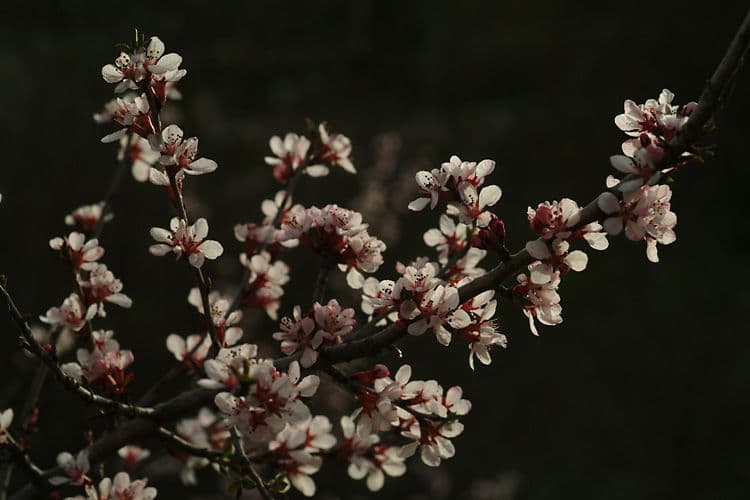
Oriental almond forms a dense, multi-stemmed shrub with slender, occasionally spiny twigs and soft grey-green foliage. Leaves are narrow, lance-shaped, 2 to 4 centimeters long, finely toothed, and only appear after flowering. From February to April, depending on climate, the shrub produces solitary or paired blossoms about 2 centimeters across, pale pink to nearly white, with five rounded petals surrounding a cluster of yellow stamens. Bloom is generous and often covers the bare branches completely, creating a striking contrast against a still-dormant garden. After flowering, small, fuzzy stone fruits develop, resembling miniature almonds with a dry, leathery husk. These fruits are not meant for eating but add an extra decorative layer through summer.
Ideal location
This shrub needs at least 6 to 8 hours of full sun daily to bloom well; in shade, flowering is sparse and the growth habit becomes loose and open. A south- or southwest-facing spot against a wall, or an open, sunny bed, is ideal. Oriental almond tolerates wind and heat exceptionally well, making it suitable for exposed gardens, roof terraces, and gravel gardens. Allow at least 1.5 to 2 meters of space from neighboring plants so the dense, rounded crown can develop freely. In a gardenworld.app design, we often pair this shrub with other sun lovers in a dry, south-facing section of the garden, where it serves as an early-blooming focal point before the rest of the border wakes up.
Soil
In the wild, this species grows on calcareous, stony ground, so it tolerates alkaline, lean soils with a pH between 7.0 and 8.5 without complaint. Good drainage is the single most important requirement: wet feet are poorly tolerated and quickly lead to root rot. Amend heavy clay with coarse sand and grit to improve drainage, or plant in a raised bed. Rich, moisture-retentive garden soil is actually counterproductive; too many nutrients produce soft growth and fewer flowers. Sandy or gravelly soils, such as those found in coastal dunes or river terraces, are where oriental almond feels most at home.
Free design
Want to see Oriental almond: complete guide in your garden? Make a free design now.
Watering
During the first growing season after planting, water weekly, especially during dry spells, to help the shrub establish a strong root system. Once established, usually after one to two years, supplemental water is barely needed except during prolonged heat waves. Overwatering is the biggest threat to this species: its roots are adapted to dry, fast-draining ground and cannot tolerate constant moisture. When in doubt, water less rather than more, and let the soil dry out completely between waterings.
Pruning
Prune oriental almond right after flowering, in April or May, since flower buds form on the previous year's wood. Pruning in winter or early spring removes next season's blooms. Remove dead, damaged, or overly crowded wood to improve air circulation and prevent diseases such as blossom blight. Older shrubs benefit from renewal pruning every few years: cut back a third of the oldest stems to ground level to stimulate vigorous new flowering growth.
Maintenance calendar
- January: dormant period; check for winter damage
- February: first flower buds swell; enjoy the earliest blooms
- March: peak flowering in most climates
- April: bloom ends; prune immediately after the last flowers
- May: new foliage emerges; water lightly during dry spells
- June: fruit begins forming; no special care needed
- July: heat and drought tolerance at its best; barely any water needed
- August: check young shoots for aphids
- September: allow the shrub to gradually enter dormancy
- October: leaf drop begins
- November: clear fallen leaves from around the base
- December: dormant period; no fertilizing
Winter hardiness
Oriental almond is hardy to USDA zone 6a, tolerating winter lows around -23 degrees Celsius, thanks to its origin in the continental mountain climates of Iran and Turkmenistan. In most gardens across the UK, Netherlands, and much of the US, it overwinters without any protection at all. Watch out for late spring frosts following a warm spell: freshly opened flowers can be damaged, though the shrub typically recovers quickly.
Companion plants
Pair oriental almond with other drought-loving species such as lavender (Lavandula angustifolia), rosemary (Salvia rosmarinus), and rock rose (Cistus). Spring bulbs like crocus and dwarf narcissus work well beneath the bare branches and often bloom at the same time as the almond. Avoid pairing with moisture-loving plants such as hydrangeas, which need completely different growing conditions. In a gardenworld.app design, this shrub works beautifully as a transition between a gravel path and a sunny, Mediterranean-style border.
Closing
Oriental almond is an underrated shrub that delivers one of the earliest and most striking bloom displays of the year with minimal care. Its drought tolerance and modest size make it ideal for small gardens, rock gardens, and water-wise planting. Specialty nurseries and some well-stocked garden centers carry young plants; ask specifically in the ornamental shrub section. Once planted and established, this shrub rewards you for decades with a spectacular early spring show that few other plants can match. Give it at least half a meter of clearance from paths and terraces, since the twiggy, occasionally spiny growth can catch on clothing, and pay close attention to watering for the first two summers until the roots are fully settled. Gardeners who value early pollinators will also notice that the very first bumblebees and honeybees of the season eagerly visit these blooms, long before the rest of the border has woken up.
Want to see Oriental almond: complete guide in your garden? Make a free design now.
Upload a photo, pick a style, and get a photorealistic design with plant list in under a minute.
10,000+ gardens designed already
No credit card required


Similar plants
Siberian crab apple: complete guide
Malus x robusta
Complete guide to the Siberian crab apple (Malus x robusta): location, soil, pruning, winter hardiness and the best companion plants for your garden.
Chinese flowering crabapple (Malus x spectabilis): complete guide
Malus x spectabilis
Meet the Chinese flowering crabapple (Malus x spectabilis): a classic spring bloomer with carmine buds and pink blossom.
Potentilla crassinervia: complete guide
Potentilla crassinervia
Potentilla crassinervia, the Corsican cinquefoil, grows wild on Corsica and Sardinia's peaks. Discover how to grow this hardy alpine rock garden gem.