
Wikimedia Commons / CC BY-SA 3.0, via Wikimedia Commons
Perfumed cherry: complete guide
Prunus mahaleb
Want to see Perfumed cherry: complete guide in your garden?
1 minute, no credit card
Overview
Prunus mahaleb, commonly known as the perfumed cherry, is a tough, resilient tree or large shrub that brings subtle elegance to any garden. Native to southern Europe and parts of western Asia, including Greece, Bulgaria, and Iran, it thrives in USDA hardiness zones 5b to 8, tolerating winter lows down to -23°C. In the garden, it's not about flashy drama but dependable beauty – fragrant blooms, clean foliage, and a compact form that fits well in both small and large landscapes. It's especially suited for dry, chalky soils where many other cherries struggle.
On gardenworld.app, you can explore planting designs that highlight the perfumed cherry's natural shape and seasonal rhythm, helping you place it just right in your garden.
Appearance & bloom cycle
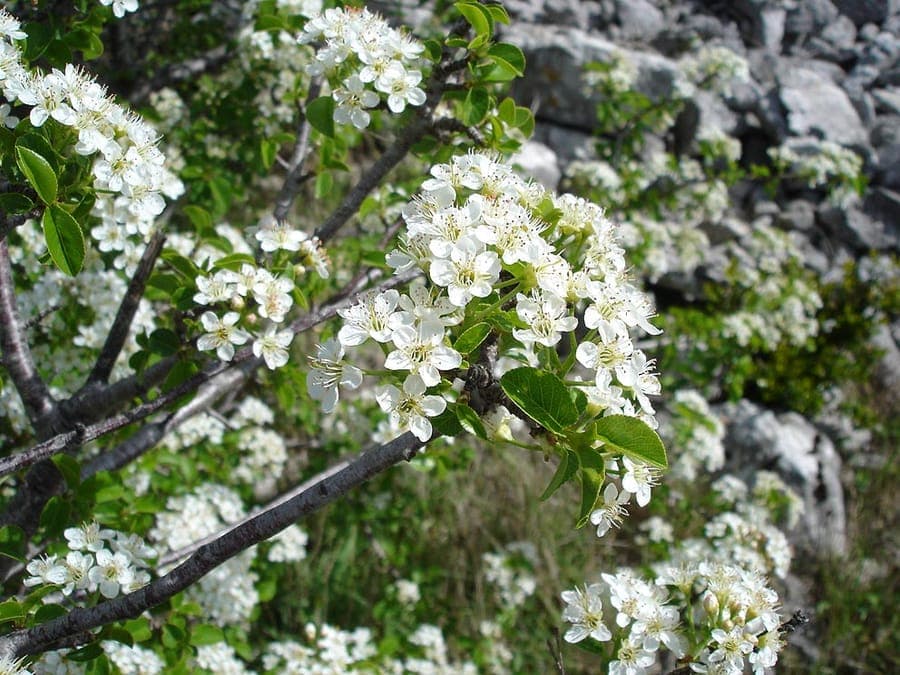
This deciduous tree typically grows 5–8 meters tall, with a spread of 4–6 meters. Its bark is smooth and grey-brown, developing shallow fissures with age. The leaves are oval, dark green, and 3–6 cm long, turning golden yellow in early autumn before dropping. But the real show starts in April and May, when dense clusters of small, pure white, five-petaled flowers burst open. These blooms are intensely fragrant – sweet, almost almond-like, with hints of vanilla – and attract bees, hoverflies, and early butterflies. Each flower is about 1.5 cm across, arranged in pendulous racemes that drape elegantly from the branches.
After flowering, small black drupes form. These are mildly toxic to humans but loved by birds, especially thrushes and blackbirds, making this tree a valuable part of a wildlife-friendly garden.
Ideal location
For best results, plant your perfumed cherry in full sun (light level 7–10), meaning at least 6 hours of direct sunlight daily. A south- or west-facing spot works best. It tolerates light shade but may bloom less. The tree is wind-resistant and handles exposed sites well, though young saplings benefit from staking and wind protection in their first two years. Allow at least 3 meters of clearance from buildings or other trees to ensure proper air circulation and light penetration.
Soil requirements
Prunus mahaleb prefers alkaline, well-drained soils with a pH between 7.5 and 8.0. It thrives in chalky or limestone-rich ground, common in southern England and parts of the US Midwest. Avoid heavy clay or acidic soils unless amended with lime and grit. On sandy soils, mix in compost or well-rotted manure to improve moisture retention. Once established, it's highly drought-tolerant, making it ideal for xeriscaping or low-water gardens.
Free design
Want to see Perfumed cherry: complete guide in your garden? Make a free design now.
Watering
Water deeply once a week during the first growing season, especially in dry spells. Use a slow soak at the base to encourage deep root development. After year one, supplemental watering is rarely needed except during prolonged droughts. Never let the roots sit in water – poor drainage leads to root rot, a common issue in poorly prepared sites.
Pruning
Minimal pruning is required. The natural habit is neat and upright. If shaping is needed, prune in late summer (August) to avoid fungal infections like silver leaf, which enter through fresh cuts in winter. Remove dead, damaged, or crossing branches. For a tree form, select a central leader and remove lower limbs gradually. For a shrubby look, allow multiple stems to develop from the base.
Maintenance calendar
- Jan: Check for winter damage; inspect bark for pests
- Feb: Prepare tools for summer pruning
- Mar: Resume regular checks; watch for bud swell
- Apr: Peak bloom – avoid pruning; monitor pollinators
- May: Flowers fade; remove spent racemes if desired
- Jun: No routine care needed
- Jul: Monitor for aphids or leaf spot; water only in extreme drought
- Aug: Light pruning if needed; avoid heavy cuts
- Sep: Leaves begin to yellow; collect and compost fallen foliage
- Oct: Apply mulch around base to conserve moisture and suppress weeds
- Nov: Protect young trunks from rodents with guards
- Dec: Dormant period – no fertilizing
Winter hardiness
Hardy in USDA zones 5b–8, the perfumed cherry withstands cold winters but young shoots may suffer from late frosts after mild spells. Mature trees need no protection, but in zone 5, a thick mulch layer helps insulate roots. Avoid late-season fertilizing, which can promote tender growth vulnerable to frost.
Companion plants
Pair with drought-tolerant, sun-loving perennials like Echinacea purpurea, Stachys byzantina, or Allium giganteum. Underplant with spring bulbs such as Narcissus or Muscari to fill the ground before the canopy closes. Avoid moisture-loving plants like hostas or ferns, which won't thrive in the dry, alkaline conditions this tree prefers.
Plan a layered planting scheme featuring Prunus mahaleb as a focal point using gardenworld.app's design tools, which help visualize spacing, height, and seasonal interest.
Closing
The perfumed cherry is a quiet achiever in the garden – not loud, but deeply rewarding. With fragrant spring blooms, tidy growth, and resilience to dry conditions, it's a smart choice for sustainable landscapes. Buy healthy specimens from reputable garden centres, especially those specializing in ornamental trees. Once planted, it asks for little and gives back for decades – a true long-term investment in your outdoor space.
Want to see Perfumed cherry: complete guide in your garden? Make a free design now.
Upload a photo, pick a style, and get a photorealistic design with plant list in under a minute.
No credit card required


Similar plants
Siberian crab apple: complete guide
Malus x robusta
Complete guide to the Siberian crab apple (Malus x robusta): location, soil, pruning, winter hardiness and the best companion plants for your garden.
Chinese flowering crabapple (Malus x spectabilis): complete guide
Malus x spectabilis
Meet the Chinese flowering crabapple (Malus x spectabilis): a classic spring bloomer with carmine buds and pink blossom.
Potentilla crassinervia: complete guide
Potentilla crassinervia
Potentilla crassinervia, the Corsican cinquefoil, grows wild on Corsica and Sardinia's peaks. Discover how to grow this hardy alpine rock garden gem.