
Sten Porse / CC BY-SA 3.0, via Wikimedia Commons
Portuguese laurel cherry: complete guide
Prunus lusitanica
Want to see Portuguese laurel cherry: complete guide in your garden?
1 minute, no credit card
Overview
Prunus lusitanica, commonly known as Portuguese laurel cherry, is a hardy evergreen shrub or small tree that brings year-round structure and charm to gardens. Native to western Europe and Atlantic islands like the Azores and Madeira, it thrives in temperate zones and adapts well to UK and northern European conditions. It grows slowly-about 20–30 cm per year-and can reach 5–8 m tall as a tree, or stay compact at 2.5–3.5 m when pruned as a hedge.
Unlike its edible cherry relatives, the fruit of Prunus lusitanica isn't particularly tasty for humans, but it's a magnet for birds. The plant is often used for screening, as a windbreak, or as a specimen in lawns. With glossy leaves, elegant white flower spikes, and minimal pest issues, it's a solid performer in any garden.
On gardenworld.app, you can visualise how a Portuguese laurel cherry hedge would look in your garden using the interactive design planner.
Appearance & bloom cycle
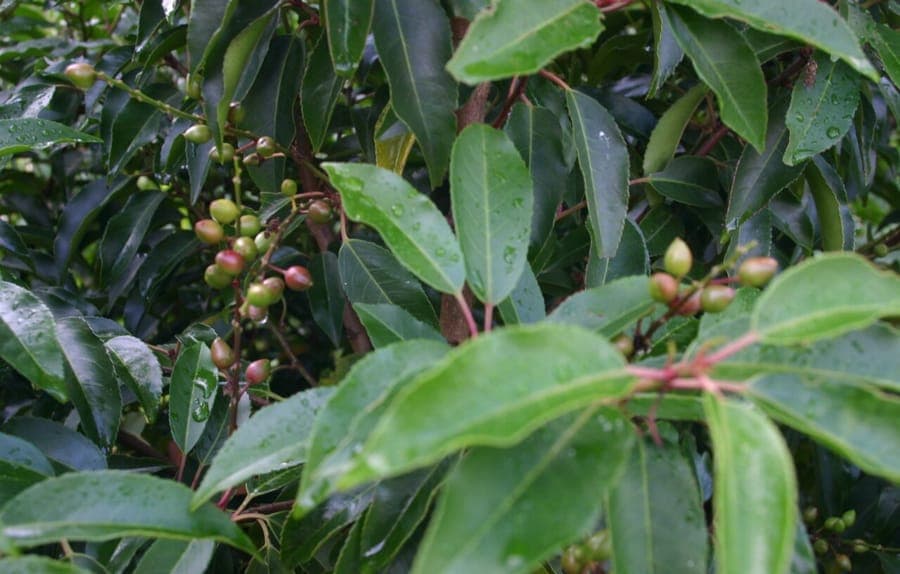
This plant features leathery, dark green oval leaves with finely toothed edges and a striking reddish midrib on the underside. New growth emerges with a rich chestnut-brown flush at the stem tips, adding seasonal interest. The foliage stays on the plant all year, making it excellent for privacy.
In early summer-typically from late May to June-long, drooping racemes of small white flowers appear. They have a light, sweet scent that attracts bees and other pollinators. After flowering, small round fruits form, starting green and ripening to deep purple-black by autumn. While technically edible, they're often bitter and best left for birds to enjoy.
Ideal location
Prunus lusitanica thrives in full sun to partial shade, scoring around 8 on the light scale (where 10 is full sun). It performs best in east- or west-facing spots with 4–6 hours of direct sunlight. It can tolerate full sun if the soil retains moisture, but avoid deep shade, which leads to sparse growth and fewer flowers.
It works well as a boundary hedge, freestanding feature, or in mixed borders. It's also urban-friendly, tolerating pollution and coastal exposure, making it suitable for city gardens and exposed coastal sites.
Soil requirements
This plant prefers well-drained, fertile soil with a pH between 5.5 and 6.5. It handles clay soils as long as they don't stay waterlogged. Sandy soils are acceptable but require extra organic matter-like compost or well-rotted manure-to retain moisture and nutrients.
Avoid very acidic peat soils unless amended with lime. A soil test kit is recommended before planting, especially in established beds. If your soil is too alkaline, consider mulching with ericaceous compost annually.
Free design
Want to see Portuguese laurel cherry: complete guide in your garden? Make a free design now.
Watering
Young plants need consistent watering during their first two growing seasons. In dry summers, water deeply once a week-about 10–15 litres per plant-rather than light daily sprinkles. Established plants are drought-tolerant but will perform better with occasional watering during prolonged dry spells.
Rainwater is preferred over tap water, which can be high in lime. Mulch the base with bark chips or leaf mould to conserve moisture and suppress weeds. Keep the mulch a few inches away from the stem to prevent rot.
Pruning
Portuguese laurel cherry responds well to pruning, making it ideal for formal hedges. For a neat hedge, trim twice a year: once in late June after flowering, and again in mid-August to refine shape. Use sharp, clean secateurs or hedge trimmers for clean cuts.
For a tree form, gradually remove lower branches up to 1.5 m over a few years. Avoid heavy pruning in late autumn, as new growth may not harden before frost.
On gardenworld.app, you can generate a custom pruning calendar based on your local climate and planting date.
Maintenance calendar
- Jan: Check for frost damage, remove dead wood
- Feb: Prepare tools, inspect for pests
- Mar: Light inspection, no pruning
- Apr: Begin watering if dry, apply mulch
- May: Monitor for aphids, avoid pruning
- Jun: Prune after flowering for hedges
- Jul: Deep water young plants in dry spells
- Aug: Second hedge trim, shape as needed
- Sep: Stop pruning to allow new growth to harden
- Oct: Mulch with compost, collect fallen leaves
- Nov: Leave leaf litter around base for insulation
- Dec: Protect young plants from harsh winds with fleece
Winter hardiness
Prunus lusitanica is hardy in USDA zones 7b to 9. In the UK (zone 8), it generally survives winter well, but young plants may suffer in severe cold, especially with drying winds. Protect the root zone with a thick mulch and wrap the trunk with horticultural fleece for the first two winters.
In harsh winters, leaves may turn bronze or brown-this is usually cosmetic. The plant typically recovers in spring unless the cold was extreme.
Companion plants
Pair Portuguese laurel cherry with other evergreens like yew (Taxus baccata) or holly (Ilex aquifolium). For borders, try shade-tolerant perennials such as hellebores (Helleborus orientalis), snowdrops (Galanthus), or ferns like Dryopteris. Underplant hedges with Lamium maculatum or Pachysandra for ground cover.
Ensure at least 60 cm spacing between plants to reduce root competition.
Closing
Prunus lusitanica is a reliable, attractive, and low-maintenance choice for hedges, screens, or ornamental trees. With proper planting and care, it delivers decades of privacy, beauty, and wildlife value. Available at most garden centres in 60–80 cm pots, plant in spring or autumn for best results. Choose a sheltered spot, keep it watered in the first year, and enjoy a resilient garden staple.
Want to see Portuguese laurel cherry: complete guide in your garden? Make a free design now.
Upload a photo, pick a style, and get a photorealistic design with plant list in under a minute.
No credit card required


Similar plants
Siberian crab apple: complete guide
Malus x robusta
Complete guide to the Siberian crab apple (Malus x robusta): location, soil, pruning, winter hardiness and the best companion plants for your garden.
Chinese flowering crabapple (Malus x spectabilis): complete guide
Malus x spectabilis
Meet the Chinese flowering crabapple (Malus x spectabilis): a classic spring bloomer with carmine buds and pink blossom.
Potentilla crassinervia: complete guide
Potentilla crassinervia
Potentilla crassinervia, the Corsican cinquefoil, grows wild on Corsica and Sardinia's peaks. Discover how to grow this hardy alpine rock garden gem.