
Silver almond: complete guide
Prunus argentea
Want to see Silver almond: complete guide in your garden?
1 minute, no credit card
Overview
Prunus argentea, known as silver almond in English and silber-mandel in German, is an elegant, drought-tolerant wild almond species in the rose family (Rosaceae). The botanist Rehder described the species in 1922, building on earlier work by Lamarck. In taxonomic literature the plant also appears under the synonyms Amygdalus argentea and Amygdalus orientalis. It grows naturally on the dry, rocky mountain slopes of Iran, Iraq, and the border region of Lebanon and Syria, with an introduced population in Turkey.
The species epithet argentea, meaning silvery, refers to the shrub's most striking feature: finely haired, silvery-grey foliage that gives the plant a unique, almost Mediterranean character even outside its short flowering season. For gardeners seeking a hardy, water-wise shrub with strong visual character, this is an appealing choice. Through gardenworld.app you can design a drought garden or gravel garden in which silver almond serves as a structural plant among other Mediterranean species. Within the genus Prunus, and more specifically within the former subgenus Amygdalus of wild almond species, this plant ranks among the most ornamental thanks to its silvery foliage, a trait rarely found to this degree in other hardy shrubs. It is seldom offered by mainstream garden centres but can be sourced through specialist nurseries and botanical gardens by enthusiasts of distinctive, authentic shrubs.
Appearance and bloom
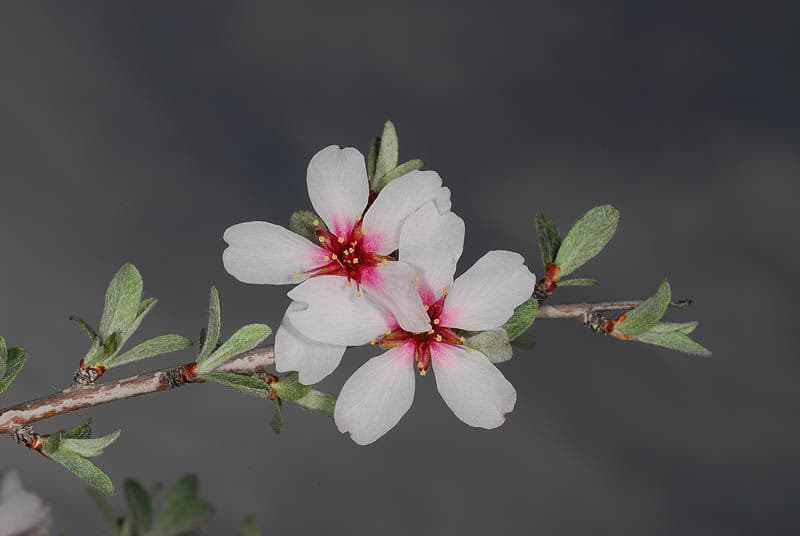
Silver almond grows as a dense, rounded shrub 1.5 to 3 metres tall and roughly as wide, with sturdy, sometimes slightly thorny twigs. The leaves are narrow-lanceolate, 3 to 6 centimetres long, and densely covered in fine, silvery-white hairs that protect the plant from intense sun and moisture loss in its dry, continental homeland.
Flowering occurs early in spring, typically from March to April, before the leaves have fully emerged. The flowers are pink to pale pink, about 2 to 2.5 centimetres wide, and appear abundantly along the bare branches, creating a striking contrast against the still-leafless, dark twigs. After flowering, small, felted almond-like fruits develop that are botanically interesting but not suitable for eating, unlike the cultivated almond.
Ideal location
This species needs a position in full sun, with at least 6 to 8 hours of direct light daily; less sun results in sparser flowering and a less compact growth habit. A warm, sheltered spot against a south-facing wall is ideal, especially in the first few years after planting.
Silver almond tolerates wind and drought remarkably well, making it suitable for exposed, sunny sites where many other ornamental shrubs struggle. Avoid damp, shady corners; the plant originates from a climate of hot, dry summers and cold winters.
Soil
In its natural habitat this species grows on rocky, lime-rich mountain soils with excellent drainage and little organic matter. In the garden, use free-draining soil, enriched with coarse sand or gravel if needed, with a pH between 6.5 and 8.0, so neutral to alkaline.
Avoid heavy clay and persistently damp soil; root rot is the main threat to this drought-adapted species. When planting in heavier soils typical of the Netherlands or Belgium, it helps to improve the planting hole with gravel and compost at a ratio of roughly two parts original soil to one part amendment. A raised planting bed or a gentle slope in the garden also helps excess rainwater drain away quickly, which poses a greater risk in the wetter climate of the Netherlands and Belgium than in the plant's dry native range.
Free design
Want to see Silver almond: complete guide in your garden? Make a free design now.
Watering
Young, newly planted shrubs need regular watering during their first growing season to root well; water twice a week during warm, dry spells. Once established, after about two years, silver almond becomes exceptionally drought-tolerant.
In a typical Dutch or Belgian garden climate, supplemental watering of established specimens is rarely needed, except during prolonged summer drought lasting more than a month. Overwatering is more harmful than underwatering for this species.
Pruning
Silver almond flowers on the previous year's wood, so prune ideally right after flowering in April or May, giving the plant the rest of the season to form new flowering wood. Remove dead, damaged, or crossing branches and thin the shrub lightly if needed to let air and light reach the centre.
Heavy pruning in autumn or winter should be avoided, as it removes next spring's flowers. Older, woody shrubs can be rejuvenated every few years by cutting a third of the oldest stems back to ground level, which encourages fresh growth from the base and keeps the silhouette dense rather than sparse and leggy over time.
Maintenance calendar
March-April: flowering period, enjoy the pink blossom, no pruning during bloom. April-May: prune right after flowering, light feeding with compost. June-August: main growth phase, water during prolonged dry spells, check for aphids. September-October: growth slows, stop feeding, final disease check. November-February: full winter dormancy, no protection needed for established shrubs.
Winter hardiness
Prunus argentea is very winter hardy, corresponding to USDA zone 6 to 8, fitting its origins in the continental mountain regions of Iran and Iraq, where cold winters alternate with hot summers. Frost down to approximately -20 degrees Celsius poses no problem for established shrubs.
In the Netherlands, Belgium, and France, silver almond survives winter without extra protection. Young plants in their first year do benefit from a 5 to 10 centimetre mulch layer around the root collar during their first, harshest winter.
Companion plants
Silver almond combines beautifully with other drought-tolerant Mediterranean plants such as lavender, rosemary, cistus, and santolina, which share the same preference for full sun and well-drained soil. The closely related Prunus tenella and Prunus webbii also make a logical addition to a collection of wild almond species.
At garden centres you will more often find the cultivated ornamental relatives, such as Prunus triloba 'Multiplex' with its double pink flowers, which pairs well with silver almond in a mixed border. On gardenworld.app you can test different combinations of drought-tolerant shrubs virtually before you start planting.
Closing
Prunus argentea is an underrated choice for anyone seeking a hardy, drought-tolerant shrub with strong visual character thanks to its silvery-grey foliage and early pink blossom. Give it a sunny, well-drained spot and it will demand little further care. For more inspiration on drought gardens and Mediterranean plant combinations, gardenworld.app offers a valuable starting point, with concrete examples of successful pairings for a sunny, water-wise garden that stays attractive through every season.
Want to see Silver almond: complete guide in your garden? Make a free design now.
Upload a photo, pick a style, and get a photorealistic design with plant list in under a minute.
10,000+ gardens designed already
No credit card required


Similar plants
Siberian crab apple: complete guide
Malus x robusta
Complete guide to the Siberian crab apple (Malus x robusta): location, soil, pruning, winter hardiness and the best companion plants for your garden.
Chinese flowering crabapple (Malus x spectabilis): complete guide
Malus x spectabilis
Meet the Chinese flowering crabapple (Malus x spectabilis): a classic spring bloomer with carmine buds and pink blossom.
Potentilla crassinervia: complete guide
Potentilla crassinervia
Potentilla crassinervia, the Corsican cinquefoil, grows wild on Corsica and Sardinia's peaks. Discover how to grow this hardy alpine rock garden gem.