
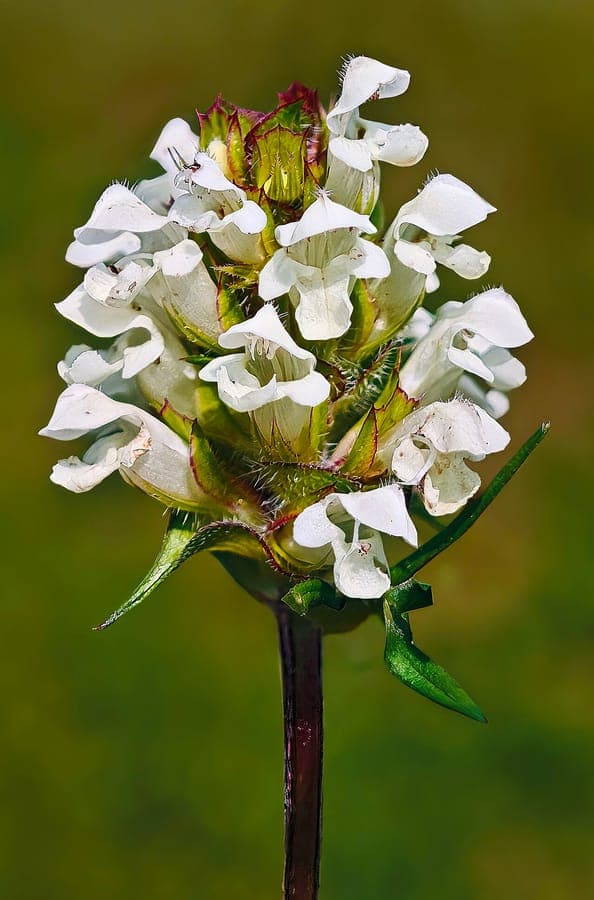
Didier Descouens / CC BY-SA 4.0, via Wikimedia Commons
Cutleaf selfheal (Prunella laciniata): complete guide
Prunella laciniata
Want to see Cutleaf selfheal (Prunella laciniata): complete guide in your garden?
1 minute, no credit card
Overview
Prunella laciniata, also known as cutleaf selfheal or white selfheal, is an elegant perennial from Europe, the Mediterranean, and northwestern Iran. This plant distinguishes itself from its sister, large selfheal, by its characteristic white or pale pink flowers and finer, more dissected foliage. The name laciniata refers to the deeply cut leaves.
Cutleaf selfheal is an elegant addition to any border or rock garden. It grows cautiously and forms non-invasive cushions. This makes it ideal for plant enthusiasts who want to experiment with less common selfheal variants.
Appearance and Bloom
Prunella laciniata grows to about 20-30 cm in height, which is shorter than Prunella grandiflora. The leaves are finely divided, linear to lance-shaped with wavy margins. This gives the plant a delicate, almost feathery appearance.
The flowers appear in loose, less densely packed flower spikes than other Prunella species. They are white or very pale pink with sometimes a light yellowish tint. Individual flowers are small, approximately 0.8-1 cm long, with the characteristic two-lipped design of the family. Blooming runs from June to August.
Ideal Location
Cutleaf selfheal grows best in sunny locations, though it tolerates partial shade as well. It performs better than its purple sister in somewhat shadier conditions. Ensure a spot with good air circulation.
Don't plant cutleaf selfheal in very wet or boggy locations. It thrives on dry slopes, in rock gardens, and on raised beds where its roots can stay dry.
Soil
Cutleaf selfheal grows in practically any well-draining soil. It thrives in poor, stony soils where much stronger-growing plants cannot gain a foothold. The plant also tolerates calcareous soils well.
Ensure minimal feeding. Too much nutrition leads to lax, non-compact growth. The plant grows better in poor soils with good drainage.
Free design
Want to see Cutleaf selfheal (Prunella laciniata): complete guide in your garden? Make a free design now.
Watering
Once established, cutleaf selfheal is very drought-tolerant. It needs no extra water under normal conditions. During very dry periods, you can water it, but it is not essential.
Avoid waterlogging, especially in winter. Plant on raised beds or add sand to heavier soils.
Pruning
Prune the plant after blooming (August-September) back to 5 cm height. This encourages denser growth in the following season. Remove spent flowers throughout blooming to encourage continued flowering.
In early spring, you can remove dead growth.
Maintenance Calendar
March: Maintenance pruning, remove dead growth. April-May: Growth begins. June: Blooming begins. June-August: Full bloom, remove spent flowers. September: Prune back after blooming. October-February: Rest period.
Winter Hardiness
Cutleaf selfheal is winter-hardy to about -15 degrees Celsius. In most parts of the UK and Northern Europe, they overwinter well, though in very severe winters some leaf drop can occur. They require no extra protection.
Winter hardiness depends on good drainage. In very wet winters on poor drainage, problems can occur.
Companion Plants
Cutleaf selfheal combines beautifully with other delicate, light-growing perennials. Try it alongside Silene, Dianthus, and other alpine plants. Also lovely with silver-leaved plants like Artemisia stelleriana.
In borders, it works well as a front or edging plant.
Final Thoughts
Prunella laciniata offers an elegant, white variant on the selfheal theme. With its fine foliage and subtle flowers, it adds grace to any rock garden. The plant is low-maintenance and worthy of gardeners who want something special.
Find this plant at specialized plant nurseries. Consult gardenworld.app for more information about perennials and garden design. Also read our guide at gardenworld.app for other interesting alpine plant variants.
Want to see Cutleaf selfheal (Prunella laciniata): complete guide in your garden? Make a free design now.
Upload a photo, pick a style, and get a photorealistic design with plant list in under a minute.
No credit card required


Similar plants
Apple mint (Mentha x villosa): complete guide
Mentha x villosa
Meet apple mint (Mentha x villosa): a fruity-scented kitchen herb with woolly leaves, perfect for tea and mojitos.
Salvia peyronii: complete guide
Salvia peyronii
Discover Salvia peyronii, a rare Lebanese mountain sage. Growing tips, hardiness, and companion planting for a Mediterranean gravel garden.
Bigleaf mint (Mentha x rotundifolia): complete guide
Mentha x rotundifolia
Discover bigleaf mint: cultivation, care tips, and garden uses. Learn how to grow this aromatic herb with soft, hairy leaves.