
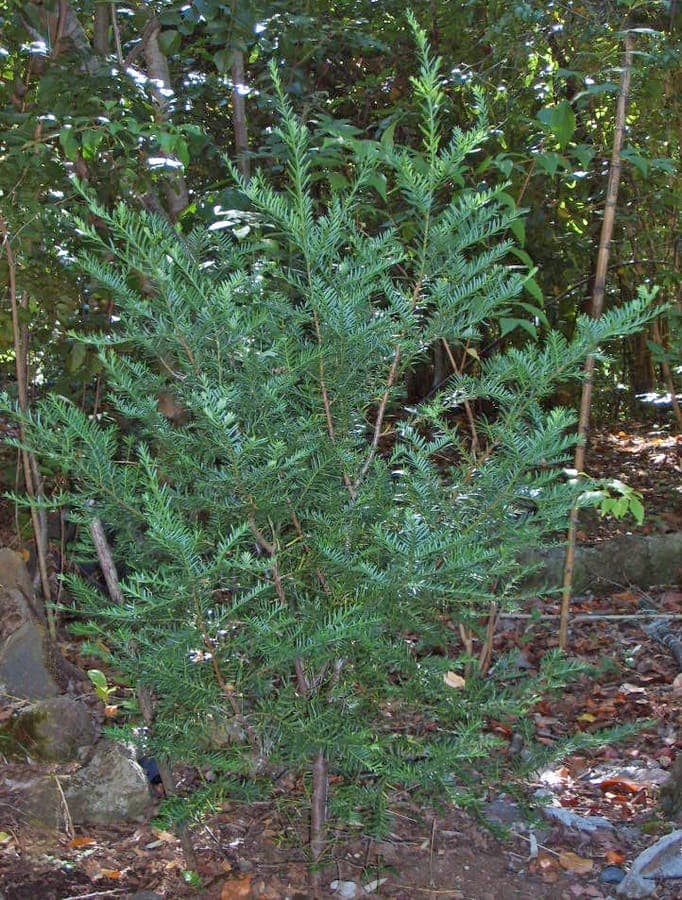
User:Daga modified by User:Kahuroa / Public domain, via Wikimedia Commons
Prumnopitys andina: complete guide
Prumnopitys andina
Want to see Prumnopitys andina: complete guide in your garden?
1 minute, no credit card
Overview
Prumnopitys andina, also known as lleuque in Chile and plumyew in English, is a unique coniferous tree native to the mountain regions of Chile and Argentina. This remarkable conifer grows naturally in the Andes at elevations between 1000 and 2000 meters, in the cold, wet climate of Patagonia.
The tree is botanically interesting due to its placement in the Podocarpaceae family, a very ancient family of conifers from the southern hemisphere. In its natural habitat, the tree can reach 30 meters or more. In cultivated conditions, it typically remains smaller, between 10 to 20 meters, making it suitable for larger residential gardens.
Appearance and bloom
Prumnopitys andina displays an elegant, conical form with densely packed needles that are gray-green to dark green. The needles are flattened in form and approximately 1 to 1.5 centimeters long. The bark is dark brown and rough, characteristic of mature specimens, providing visual interest year-round.
The tree is dioecious, meaning male and female cones appear on different trees. The female cones develop into plum-like fruits approximately 2 centimeters long. These fruits are dark blue to purple when ripe and have a wrinkled surface resembling plums, hence the common name plum-fruited yew.
Ideal location
Plant Prumnopitys andina in full sun to light shade. The tree prefers cool, mountainous conditions and does not tolerate hot, dry climates well. Provide a sheltered location where the tree is not exposed to strong winds that might damage the dense foliage.
This tree is suitable for mountain gardens, landscapes in cool regions, and formal garden designs. The tree develops a noble, formal appearance that fits well in large gardens and landscapes. Plant only in regions with moderately cold winters and consistent moisture availability.
Soil
Prumnopitys andina grows best in moist, well-draining soil. The tree tolerates both acidic and neutral terrain (pH 5.5 to 7). In its natural habitat, the tree grows in humus-rich mountain soils with regular moisture supply.
Provide soil that drains well and is rich in organic matter. Add compost or well-rotted leaf mold. The tree does not tolerate very dry soils and also struggles in prolonged periods of waterlogging. Gradual, consistent moisture is ideal for healthy growth and development.
Free design
Want to see Prumnopitys andina: complete guide in your garden? Make a free design now.
Watering
Regular watering is essential, especially during the first growing season. Water deeply and thoroughly, ensuring the soil remains consistently moist without becoming waterlogged. In dry seasons, additional watering may be necessary.
Once established, the tree requires less water but benefits from consistently moist soil. In very dry conditions, leaf drop may occur. Mulching around the tree helps retain moisture and moderates soil temperature. In Patagonian conditions, the tree evolved with regular rainfall.
Pruning
Pruning is usually unnecessary, as the tree develops a natural, elegant form on its own. In youth, some structural pruning can maintain good form. Remove dead or damaged branches to maintain health. Avoid severe pruning that removes the natural conical silhouette.
Maintenance calendar
March to April: Water regularly; check structure. May to June: Provide feeding; water thoroughly. July to August: Continue regular watering. September to October: Gradually reduce watering. November to January: Minimal care; prepare for cold period.
Winter hardiness
Prumnopitys andina is moderately hardy (USDA zones 8 to 10). The tree tolerates cold to approximately -10 to -12 degrees Celsius, depending on conditions. In very cold regions, protection may be necessary.
Provide protection in severe winters by wrapping jute around the trunk. The tree thrives better in regions with consistent moisture and moderately cold winters, not extreme freezes followed by drought.
Companion plants
Combine Prumnopitys andina with other mountain plants and forest trees such as other conifers and shade-tolerant understory plants. Avoid very dry shrubs. Plant with other moisture-loving species for authentic alpine Andean appearance and natural woodland character.
Closing
Prumnopitys andina is an exceptional coniferous tree for gardeners with interest in southern hemisphere plants and mountain species. With regular watering and cool, moist conditions, this tree will deliver decades of architectural interest and unique visual character. Visit gardenworld.app to explore mountain garden design and exotic tree integration.
Want to see Prumnopitys andina: complete guide in your garden? Make a free design now.
Upload a photo, pick a style, and get a photorealistic design with plant list in under a minute.
No credit card required


Similar plants
Podocarpus neriifolius: complete guide
Podocarpus neriifolius
Brown Pine is a subtropical conifer with elegant needle-like foliage resembling oleander leaves. Ideal for protected, warm locations with excellent drainage.
Podocarpus nubigenus: complete guide
Podocarpus nubigenus
Cloud Podocarp is an elegant, frost-sensitive conifer from the Andes with fine needle structure. Perfect for sheltered gardens with moderate winter cold.
Saxegothaea conspicua: complete guide
Saxegothaea conspicua
Discover Prince Albert's Yew, a unique South American conifer with elegant needle foliage and interesting fruits. Perfect for shaded, moist gardens.