
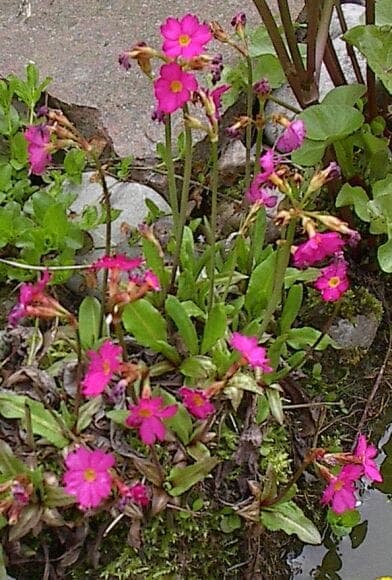
Wikimedia Commons / CC BY-SA 3.0, via Wikimedia Commons
Rosy Primrose: complete guide
Primula rosea
Want to see Rosy Primrose: complete guide in your garden?
1 minute, no credit card
Overview
Rosy Primrose (Primula rosea) is a breathtaking early spring alpine plant native to the West Himalayas, where it thrives in moist alpine meadows and mountain stream banks across Afghanistan and Pakistan. This charming dwarf has become a favourite among European alpine gardeners for its vivid fuchsia-magenta flowers appearing in March-April. Despite its delicate appearance, Rosy Primrose is remarkably resilient and long-lived with proper moisture management.
Appearance and bloom
Rosy Primrose is a compact, ground-hugging plant reaching only 15-30 cm at maturity. Its most distinctive feature is the glossy, deep-green foliage arranged in dense rosettes tight against the soil. The leaves are lance-shaped with a slightly wrinkled texture, creating visual interest. In March-April, flower stems emerge from the rosette centre, each bearing 5-20 vivid fuchsia-pink blooms, each 2-3 cm across. These flower clusters remain ornamental for 3-4 weeks, depending on temperature and moisture.
Ideal location
Location selection is absolutely critical for Rosy Primrose success. Plant in partial shade to dappled light: 3-4 hours of indirect sunlight daily. Full sun causes excessive moisture evaporation the plant cannot sustain; deep shade prevents flowering. Identify naturally moist sites: near underground springs, areas where spring water collects, along small garden streams, or boggy depressions. The plant absolutely cannot tolerate dry spots.
Soil
Rosy Primrose demands consistently moist to wet soil rich in organic matter. Ideal soil composition is 40% garden soil plus 40% peat moss or leaf mould plus 20% grit for structure. A slightly acidic pH (5.5-6.5) is strongly preferred. Annual mulching in May with 5 cm of leaf mould improves moisture retention and stabilises root-zone temperature.
Watering
This is the critical factor: Rosy Primrose must stay constantly moist but never waterlogged. Water 2-3 times weekly during spring growth (March-May), daily if temperatures exceed 20 degrees C. Reduce frequency slightly in summer (July-August) as the plant naturally becomes dormant. Resume intensive watering in September-October when new foliage emerges. Even in winter, never allow the soil to dry completely.
Free design
Want to see Rosy Primrose: complete guide in your garden? Make a free design now.
Pruning
Rosy Primrose requires virtually no pruning. Remove yellowed or declining leaves as they appear to make room for fresh growth. After flowering (April), you may cut back flower stems to 1-2 cm for tidiness, though this isn't necessary. The plant is naturally compact and neat.
Maintenance calendar
January-February: Minimal activity. Maintain moist soil without waterlogging. March-April: Peak flowering period. Water 3x weekly. Enjoy spectacular blooms. May-June: Late flowers possible. Dead-head spent blooms. Apply 5 cm leaf mould mulch. July-August: Dormancy period. Reduce watering to 1x weekly. September-October: New foliage emerges. Resume 2-3x weekly watering. November-December: Dormancy. Minimal watering (1x weekly), but never fully dry.
Winter hardiness
Rosy Primrose is winter hardy to USDA Zone 4-5 (-30 to -20 degrees C). All Dutch, Belgian, and French winters are well within tolerance. Even German highlands and Scandinavia see excellent survival, though heavy snow and prolonged freezing can stress plants. A protective snow layer of 5-10 cm (natural or applied) in winter provides excellent root-zone insulation.
Companion plants
Rosy Primrose combines beautifully with other moisture-loving, shade-tolerant alpine plants: Valeriana supina (Dwarf Valerian) with matching moisture requirements, Astilbe species for contrasting flower form, Hosta varieties for complementary leaf structure, Caltha palustris (Marsh Marigold) for matching boggy habitat, Ferns for identical shade and moisture needs. Avoid pairing with drought-loving plants like Polygonum glaucum or Syringa josikaea.
Closing
Rosy Primrose is a gem for gardeners seeking to brighten shaded, moist areas with early spring colour. With vivid fuchsia blooms and reliable character, this Himalayan alpine transforms shadowy corners. Correctly sited and watered, Rosy Primrose becomes a long-lived, virtually maintenance-free garden treasure. Use gardenworld.app to identify the perfect placement for your Rosy Primrose in a comprehensive garden design.
Want to see Rosy Primrose: complete guide in your garden? Make a free design now.
Upload a photo, pick a style, and get a photorealistic design with plant list in under a minute.
No credit card required


Similar plants
Primula incana: complete guide to silvery alpine primrose
Primula incana
Silvery primrose (Primula incana), a delicate alpine flower with white blooms and powdered grey-green leaves. Growing, care, and cultivation guide.
Mealy cowslip: complete guide
Primula pulverulenta
Grow the Mealy cowslip (Primula pulverulenta): striking candelabra flowers in red and purple tones, moisture-loving and ideal for shady, damp garden corners.
Cliff dwarf-primrose: complete guide
Androsace laevigata
Full guide to growing Androsace laevigata, a rare Pacific Northwest alpine cushion plant. Planting, care, and garden design tips explained.