
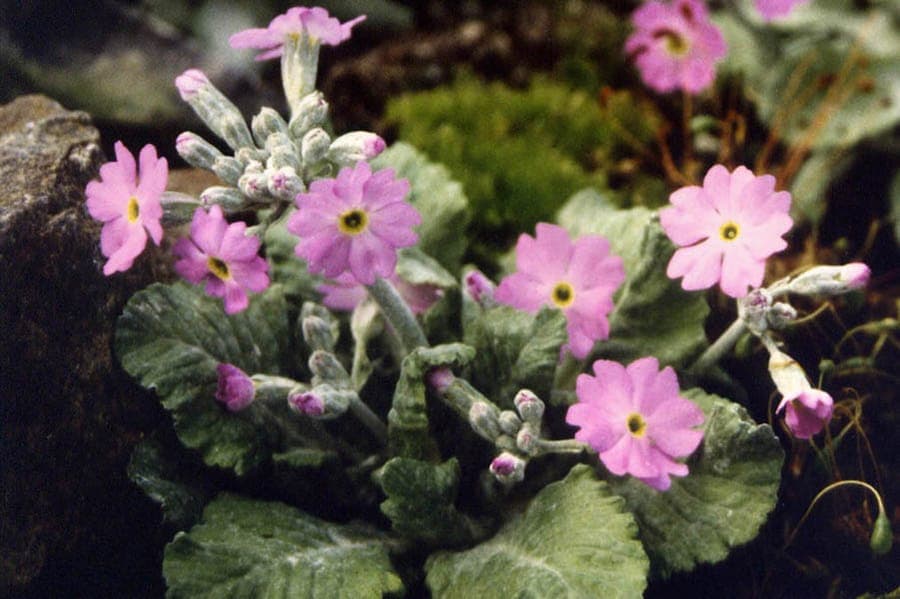
Ghislain118 (AD) http://www.fleurs-des-montagnes.net / CC BY-SA 3.0, via Wikimedia Commons
Leafy Primrose: complete guide
Primula frondosa
Want to see Leafy Primrose: complete guide in your garden?
1 minute, no credit card
Overview
Leafy primrose (Primula frondosa) is a rare alpine plant in the Primulaceae family (Primrose family), endemic to central Bulgaria in the mountains. This high-altitude specialist grows at elevations of 1,500 to 2,200 meters on moist, steep rocky slopes and alpine meadows. The plant reaches only 10-20 cm height, forming compact, tight rosettes. Flowers appear in May and June in rosy-red hues. This is a fully hardy but challenging species requiring exceptional drainage and precise watering discipline. Due to its restricted wild range and specialized niche, it is highly prized among alpine gardeners worldwide.
Appearance and Bloom
Leafy primrose forms extremely dense, compact rosettes of 8-15 cm diameter. The leaves are characteristic: approximately 3-5 cm long, linear to lanceolate, dark green, with prominently visible veining ("frondosa" refers to leaf-like structures). Leaf margins are entire (smooth). In May-June, 1-3 flowers appear per plant on short stems (3-5 cm tall). Flowers measure approximately 12-15 mm across, have 5 petals with deep notches at the margins, and are bright red to rose-pink with often yellow or white centers. The flowers emit a pleasant light fragrance. After flowering, small seed capsules develop over June-July. The plant grows slowly, achieving full size only after 3-4 years.
Ideal Location
Leafy primrose thrives in light shade to partial sun, but naturally in a mountain environment with plentiful air and moisture. In gardens, a position with morning sun and afternoon shade is ideal. North-facing or northeast-facing slopes are actually preferable to south-facing (too hot, too dry). The plant tolerates north light well and grows acceptably in half-shade. Critical: excellent air circulation is essential to prevent moisture-dependent fungal diseases (botrytis and mildew). Avoid planting in still, damp pockets where moisture accumulates. Wind is beneficial, provided it is not desiccating or excessively cold.
Soil
Leafy primrose requires extremely well-drained soil with high humus content. In nature, the plant grows in alpine seepage areas with moisture-retaining but well-draining mineral soils. An ideal mix is 40% alpine grit, 30% coarse sand, 20% garden compost, and 10% leaf mold. Heavy clay must be avoided absolutely. Soil pH should be 6.5-7.5 (neutral to slightly alkaline). For container cultivation: use specialist alpine plant potting soil with additional perlite or gravel added. Drainage in pots is critical: drainage holes in the pot base are essential. No fertilizer is needed; nutrient levels should be minimal.
Free design
Want to see Leafy Primrose: complete guide in your garden? Make a free design now.
Watering
Leafy primrose requires consistent moisture but absolutely NO waterlogging. This is the most difficult balance: consistently moist but certainly not wet or waterlogged. During the growing season (April-June), water when the top 1-2 cm feels dry, but never allow the soil to remain sodden. During summer dormancy (July-October), reduce watering substantially; keep relatively dry. In winter (November-March), minimize watering: water only when the soil feels very dry to touch. Regular checking is essential. Use rainwater or distilled water; hard water can be harmful. Early morning watering is better than evening (preventing fungal problems). Never water from above; bottom watering (from saucers) is superior.
Pruning
Leafy primrose requires no pruning. The plant naturally assumes a compact form. Spent flowers may be carefully removed after June's bloom, but this is unnecessary. Dead leaves must be promptly removed to prevent botrytis. Seed capsules can be removed after ripening (September-October) to prevent self-seeding, or left to produce seed for propagation.
Maintenance Calendar
February-March: Plant begins emerging from winter dormancy, gently restore watering. April: Rapid growth period, water consistently. May-June: Peak flowering, maintain continuous moderate moisture. July-August: Heat stress period, reduce watering significantly, keep plant in shade. September-October: Plant transitions to rest, minimize watering further. November-December: Deep dormancy, keep dry.
Winter Hardiness
Leafy primrose is fully hardy to USDA Zone 3 (-35 to -40 degrees C). The plant overwinters without protection in the Netherlands, Belgium, and Germany. In very wet winters, protection with glass cloches or fleece may be beneficial to prevent excessive winter moisture. The plant tolerates snow well and is protected by it.
Companion Plants
Leafy primrose grows best in alpine troughs with similar alpine miniatures. Other alpine primulas (P. marginata, P. minima) are good companions. Small saxifrage species (S. arendsii), miniature sedum species (S. spathulifolium), and dwarf grasses provide excellent associations. Avoid large, vigorous-growing plants that create competition. Best grown with other Bulgarian alpines or East European mountain plants.
Summary
Leafy primrose is a hardy, challenging alpine requiring exceptional attention: perfect drainage, consistent moisture, excellent ventilation. This is for dedicated alpine gardeners. Rarity and specialized beauty reward the effort. Plant material is extremely difficult to source; seed occasionally appears in alpine plant auctions and specialized alpine plant societies.
Want to see Leafy Primrose: complete guide in your garden? Make a free design now.
Upload a photo, pick a style, and get a photorealistic design with plant list in under a minute.
No credit card required


Similar plants
Primula incana: complete guide to silvery alpine primrose
Primula incana
Silvery primrose (Primula incana), a delicate alpine flower with white blooms and powdered grey-green leaves. Growing, care, and cultivation guide.
Mealy cowslip: complete guide
Primula pulverulenta
Grow the Mealy cowslip (Primula pulverulenta): striking candelabra flowers in red and purple tones, moisture-loving and ideal for shady, damp garden corners.
Cliff dwarf-primrose: complete guide
Androsace laevigata
Full guide to growing Androsace laevigata, a rare Pacific Northwest alpine cushion plant. Planting, care, and garden design tips explained.