
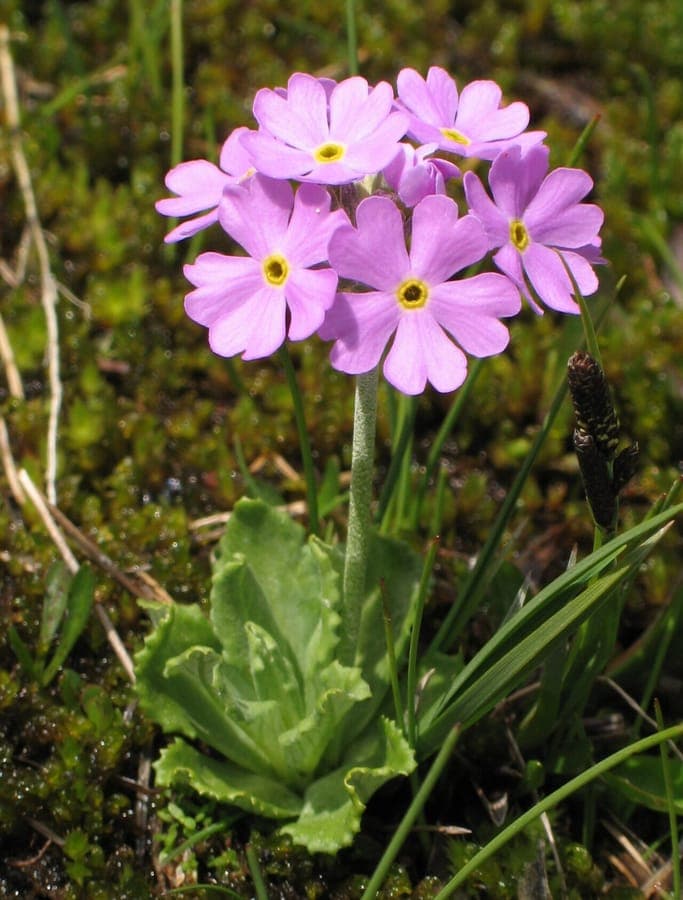
Robert Flogaus-Faust / CC BY 4.0, via Wikimedia Commons
Bird-eye primrose: complete guide
Primula farinosa
Want to see Bird-eye primrose: complete guide in your garden?
1 minute, no credit card
Overview
Primula farinosa, commonly known as the Bird-eye primrose, is a charming perennial that thrives in cool, moist conditions across Europe and parts of Asia. Native to regions including the Baltic States, Austria, and parts of Russia, this delicate plant reaches 10–15 cm in height and forms tight rosettes of narrow, mealy-textured leaves. It's a standout in rock gardens or woodland edges, blooming reliably from May through August with vibrant purple flowers that contrast beautifully against its silvery foliage.
On gardenworld.app, you can design a garden layout that highlights the natural beauty of Primula farinosa, matching it with compatible soil and light conditions.
Appearance & bloom cycle
The Bird-eye primrose features oblong, slightly hairy leaves arranged in a basal rosette. A fine, powdery coating (farinose bloom) gives the leaves a pale, almost dusty appearance-hence the species name 'farinosa'. Flower stems rise 10–15 cm above the foliage, each carrying 3–6 small, five-petaled flowers. The petals are deep violet to lilac with a bright yellow eye, creating a striking 'bird-eye' effect.
Blooming begins in late May, peaks in June and July, and can extend into August in cooler, wetter summers. Each flower lasts about 7–10 days, and deadheading encourages a cleaner look, though it won't significantly prolong blooming.
This plant is a magnet for early pollinators, especially small bumblebees and solitary bees, making it a valuable addition to wildlife-friendly gardens.
Ideal location
Primula farinosa needs at least 8 hours of light per day (on a scale of 1-10, this is an 8), but prefers dappled or partial shade, especially in warmer climates. Full morning sun with afternoon shade works best. Avoid hot, south-facing exposures unless the soil stays consistently moist.
In USDA zones 4–7, it performs well under deciduous shrubs or at the edge of shaded rock walls. In hotter zones (8+), provide more shade and increase mulch to retain moisture. On gardenworld.app, you can simulate sun patterns in your garden to find the perfect spot for this primrose.
Soil requirements
This species demands alkaline soil with a pH between 7.5 and 8.0. It thrives in calcareous, humus-rich substrates that are moist but well-drained. Heavy clay or acidic soils will cause poor growth or rot.
To improve conditions, amend the soil with crushed limestone, leaf mold, and fine grit. A raised bed or rock garden crevice filled with this mix provides ideal drainage and pH balance.
Free design
Want to see Bird-eye primrose: complete guide in your garden? Make a free design now.
Watering
Keep the soil evenly moist, especially during spring growth and flowering. Water deeply once or twice a week during dry spells. Avoid overhead watering if possible to prevent fungal issues on the mealy leaves.
Mulch lightly with leaf litter or fine bark to conserve moisture, but don't bury the crown. In summer, reduce watering as the plant enters dormancy, but never let the root zone dry out completely.
Pruning
No formal pruning is needed. Simply remove spent flower stalks after blooming to maintain a tidy appearance. Use clean, sharp snips and cut close to the base. In autumn, leave old foliage in place to protect the crown over winter.
In early spring, gently clear any matted or diseased leaves before new growth emerges.
Maintenance calendar
- Jan: Check for frost heave in exposed areas.
- Feb: No action required.
- Mar: Clear old leaves, inspect for pests.
- Apr: Begin regular watering, apply a thin layer of compost.
- May: Flowers emerge; ensure consistent moisture.
- Jun: Peak bloom; watch for slugs and snails.
- Jul: Deadhead if desired; maintain moisture in dry weather.
- Aug: Bloom tapers off; reduce watering gradually.
- Sep: Allow plant to rest; no feeding.
- Oct: Leave leaf litter as natural mulch.
- Nov: Ensure good drainage before winter rains.
- Dec: Minimal care; protect from ice crusts.
Winter hardiness
Primula farinosa is reliably hardy in USDA zones 4–7. It tolerates temperatures down to -34°C when planted in well-drained soil. In colder zones, a light mulch of straw or pine needles helps prevent frost heave, but avoid smothering the crown.
In areas with heavy snow, the plant usually survives well under the insulating layer. In wet winters, ensure the planting site doesn't become waterlogged.
Companion plants
Pair Bird-eye primrose with other alpine or rock garden species like Aubrieta, Thyme, or Saxifraga oppositifolia. It also complements ferns, small sedges (Carex), and early woodland perennials like Hepatica or Epimedium.
Avoid aggressive spreaders such as mint or goutweed, which can overwhelm its slow growth.
Closing
The Bird-eye primrose is a subtle yet rewarding plant for gardeners who appreciate understated elegance. With its cool-season bloom, pollinator appeal, and unique foliage, it adds depth to shaded crevices and borders. It's not commonly found in mainstream garden centres, but specialty nurseries and alpine plant suppliers often carry it.
Look for it at garden centres in spring, or order online. On gardenworld.app, you can explore planting combinations and design a garden that brings out the best in Primula farinosa's delicate form and color.
Want to see Bird-eye primrose: complete guide in your garden? Make a free design now.
Upload a photo, pick a style, and get a photorealistic design with plant list in under a minute.
No credit card required


Similar plants
Primula incana: complete guide to silvery alpine primrose
Primula incana
Silvery primrose (Primula incana), a delicate alpine flower with white blooms and powdered grey-green leaves. Growing, care, and cultivation guide.
Mealy cowslip: complete guide
Primula pulverulenta
Grow the Mealy cowslip (Primula pulverulenta): striking candelabra flowers in red and purple tones, moisture-loving and ideal for shady, damp garden corners.
Cliff dwarf-primrose: complete guide
Androsace laevigata
Full guide to growing Androsace laevigata, a rare Pacific Northwest alpine cushion plant. Planting, care, and garden design tips explained.