
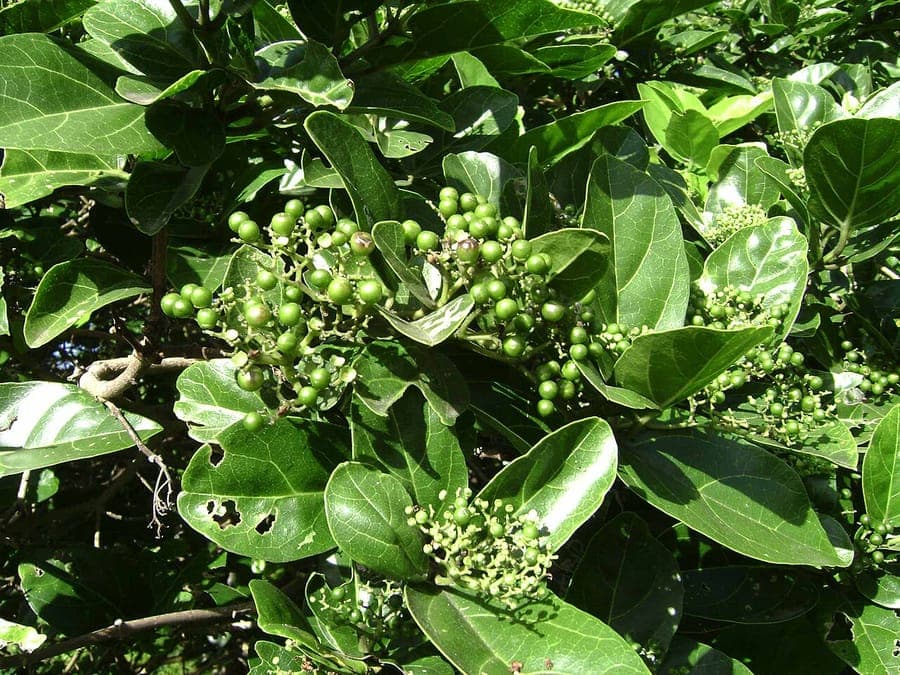
Tauʻolunga / CC BY-SA 3.0, via Wikimedia Commons
Premna serratifolia: complete guide
Premna serratifolia
Want to see Premna serratifolia: complete guide in your garden?
1 minute, no credit card
Overview
Premna serratifolia, better known as Bastard Guelder-rose or "Dancing Flowerpot" in some cultures, is an attractive, semi-deciduous tropical shrub native to East Africa, the Indian Ocean, and tropical Asia to the Pacific. This species grows naturally in warm, humid climates and adapts to diverse habitats from coasts to mountain forests.
In Dutch gardens, Premna serratifolia is best grown in a heated greenhouse or warm conservatory. With its characteristic serrated foliage, interesting stem structure, and white flowers, this plant offers exotic allure and tropical texture.
Appearance & bloom
Premna serratifolia is an attractive, upright-growing shrub that can reach 2-4 meters tall under optimal conditions. The leaves are particularly characteristic: they are elliptical, serrated (strongly toothed at the margins), giving the plant an elegant, almost geometric appearance.
The rough bark is dark and interestingly textured, especially on older stems. The flowers are small, white to light purplish, and appear in broad, flat flower clusters (panicles). They bloom mostly in summer and autumn, but can remain active longer under favorable greenhouse conditions.
After flowering, small, dark-colored fruits form that attract birds. Thus the plant has both flower beauty and interesting structure year-round.
Ideal location
Premna serratifolia grows best in warm, lightly shaded to full sun spots. In a greenhouse or conservatory, it can be quite sunny as long as temperatures remain warm (18-25 C). Overheating can be problematic if air circulation is insufficient.
Provide well-ventilated space. The plant appreciates fresh air and can suffer diseases in stagnant, hot greenhouse air. Partial shade is also acceptable and prevents possible leaf burn in extremely hot conditions.
Support the plant with stakes or framework, as it can grow somewhat straggly without support.
Soil
Premna serratifolia grows in rich, well-drained greenhouse soil. A mixture of humus-rich potting soil, perlite, and some sand is ideal. Good drainage is critical, as waterlogging leads to root rot.
The plant does well in slightly acidic to neutral soil (pH 6-7). Heavy, water-retaining soils should be avoided. Repotting is best done each spring in a slightly larger pot.
And adequate drainage hole in the pot is essential.
Free design
Want to see Premna serratifolia: complete guide in your garden? Make a free design now.
Watering
During the growing season (spring-summer), Premna serratifolia should be watered regularly. Ensure the top centimeter stays moist, but not soggy. Summer temperatures and higher evaporation demand more frequent watering.
In autumn and winter, watering should be gradually reduced as temperature drops. The plant can be somewhat drier, but the soil should never completely dry out.
Use lukewarm water. Cold water can shock the plant, especially when greenhouse temperature is high.
Pruning
Premna serratifolia responds well to pruning. In spring, you can give it vigorous pruning - up to 1/3 or even half of the original volume can be cut back. This stimulates branching and ensures fuller habit.
Remove dead or weakened shoots year-round. Supported growth can also be encouraged by pinching tips to encourage branching.
Cut branches can be used for cuttings, which usually root well in warm, humid greenhouse conditions.
Maintenance calendar
Spring (March-May): Increase watering as greenhouse temperature rises. Begin monthly feeding (half strength). Pruning and repotting. Take cuttings.
Summer (June-August): Regular watering. Monitor for insect pests (mealybugs, spider mites) in warm, dry conditions. Continue feeding. Ensure adequate ventilation.
Autumn (September-October): Gradually reduce feeding. Adjust watering to lower temperatures.
Winter (December-February): Minimal feeding and watering. Keep greenhouse temperature around 15 C. Ensure daily air exchange.
Winter hardiness
Premna serratifolia is absolutely not winter hardy in the Netherlands. This tropical plant dies when temperatures drop below 10 C. Therefore, ensure greenhouse temperature does not drop below 15 C, ideally 18-25 C.
Young plants can be especially sensitive to temperature drops. Ensure overwintering plants are on a warm spot in the greenhouse, far from cold windows.
Companion plants
Premna serratifolia can grow beautifully alongside other tropical plants in a greenhouse: Manihot, Passiflora, or other warm-dependent species. Ensure other plants have similar warmth and humidity requirements.
Low growers can be used as understory, as long as they don't fall in Premna's shade.
Closing
Premna serratifolia is a fascinating and exotic project for greenhouse enthusiasts. This tropical shrub offers interesting foliage, flower, and stem structure. With regular pruning, warmth, and humidity management, you can enjoy this fascinating Asian shrub for years.
Specialized plant greenhouses or tropical nurseries supply young plants. For more inspiration, visit gardenworld.app.
Want to see Premna serratifolia: complete guide in your garden? Make a free design now.
Upload a photo, pick a style, and get a photorealistic design with plant list in under a minute.
No credit card required


Similar plants
Apple mint (Mentha x villosa): complete guide
Mentha x villosa
Meet apple mint (Mentha x villosa): a fruity-scented kitchen herb with woolly leaves, perfect for tea and mojitos.
Salvia peyronii: complete guide
Salvia peyronii
Discover Salvia peyronii, a rare Lebanese mountain sage. Growing tips, hardiness, and companion planting for a Mediterranean gravel garden.
Bigleaf mint (Mentha x rotundifolia): complete guide
Mentha x rotundifolia
Discover bigleaf mint: cultivation, care tips, and garden uses. Learn how to grow this aromatic herb with soft, hairy leaves.