
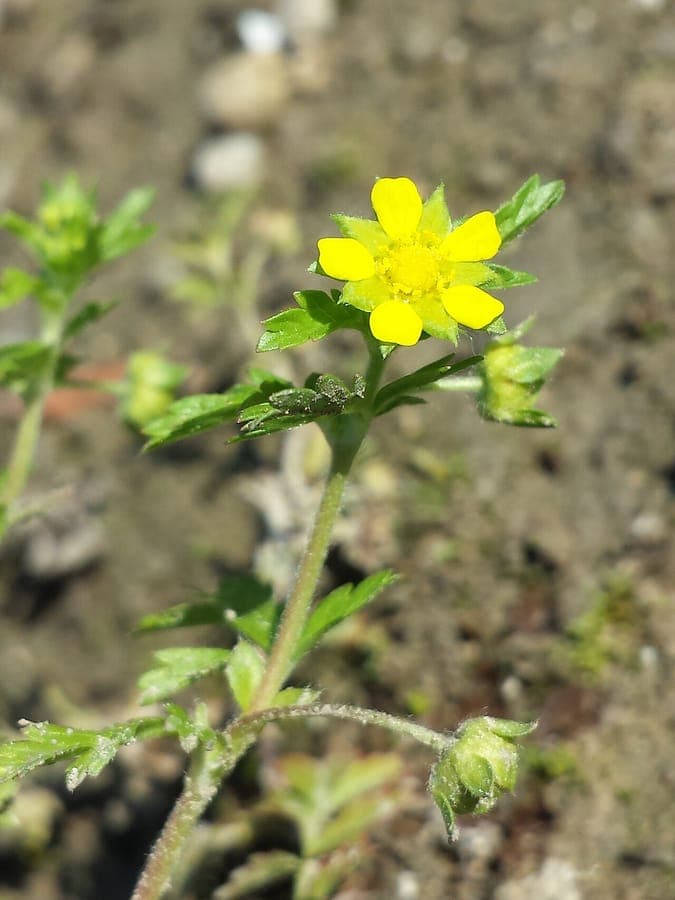
Stefan.lefnaer / CC BY-SA 4.0, via Wikimedia Commons
Bushy cinquefoil: complete guide
Potentilla supina
Want to see Bushy cinquefoil: complete guide in your garden?
1 minute, no credit card
Overview
Bushy cinquefoil (Potentilla supina) is a rugged, low-growing perennial that thrives in sunny, dry spots where other plants struggle. A member of the rose family (Rosaceae), it's known for its fern-like leaves and cheerful, butter-yellow flowers that bloom from early summer into autumn. Native to regions stretching from Eastern Europe to Central Asia, this plant has adapted to poor soils and harsh climates, making it a solid choice for modern, low-input gardens.
Growing as a subshrub or herbaceous perennial, Potentilla supina reaches 10–25 cm in height and spreads 30–40 cm wide. It forms a loose, spreading mat, with stems that trail along the ground or climb slightly over nearby rocks or low plants. It's hardy in USDA zones 4–8, surviving winter lows down to -34°C, which covers most of the UK, US, and central Europe.
On gardenworld.app, you can design a planting scheme that takes full advantage of bushy cinquefoil's spreading habit, ensuring it has room to creep without overcrowding.
Appearance & bloom cycle
The foliage is one of its standout features: pinnate leaves divided into 5–7 narrow, grey-green leaflets with serrated edges. They're soft to the touch and create a fine-textured backdrop that contrasts well with bolder plants. Stems are slender and often reddish-brown, lying close to the soil.
From June through September, the plant produces hundreds of small, five-petaled flowers. Each bloom is about 1–1.5 cm across, bright yellow, and held just above the foliage. The flowering period is impressively long, especially if you deadhead or trim after the first flush. Even without pruning, it reblooms sporadically through late summer. Seed heads are small and inconspicuous, but they provide winter interest and food for finches and small birds.
Ideal location
This plant demands sun - aim for 6 to 8 hours of direct light daily (rated 8/10 for light needs). In partial shade, it becomes leggy and loses its compact shape. Full sun encourages dense growth and maximum flowering.
Best planted in south- or west-facing slopes, rock gardens, dry borders, or along gravel paths. It's excellent for stabilising light slopes or filling gaps between stepping stones. Avoid damp, shady corners under trees or near downspouts, where competition and poor drainage will weaken it.
Soil requirements
Bushy cinquefoil isn't fussy about soil type. It grows well in sandy, loamy, or even clay soils as long as drainage is good. The ideal pH range is 6.5 to 7.0 - slightly acidic to neutral. In highly acidic soils (below 6.0), a light application of garden lime in autumn can help, but it's rarely needed.
Don't enrich the soil with compost or manure. Potentilla supina performs best in lean conditions. Over-fertilising leads to floppy growth and fewer flowers. If planting in heavy clay, mix in grit or coarse sand to improve drainage.
Watering
Once established, this plant is highly drought-tolerant. Young plants in their first season need regular watering - about once a week during dry spells. Water at the base to keep foliage dry and reduce fungal risk.
In summer, mature plants rarely need supplemental watering unless facing prolonged drought (3+ weeks without rain). When you do water, give a deep soak rather than frequent sprinkles. Rainwater is preferred - the plant can be sensitive to high levels of chlorine or lime in tap water.
Free design
Want to see Bushy cinquefoil: complete guide in your garden? Make a free design now.
Pruning
Pruning extends the bloom season and keeps the plant tidy. After the main flowering peak in early July, cut back the stems by about one-third. Use sharp secateurs and cut just above a leaf node. This encourages a second flush of flowers in late summer.
In early spring (late March to early April), remove any dead or damaged stems. Avoid hard pruning in autumn, as it can expose the crown to winter rot. For older plants, a light rejuvenation cut every 3–4 years helps prevent woody, bare centres.
Maintenance calendar
- January: Check for heaved plants after frost. No action needed.
- February: Clear debris from crowns. Keep mulch light.
- March: Remove old stems. No feeding.
- April: New growth emerges. Light cultivation around base.
- May: Prepare for blooming. Watch for aphids.
- June: Main flowering begins. Water if dry.
- July: Trim after first bloom. Deadhead spent flowers.
- August: Second flowering phase. Monitor for pests.
- September: Final blooms. Stop fertilising.
- October: Leave seed heads for birds. No pruning.
- November: Remove broken stems. Avoid wet mulch.
- December: Observe winter structure.
Winter hardiness
Hardy to USDA zone 4, bushy cinquefoil reliably survives cold winters. Top growth may die back, but the root system remains intact. In wet winters, especially in poorly drained clay, root rot can occur. A light mulch of dry leaves or straw helps in colder zones, but avoid piling it against the crown.
The plant often retains its low, woody stems through winter, which protect new shoots in spring. Avoid walking on frozen mats - they're fragile when icy.
Companion plants
Pair bushy cinquefoil with other drought-tolerant, sun-loving perennials. Good matches include creeping thyme (Thymus serpyllum), sedums like 'Autumn Joy', and catmint (Nepeta faassenii). In rock gardens, it complements dwarf irises or Helianthemum.
Avoid aggressive spreaders like mint or ivy, which will overwhelm it. Instead, plant alongside slower companions such as ornamental grasses (Festuca ovina) or yarrow (Achillea millefolium).
Use the garden planner on gardenworld.app to test spacing and light overlap with companion plants, ensuring healthy growth for all.
Closing
Bushy cinquefoil is a quiet achiever in the garden - unassuming but reliable. It asks for little and gives back months of bloom, texture, and habitat for pollinators. With minimal care, it forms a durable ground cover that suppresses weeds and thrives in tough spots. Buy it in spring or early autumn from garden centres like B&Q, Wyevale, or local independents. Confirm the label says Potentilla supina, not the more upright P. erecta or P. fruticosa.
Plant in sun, skip the fertiliser, and give it space to spread. Trim lightly in summer, and you'll enjoy golden flowers well into autumn. For gardeners seeking resilience and simplicity, this plant delivers.
Want to see Bushy cinquefoil: complete guide in your garden? Make a free design now.
Upload a photo, pick a style, and get a photorealistic design with plant list in under a minute.
No credit card required


Similar plants
Siberian crab apple: complete guide
Malus x robusta
Complete guide to the Siberian crab apple (Malus x robusta): location, soil, pruning, winter hardiness and the best companion plants for your garden.
Chinese flowering crabapple (Malus x spectabilis): complete guide
Malus x spectabilis
Meet the Chinese flowering crabapple (Malus x spectabilis): a classic spring bloomer with carmine buds and pink blossom.
Potentilla crassinervia: complete guide
Potentilla crassinervia
Potentilla crassinervia, the Corsican cinquefoil, grows wild on Corsica and Sardinia's peaks. Discover how to grow this hardy alpine rock garden gem.