
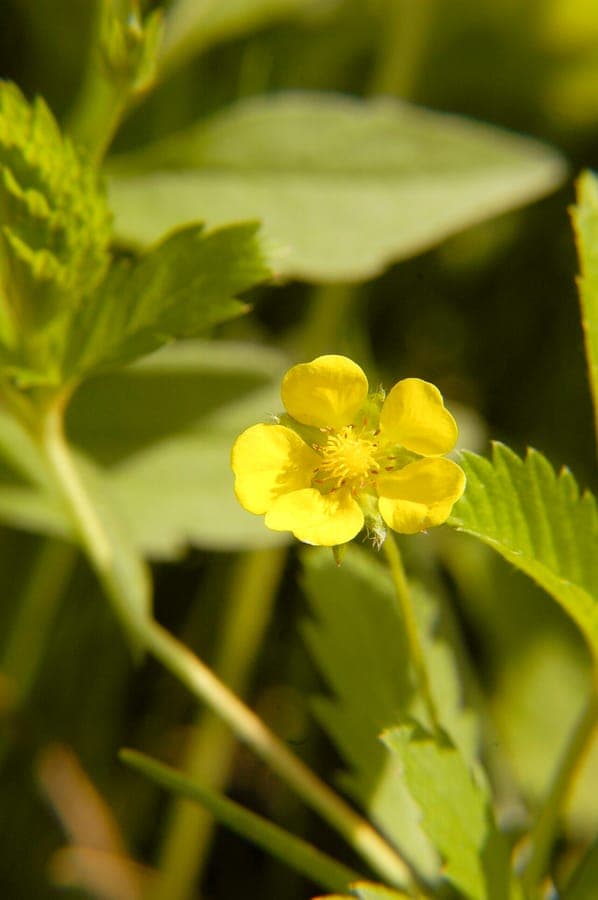
Frank Mayfield / CC BY-SA 2.0, via Wikimedia Commons
Potentilla simplex: complete guide
Potentilla simplex
Want to see Potentilla simplex: complete guide in your garden?
1 minute, no credit card
Potentilla simplex, known as old-field cinquefoil or simple cinquefoil, is a North American native groundcover that spreads widely from Canada to Texas. This excellent groundcover grows under diverse conditions, including shady and dry areas, making it very versatile.
Overview
Potentilla simplex grows endemically from Canada (Quebec and Ontario) to the central-eastern states of the USA, with distribution to Texas. The plant grows in open fields, along roadsides, on mountain slopes, and in forest edges. It is highly adaptable to diverse soil types and climate conditions. The plant grows from underground runners (stolons) and spreads slowly but consistently.
The plant reaches 10 to 25 centimeters in height and forms a dense matrix of foliage and flowers. It is excellent for erosion control and as groundcover in difficult conditions.
Appearance and Bloom
Potentilla simplex grows as a low rosette of compound leaves. Each leaf consists of five (sometimes seven) leaflets, each about 0.5 to 2 centimeters long. The leaves are green with fine hairs. In autumn, leaves can take on red to purple tinges.
Flowers appear from May to July, depending on climate zone. The flowers are small, about 5 to 8 millimeters diameter, and bright yellow. They arise singly or in small clusters at the end of thin, upright stems. The flowering is extended and prolific. After blooming, plants produce small achene fruits.
Ideal Location
Potentilla simplex thrives in open sun (at least 4 to 6 hours of daily sunlight), but since it is more shade-tolerant than many other Potentilla species, it can tolerate partial shade. In dense shade, growth may be poor.
The plant grows in numerous locations: borders, pathways, rock gardens, and slopes. It is robust for roads, parking lots, and other hardscaped areas where many plants fail. It can even grow under trees.
Free design
Want to see Potentilla simplex: complete guide in your garden? Make a free design now.
Soil and Nutrition
Potentilla simplex is very tolerant of soil types. Sand, clay, loam, and even poor soil - it grows anywhere. pH can range from acidic to alkaline. The plant requires no special nutrition.
Waterlogging is the main enemy, so drainage must be good, but it can also tolerate drought. This makes it ideal for difficult locations.
Watering
Once established, Potentilla simplex is very drought-tolerant. Minimal watering is needed. Regular moderate watering can stimulate growth during first season, but thereafter watering can be significantly reduced.
Overwatering can lead to root rot, so water sparingly. The plant also tolerates semi-dry conditions well.
Pruning and Shaping
Potentilla simplex requires minimal pruning. The plant grows compactly and usually requires no pruning. Light pruning after flowering (August-September) can improve shape if desired. Dead leaves can be removed.
If the plant grows out of bounds, runners can carefully be cut or kept under control.
Maintenance Calendar
March-April: Plant begins to emerge from winter dormancy. Minimal watering needed. May-June: Flowering begins. June-July: Flowering peaks. August-September: Light prune after bloom if desired. October-February: Winter dormancy, minimal care.
Winter Hardiness
Potentilla simplex is very cold-hardy to USDA zone 3 (-40 degrees Celsius). It survives harsh winters without protection. In very warm climates (zone 9-10), it may suffer from heat; shade can help.
Conclusion
Potentilla simplex is a reliable, low-maintenance groundcover that performs excellently in difficult conditions. It deserves more attention from gardeners looking to introduce native North American plants. For GardenWorld users with dry, shady, or problematic locations, this is an excellent choice.
Want to see Potentilla simplex: complete guide in your garden? Make a free design now.
Upload a photo, pick a style, and get a photorealistic design with plant list in under a minute.
No credit card required


Similar plants
Siberian crab apple: complete guide
Malus x robusta
Complete guide to the Siberian crab apple (Malus x robusta): location, soil, pruning, winter hardiness and the best companion plants for your garden.
Chinese flowering crabapple (Malus x spectabilis): complete guide
Malus x spectabilis
Meet the Chinese flowering crabapple (Malus x spectabilis): a classic spring bloomer with carmine buds and pink blossom.
Potentilla crassinervia: complete guide
Potentilla crassinervia
Potentilla crassinervia, the Corsican cinquefoil, grows wild on Corsica and Sardinia's peaks. Discover how to grow this hardy alpine rock garden gem.