
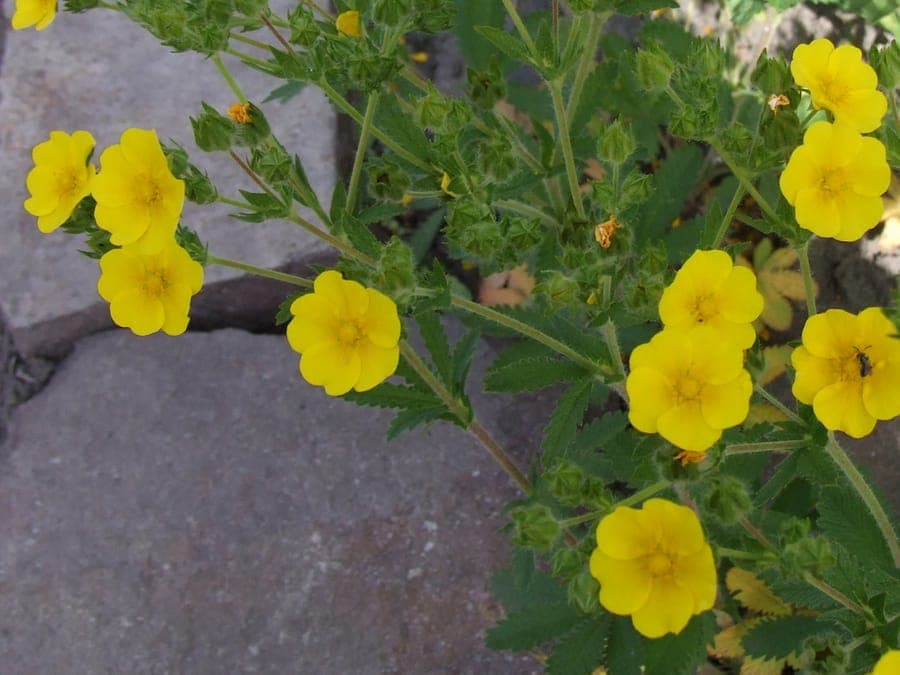
Jerzy Opioła / CC BY-SA 4.0, via Wikimedia Commons
Sulphur cinquefoil: complete guide
Potentilla recta
Want to see Sulphur cinquefoil: complete guide in your garden?
1 minute, no credit card
Overview
Sulphur cinquefoil, or Potentilla recta, is a hardy perennial that thrives in dry, sunny spots. Native to southern Europe and parts of eastern Russia, it's adapted to poor soils and intense sun. This upright herb grows 30 to 60 cm tall and spreads about 30 cm wide. It's not invasive in most garden settings, but it does establish well once settled, especially in tough conditions where other plants struggle.
On gardenworld.app, you can design a drought-resistant border that highlights Sulphur cinquefoil's bright yellow blooms and long flowering season.
Appearance & bloom cycle
This plant produces cheerful, five-petaled yellow flowers, each about 2 cm across. Blooming runs from May through July, peaking in early summer. The upright stems are slender and covered in palmate leaves with a silvery underside, giving the foliage a soft, textured look. Each flower has a dense cluster of stamens in the center, attracting bees and hoverflies.
After flowering, seed heads form but rarely self-sow aggressively in cultivated gardens. The plant stays mostly in place, making it predictable and manageable in mixed borders. Deadheading encourages a slight rebloom in late summer, especially in cooler regions.
Ideal location
Sulphur cinquefoil needs full sun - think 8 to 10 hours of direct light daily. With a light score of 9, it won't perform well in shade. It excels in hot, dry areas: rocky slopes, gravel gardens, or sunny borders. It's a good choice for urban gardens with heat-reflecting walls or paved areas.
Avoid planting it in dense shade or under tree canopies. Use it in naturalistic designs, alongside grasses or other drought-tolerant perennials. It looks great in cottage-style gardens, especially when paired with airy textures.
Soil requirements
This plant isn't fussy about soil type. It grows in sandy, loamy, or clay soils as long as drainage is good. The ideal pH is between 6.5 and 7.0 - slightly acidic to neutral. Avoid waterlogged or compacted ground, which can lead to root rot.
Don't enrich the soil with compost or manure. Rich soil leads to leggy growth and fewer flowers. Poorer soil actually improves blooming and keeps the plant compact. If your soil is heavy clay, amend the planting hole with grit or coarse sand to improve drainage.
Free design
Want to see Sulphur cinquefoil: complete guide in your garden? Make a free design now.
Watering
Once established, Sulphur cinquefoil is very drought-tolerant. During the first growing season, water weekly to help roots settle. After that, it survives on rainfall alone in most climates. In prolonged dry spells, a deep soak every two to three weeks is enough.
Always water at the base to avoid wetting the foliage, which can encourage fungal issues. Let the soil dry out between waterings - this plant prefers dry feet over damp ones.
Pruning
Pruning is minimal. After the main flowering flush in July, cut back spent stems to just above a leaf node. This tidy-up can promote a second, lighter bloom in August. In late autumn or early spring, trim the whole plant to 5–10 cm above ground to make room for new growth.
You can leave the stems over winter for visual interest and to shelter overwintering insects. Just cut them back before new shoots emerge in spring.
Maintenance calendar
- Jan: Dormant; no action needed unless snow load damages stems.
- Feb: Check for heaving in frost-prone areas; gently replant if needed.
- Mar: Remove old foliage if not done in fall; prepare soil.
- Apr: New growth appears; apply light mulch if desired.
- May: First blooms; monitor for dry spells.
- Jun: Peak bloom; deadhead to encourage rebloom.
- Jul: Flowering continues; second trim optional.
- Aug: Possible late blooms; no feeding.
- Sep: Foliage fades; reduce watering.
- Oct: Cut back or leave for winter interest.
- Nov: Mulch lightly in colder zones (below USDA 5).
- Dec: Dormant; avoid wet soil.
Winter hardiness
Sulphur cinquefoil is hardy in USDA zones 4 to 8. It handles cold winters well, dying back to the crown and re-emerging in spring. In zone 4, a light mulch helps prevent frost heave. In wetter climates, ensure good drainage to avoid crown rot during freeze-thaw cycles.
Companion plants
Pair it with plants that share its sun and soil needs. Try it with Salvia nemorosa, Echinacea purpurea, or ornamental grasses like Sporobolus heterolepis. It contrasts beautifully with dark-leaved Heuchera or blue-flowering Nepeta. Avoid moisture-loving plants like hostas or astilbes.
On gardenworld.app, you can build custom planting schemes that match Sulphur cinquefoil with ideal companions, including height, color, and bloom time coordination.
Closing
Sulphur cinquefoil is a no-fuss perennial that delivers bright color and resilience in sunny gardens. It needs little water, no fertilizer, and handles heat like a pro. Look for it at garden centres like B&Q, Wyevale, or local independents during spring planting season. Just give it sun, lean soil, and space to breathe - and it'll reward you for years.
Want to see Sulphur cinquefoil: complete guide in your garden? Make a free design now.
Upload a photo, pick a style, and get a photorealistic design with plant list in under a minute.
No credit card required


Similar plants
Siberian crab apple: complete guide
Malus x robusta
Complete guide to the Siberian crab apple (Malus x robusta): location, soil, pruning, winter hardiness and the best companion plants for your garden.
Chinese flowering crabapple (Malus x spectabilis): complete guide
Malus x spectabilis
Meet the Chinese flowering crabapple (Malus x spectabilis): a classic spring bloomer with carmine buds and pink blossom.
Potentilla crassinervia: complete guide
Potentilla crassinervia
Potentilla crassinervia, the Corsican cinquefoil, grows wild on Corsica and Sardinia's peaks. Discover how to grow this hardy alpine rock garden gem.