
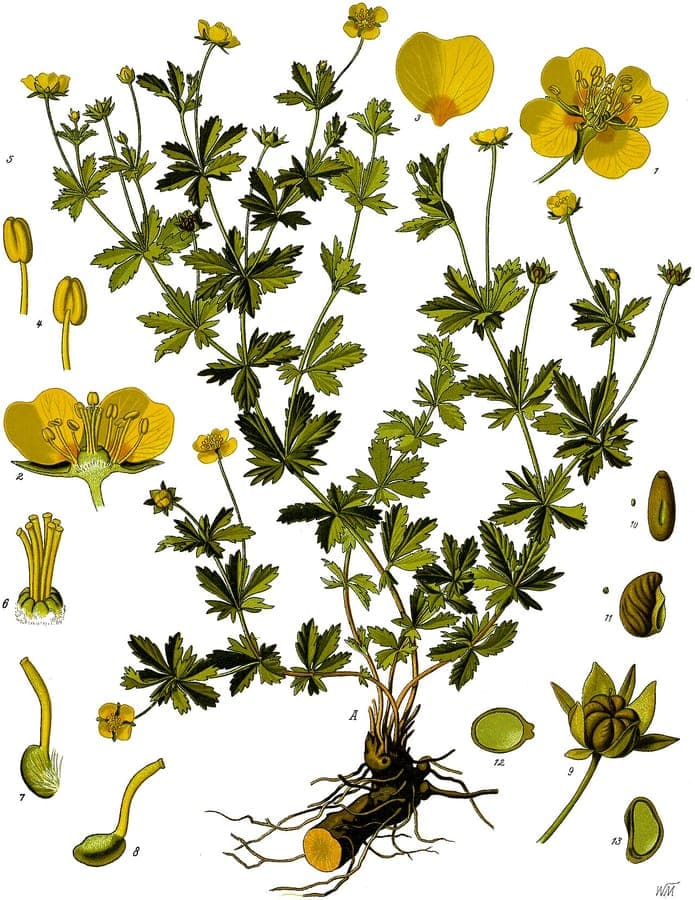
Franz Eugen Köhler, Köhler's Medizinal-Pflanzen / Public domain, via Wikimedia Commons
Cinquefoil: complete guide
Potentilla erecta
Want to see Cinquefoil: complete guide in your garden?
1 minute, no credit card
Overview
Potentilla erecta, commonly known as Cinquefoil, is a resilient little herb that often flies under the radar in wild meadows and woodland clearings. Despite its modest appearance, it's a valuable plant for naturalistic garden designs. A member of the Rosaceae family, this native European species thrives in acidic, moist soils and is perfectly adapted to low-fertility environments. In the UK and northern Europe, it's frequently found in heaths, forest edges, and along footpaths where soil is thin and slightly damp.
Cinquefoil is not a flashy plant, but it offers quiet charm and ecological benefits. It's perfect for gardeners who appreciate subtle beauty and want to support native biodiversity. On gardenworld.app, you can design a planting scheme that integrates Cinquefoil into a woodland edge or gravel garden, where its low profile and yellow blooms add texture without dominating.
Appearance & bloom cycle
Cinquefoil is a slender, upright herb growing 10–25 cm tall. The stems are square in cross-section and often reddish at the base. Leaves are palmately divided with 3–5 toothed, lance-shaped leaflets. What really sets this plant apart is its flower: unlike most members of the rose family, which have five petals, Potentilla erecta typically has four bright yellow petals, each about 1–1.5 cm across.
Flowering occurs from June to late August, peaking in midsummer. The flowers appear singly at the stem tips and attract small pollinators like hoverflies and native bees. After blooming, the plant sets small, dry fruits but doesn't self-seed aggressively, making it easy to manage.
Ideal location
Cinquefoil performs best in partial shade to full sun, rated at light level 6 (where 1 is deep shade and 10 is full sun). In full sun, it needs consistent moisture; in deep shade, it may become leggy and bloom poorly. A spot with dappled light - under open-canopy trees or at the edge of a shrub border - is ideal.
This plant is excellent for naturalistic planting schemes, such as wildflower meadows, woodland gardens, or rock gardens with acidic substrates. It also works well in gravel beds with good drainage. On gardenworld.app, you can simulate how Cinquefoil fits into a mixed border with ferns, heathers, and shade-tolerant grasses.
Soil requirements
Cinquefoil needs acidic soil with a pH between 5.0 and 5.5. It prefers light, sandy loams or humus-rich forest soils that drain well but retain some moisture. Avoid chalky or lime-rich soils - they'll cause nutrient deficiencies, especially iron chlorosis.
Do not add lime or alkaline compost. The plant doesn't need rich soil; in fact, overly fertile conditions can encourage competitive weeds or more aggressive plants to outgrow it. A thin layer of leaf mould or pine needles as mulch helps maintain acidity and moisture.
Free design
Want to see Cinquefoil: complete guide in your garden? Make a free design now.
Watering
Once established, Cinquefoil is fairly drought-tolerant in cool climates but benefits from consistent moisture during dry spells, especially in summer. Water deeply but infrequently - about once a week during prolonged dry periods if rainfall is below 25 mm.
Avoid overhead watering to prevent fungal issues. Use soaker hoses or water at the base. In containers, ensure good drainage to prevent waterlogging. Mulching helps reduce evaporation and keeps roots cool.
Pruning
Pruning is minimal. After flowering, you can trim back spent stems to tidy up the plant, but this isn't necessary for health. In late winter or early spring, remove any dead foliage to make room for new growth.
Don't cut back too hard - the plant doesn't form dense crowns like some perennials, and over-pruning can weaken it. A light trim with scissors is all it needs.
Maintenance calendar
- January–February: Dormant period. No action needed.
- March: Remove old leaf litter. Lightly fork in compost if soil is poor.
- April–May: New shoots emerge. Watch for slugs.
- June–August: Peak bloom. Monitor for drought stress.
- September–October: Flowers fade. Leave seed heads for winter interest.
- November–December: Plant dies back. No care required.
Winter hardiness
Cinquefoil is hardy in USDA zones 4–8. It survives harsh winters without protection. The top growth dies back in autumn, but the root system remains alive underground. In areas with heavy frost and freeze-thaw cycles, a light mulch of pine needles or leaf litter helps prevent heaving.
Avoid thick mulches - they can trap moisture and promote rot. In mild climates, the plant may stay semi-evergreen.
Companion plants
Pair Cinquefoil with other acid-loving plants like heather (Calluna vulgaris), wood anemone (Anemone nemorosa), or ferns such as Dryopteris species. It also combines well with grasses like Deschampsia flexuosa or Carex flacca.
Avoid vigorous growers like nettles or tall meadow species that could shade it out. Stick to low, non-competitive companions for best results.
Closing
Cinquefoil is a quiet achiever in the garden - not loud, but reliable, tough, and perfectly suited to low-maintenance, ecologically sound planting. It's a great choice for gardeners aiming for authenticity and sustainability. You can find Potentilla erecta at garden centres across the UK, especially those specialising in native or wild plants. With the right conditions - acidic soil, partial sun, and minimal interference - this little herb will thrive for years. Use gardenworld.app to visualise how it fits into your overall garden plan.
Want to see Cinquefoil: complete guide in your garden? Make a free design now.
Upload a photo, pick a style, and get a photorealistic design with plant list in under a minute.
No credit card required


Similar plants
Siberian crab apple: complete guide
Malus x robusta
Complete guide to the Siberian crab apple (Malus x robusta): location, soil, pruning, winter hardiness and the best companion plants for your garden.
Chinese flowering crabapple (Malus x spectabilis): complete guide
Malus x spectabilis
Meet the Chinese flowering crabapple (Malus x spectabilis): a classic spring bloomer with carmine buds and pink blossom.
Potentilla crassinervia: complete guide
Potentilla crassinervia
Potentilla crassinervia, the Corsican cinquefoil, grows wild on Corsica and Sardinia's peaks. Discover how to grow this hardy alpine rock garden gem.