
Walter Siegmund (talk) / CC BY-SA 3.0, via Wikimedia Commons
Anserina: complete guide
Potentilla anserina
Want to see Anserina: complete guide in your garden?
1 minute, no credit card
Overview
Potentilla anserina, commonly known as Anserina or silverweed, is a creeping perennial that spreads steadily through the garden with minimal effort. A member of the Rosaceae family, it's native across Europe and parts of northern Asia, often found in grassy fields, roadside edges, and open woodland clearings. While some gardeners dismiss it as a weed, when managed thoughtfully, it forms a soft, silvery carpet that stays green well into autumn. It's hardy in USDA zones 3 to 8, making it suitable for a wide range of temperate climates.
Anserina thrives in challenging spots - under shrubs, on slopes, or in areas where lawn grass struggles. On gardenworld.app, you can design a planting scheme that integrates Anserina without letting it overpower neighbouring plants. Its subtle beauty lies in its resilience and ground-hugging habit.
Appearance & bloom cycle
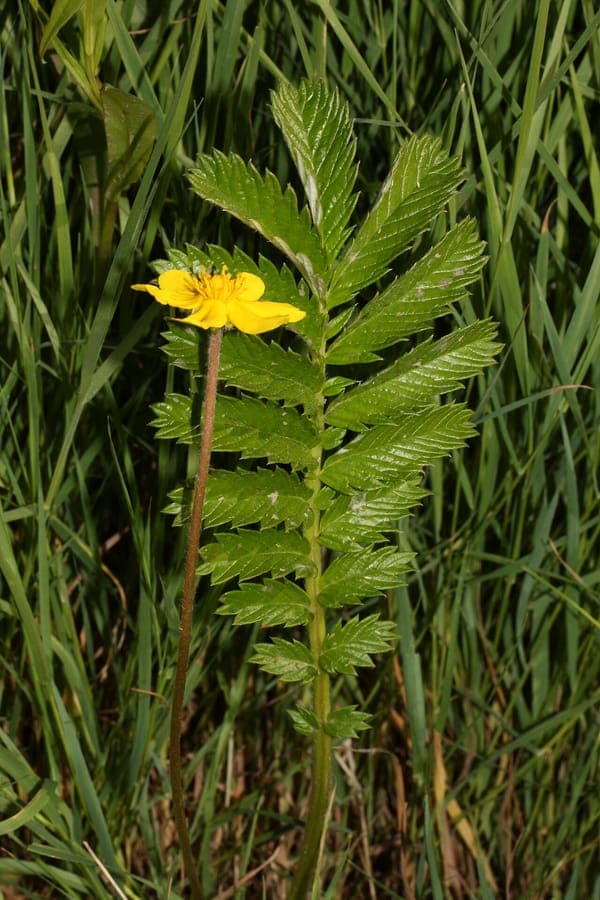
The plant spreads via long, trailing stems that root at the nodes, creating a dense mat up to 10 cm in height. Its leaves are pinnately compound with 5–7 lance-shaped leaflets, and the undersides are covered in fine white hairs, giving them a silvery sheen in sunlight. This feature makes it especially attractive in dry, sunny gardens where light reflects off the foliage.
From June to September, Anserina produces small, bright yellow flowers with five petals, each about 1.5–2 cm wide. The blooms appear singly or in loose clusters and are mildly attractive to bees and hoverflies. While not flashy, they add a cheerful touch to naturalistic plantings. The plant remains evergreen in milder winters, turning slightly bronzed but rarely dying back completely.
Ideal location
Anserina prefers full sun to light shade. It performs best with at least 5–6 hours of direct sunlight daily. In deep shade, growth becomes sparse and leggy, with fewer flowers. Full sun encourages tight, compact growth and maximum blooming.
Because it spreads easily, it's best used in areas where expansion isn't a concern - along footpaths, between stepping stones, or on banks. Avoid planting it near delicate perennials that could be smothered. On gardenworld.app, you can map out zones where creeping plants like Anserina enhance stability without causing chaos.
Soil requirements
This plant is highly adaptable. It grows in sandy, loamy, or even gravelly soils, as long as drainage is adequate. It tolerates poor, low-fertility soils better than rich ones - in fact, overly fertile conditions can lead to excessive spreading. The ideal pH range is slightly acidic to neutral (5.5–7.0), but it handles mildly alkaline soils too.
No fertiliser needed. Adding compost or manure may encourage aggressive growth. Let it thrive in lean conditions to maintain balance.
Free design
Want to see Anserina: complete guide in your garden? Make a free design now.
Watering
Once established, Anserina is drought-tolerant. During the first growing season, water young plants weekly with about 10 litres per square metre during dry spells. After that, rainfall is usually sufficient. In prolonged droughts, the leaves may curl slightly or fade, but recovery is quick once moisture returns.
Avoid overwatering - soggy soil leads to root rot, especially in winter.
Pruning
Pruning isn't usually required. Anserina maintains a neat, low profile on its own. However, if you want to control its spread - say, along a border or near a lawn - you can trim it back in late summer (August) with shears or a mower set to 5 cm. This keeps growth dense and tidy.
Remove runners by hand if they invade unwanted areas. Use the cuttings as mulch or compost, unless diseased.
Maintenance calendar
- January–February: Dormant. No action needed.
- March: Check for runners; trim if necessary.
- April: Clear old foliage. No feeding required.
- May: Monitor for moisture during dry periods.
- June–September: Flowering period. Watch for spreading.
- October: Light trim for neatness, if desired.
- November–December: Dies back slightly; stays mostly green in mild areas.
Winter hardiness
Anserina is extremely cold-hardy (USDA zones 3–8). It withstands temperatures down to -35°C. Foliage often persists through winter, turning bronze but rarely disappearing. No winter protection is needed, even in harsh climates. The main risk is waterlogged soil during freeze-thaw cycles, which can cause root rot. Ensure good drainage to prevent this.
Companion plants
Anserina pairs well with other low-growing, non-invasive plants:
- Thymus serpyllum – adds fragrance and texture
- Ajuga reptans – offers dark green to purple foliage contrast
- Sedum acre – thrives in similar dry, sunny conditions
- Pachysandra terminalis – for shadier spots
Avoid aggressive growers like Glechoma hederacea or dense grasses. Anserina is a modest spreader, so give it space to breathe.
Closing
Anserina isn't a showstopper, but it's a dependable, low-effort ground cover that excels in tough spots. It's perfect for natural gardens, erosion control on slopes, or replacing lawn in hard-to-mow areas. You can find it at garden centres across the UK and North America, often sold as part of native or wildflower mixes. With smart placement and occasional trimming, it delivers years of quiet, silvery charm. Let gardenworld.app help you integrate it seamlessly into your landscape design.
Want to see Anserina: complete guide in your garden? Make a free design now.
Upload a photo, pick a style, and get a photorealistic design with plant list in under a minute.
No credit card required


Similar plants
Siberian crab apple: complete guide
Malus x robusta
Complete guide to the Siberian crab apple (Malus x robusta): location, soil, pruning, winter hardiness and the best companion plants for your garden.
Chinese flowering crabapple (Malus x spectabilis): complete guide
Malus x spectabilis
Meet the Chinese flowering crabapple (Malus x spectabilis): a classic spring bloomer with carmine buds and pink blossom.
Potentilla crassinervia: complete guide
Potentilla crassinervia
Potentilla crassinervia, the Corsican cinquefoil, grows wild on Corsica and Sardinia's peaks. Discover how to grow this hardy alpine rock garden gem.