
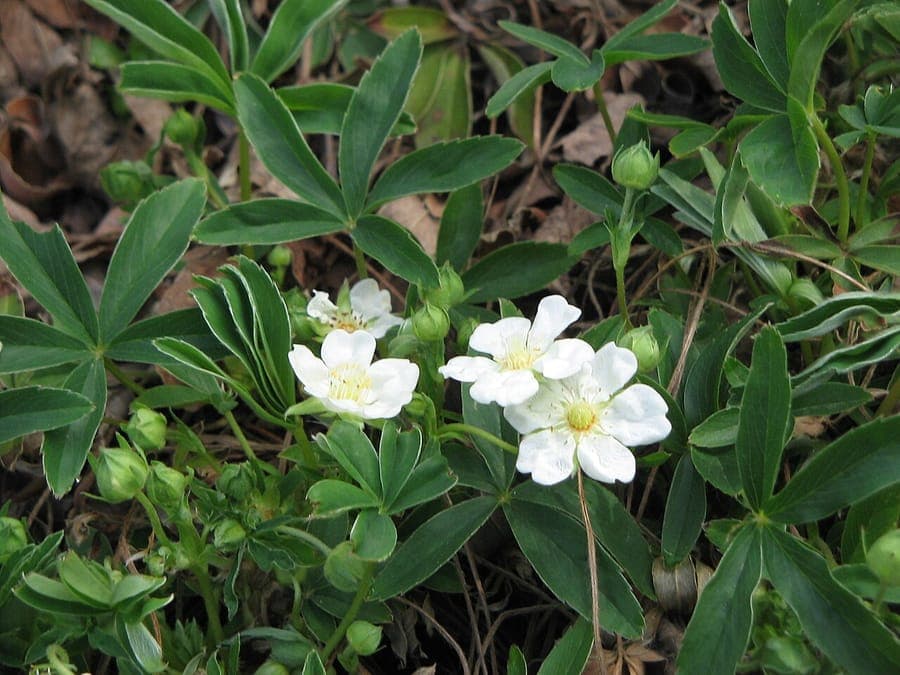
Meneerke bloem / CC BY-SA 3.0, via Wikimedia Commons
White cinquefoil: complete guide
Potentilla alba
Want to see White cinquefoil: complete guide in your garden?
1 minute, no credit card
Overview
Potentilla alba, commonly known as White cinquefoil, isn't the flashiest plant in the border, but it's one of the most reliable. Native to central and eastern Europe - think Austria, Belarus, Hungary, and the Baltic States - it's evolved to thrive in dry, open grasslands and rocky slopes. In the garden, it's a steadfast performer that handles tough conditions with ease, from poor soil to full sun exposure.
This creeping perennial forms a dense mat that suppresses weeds naturally, making it a smart pick for low-effort landscaping. It's not just practical - it's quietly beautiful. From June through August, it's covered in small, white, five-petalled flowers that draw in hoverflies, bees, and small butterflies. If you're mapping out a resilient garden layout, gardenworld.app offers design tools that integrate White cinquefoil into drought-tolerant schemes.
Appearance & bloom cycle
White cinquefoil grows 15–20 cm tall but spreads up to 50 cm wide. The foliage is silvery-green, divided into five finger-like leaflets (hence the German name Fingerkraut), each about 1–2 cm long and slightly hairy. The leaves stay semi-evergreen in mild winters, adding subtle texture when little else is green.
Flowers emerge in early summer - typically late June - and continue blooming through August, sometimes into September if deadheaded. Each blossom is 1.5–2 cm across, pure white with a golden cluster of stamens in the center. The bloom is steady, not explosive, but lasts for weeks without gaps.
Ideal location
Full sun is best. Plant in a spot that gets at least 6 hours of direct sunlight daily. In shade, the plant becomes leggy and flowers poorly. It handles reflected heat well, so it's ideal for gravel gardens, rockeries, or dry banks.
It's also a great alternative to lawn in narrow side yards or under sparse trees where grass struggles. When planning such spaces, gardenworld.app lets you simulate how White cinquefoil fills in over time, helping you avoid overplanting.
Soil requirements
This plant thrives in lean, well-drained soil. Avoid heavy clay or water-retentive beds. Sandy or gravelly loam is ideal. pH tolerance is broad: 5.8 to 7.8 works fine. If your soil is too rich, the plant produces lush foliage but fewer flowers and may flop.
No fertilizer needed - in fact, feeding reduces flowering and increases disease risk. If planting in containers, mix in extra perlite or fine gravel to improve drainage.
Free design
Want to see White cinquefoil: complete guide in your garden? Make a free design now.
Watering
Once established (after 6–8 weeks), White cinquefoil is highly drought-tolerant. In average UK or US conditions, it rarely needs supplemental watering. During extended dry spells - say, three weeks without rain - a deep soak helps prevent stress.
Overwatering is a bigger risk than underwatering. Soggy soil leads to root rot, especially in winter. Water only at the base, and avoid wetting the foliage to reduce fungal issues.
Pruning
Pruning is straightforward. After the main bloom flush in late July or early August, cut the plant back by one-third. Use shears or even a lawnmower set to the highest setting for large patches. This encourages a second, lighter bloom in September and keeps the plant compact.
In early spring, remove any winter-damaged stems or debris. No special technique - just snip or pull out what looks tired. Don't cut into old wood too deeply; new growth comes from the crown and runners.
Maintenance calendar
- March: Clear old foliage, check for pests
- April: Monitor new growth, ensure good air circulation
- May: No action needed
- June–August: Peak bloom, water only in extreme drought
- Late August: Trim back for late-season flowering
- September–October: Let plant die back naturally
- November–February: Leave undisturbed - winter hardy and self-protecting
Winter hardiness
White cinquefoil is hardy in USDA zones 4 to 8. It withstands temperatures down to -30°C without protection. In zone 7 and above, it often remains semi-evergreen. The creeping stems survive under snow or leaf litter, re-sprouting in spring.
No winter care is required. Avoid mulching heavily - this can trap moisture and cause crown rot. Just leave it be.
Companion plants
Pair White cinquefoil with other tough, sun-loving perennials:
- Sedum spurium: red-tinged foliage, late summer bloom
- Thymus vulgaris: drought-tolerant, fragrant, and edible
- Nepeta racemosa: soft purple flowers, long bloom time
- Stachys byzantina: fuzzy silver leaves for contrast
Avoid moisture-loving plants like Astilbe or aggressive spreaders like Bergenia. Keep clear of over-fertile areas where faster growers will outcompete it.
Closing
White cinquefoil won't grab attention like a peony or hydrangea, but it earns its place through reliability. It's ideal for gardeners who want beauty without fuss - a living mulch that flowers for months and asks for almost nothing. You'll find it at garden centres across the UK and US, often near rock garden or groundcover sections.
Its subtle charm works especially well in naturalistic or gravel gardens. And if you're designing such a space, gardenworld.app helps you visualise plant spacing and seasonal changes, ensuring your White cinquefoil has room to spread without crowding out neighbours. Give it sun, lean soil, and a quick trim - and it'll return the favour year after year.
Want to see White cinquefoil: complete guide in your garden? Make a free design now.
Upload a photo, pick a style, and get a photorealistic design with plant list in under a minute.
No credit card required


Similar plants
Siberian crab apple: complete guide
Malus x robusta
Complete guide to the Siberian crab apple (Malus x robusta): location, soil, pruning, winter hardiness and the best companion plants for your garden.
Chinese flowering crabapple (Malus x spectabilis): complete guide
Malus x spectabilis
Meet the Chinese flowering crabapple (Malus x spectabilis): a classic spring bloomer with carmine buds and pink blossom.
Potentilla crassinervia: complete guide
Potentilla crassinervia
Potentilla crassinervia, the Corsican cinquefoil, grows wild on Corsica and Sardinia's peaks. Discover how to grow this hardy alpine rock garden gem.