
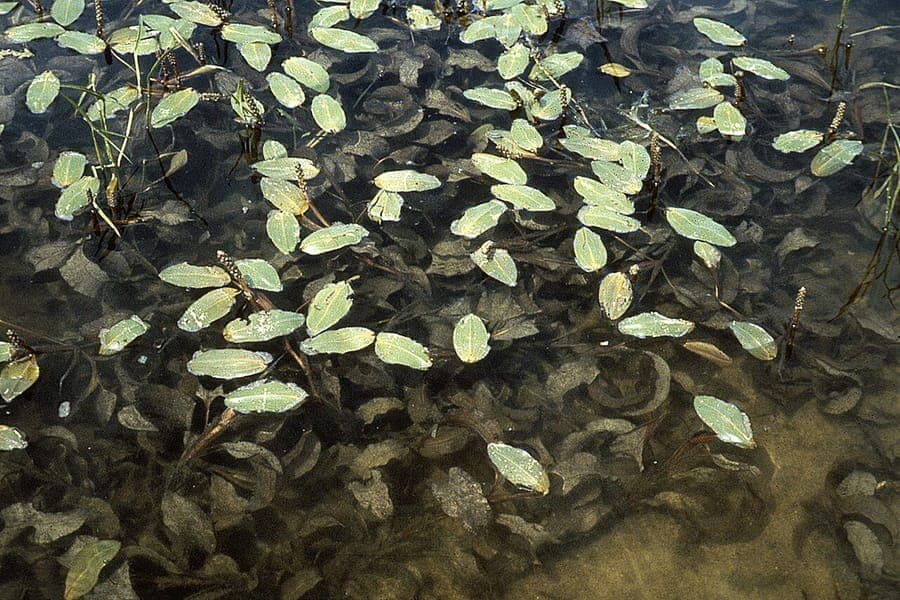
Edward G. Voss. USDA NRCS. 1995. Northeast wetland flora: Field office guide to plant species. Northeast National Technical Center, Chester. Courtesy of USDA NRCS Wetland Science Institute. / Public domain, via Wikimedia Commons
Largeleaf pondweed: complete guide
Potamogeton amplifolius
Want to see Largeleaf pondweed: complete guide in your garden?
1 minute, no credit card
Overview
Potamogeton amplifolius, commonly known as largeleaf pondweed, large-leaved pondweed, or broad-leaved pondweed, is a submerged aquatic perennial belonging to the family Potamogetonaceae. The species was described by Tuckerman in 1848 and is native to a wide range across North America, from Canada through most of the United States and extending into Mexico (Michoacán). The scientific name reflects the plant's most obvious feature: 'amplifolius' translates directly as 'wide-leaved' or 'broad-leaved'.
Largeleaf pondweed inhabits still to slow-moving freshwater environments including lakes, ponds, sluggish streams, and canals. It is one of the larger species in the Potamogeton genus and stands out for its broad, strongly undulating floating leaves that rest on the water surface, paired with long, ribbon-like submerged leaves. This dual leaf form is an elegant adaptation to varying water levels and light conditions.
In pond gardening, Potamogeton amplifolius is valued as a vigorous oxygenator - a plant that produces dissolved oxygen in the water and thereby contributes to good water quality and healthy aquatic life. The plant simultaneously provides shelter and food for fish, frogs, aquatic insects, and waterfowl. In larger ornamental ponds and garden water features, it works excellently as a decorative water plant that also fulfils an important ecological role.
The growth rate of largeleaf pondweed is classified as rapid by botanists: in a single growing season, a well-established plant can produce substantial biomass, shading the water surface to limit algal growth while absorbing dissolved nutrients that would otherwise fuel algae blooms.
Appearance & bloom cycle
Largeleaf pondweed has a distinctive dual leaf form that makes it straightforward to identify. The floating leaves are broad, oval to elliptical, up to 15 cm long and 5 cm wide, with a leathery texture and a glossy dark green upper surface. They are strongly undulating or rippled along the margins, giving them a sculptural, decorative appearance when viewed from above the water surface.
The submerged leaves are entirely different in form: elongated, ribbon-like, strongly coiled or spirally twisted, up to 30 cm long but only a few millimetres wide. These leaves are translucent pale green and create an elegant underwater effect as they drift with gentle water movement. This striking dimorphism between floating and submerged foliage is characteristic of Potamogeton species that produce both leaf types.
The flowers are inconspicuous: small, green spike-like inflorescences that protrude above the water surface on a firm stem 5 to 10 cm long. Flowering occurs primarily from June to August in the plant's native range across North America. Fruits are small, orange-brown drupelets that sink after ripening and become incorporated into the pond substrate. As a rhizomatous perennial with a rapid growth rate, the plant spreads via horizontally growing rhizomes through the pond substrate, with aerial portions dying back in winter and new shoots emerging from the rhizomes in early spring.
Ideal location
Largeleaf pondweed is best suited to water depths of 50 cm to 2 metres below the surface. In very shallow water under 30 cm it performs poorly. In natural lakes, it grows on sandy or loamy substrates at depths of up to 4 to 5 metres where adequate light still penetrates. The species naturally colonises the open water zones of lakes and ponds rather than the shallow marginal zone.
The plant prefers clear, oligotrophic to mesotrophic water (low to moderately nutrient-rich). In turbid, heavily eutrophied water with dense algal blooms, it receives insufficient light to thrive. A sunny to lightly shaded location is most suitable - the species can tolerate variable light conditions. Avoid positions with fast-flowing water, although the plant can cope with brief periods of moderate current.
In a garden pond of at least 1 metre depth, Potamogeton amplifolius can be grown in specialised aquatic planting baskets filled with lean pond substrate. The baskets are placed on the pond floor at the desired depth, or suspended from a shelf or ledge at the correct water level. Garden centres in the UK and specialist aquatic nurseries typically stock this and related pondweed species during the spring and summer months.
Soil requirements
For aquatic plants, 'soil' refers to the substrate on the pond floor. Largeleaf pondweed prefers sandy to loamy sediment with a neutral to slightly acidic pH. The botanical data records a pH range of 5.5 to 7.0, corresponding to the mildly acidic to neutral range that is optimal for many submerged aquatic plants.
In pond horticulture, aquatic plants are typically planted in special aquatic compost or lean pond soil to prevent excessive nutrient release into the water that would fuel algal growth. Do not use ordinary garden compost or nutrient-rich potting mixes, which dissolve nutrients into the pond water and promote algal blooms. A low-fertility clay-based aquatic soil or dedicated planting basket compost is the best choice.
Planting baskets of 3 to 5 litres are appropriate for individual specimens. Cover the substrate surface with a 2 to 3 cm layer of coarse sand or pea gravel to prevent erosion and soil spill into the water. Plant rhizomes horizontally in the substrate with growth buds pointing upward. Space multiple baskets 30 to 50 cm apart for a natural colony effect.
Watering
As a fully submerged aquatic plant, Potamogeton amplifolius requires no watering in the conventional sense - it lives entirely in water. Management instead focuses on maintaining water quality in the pond.
Pond water should be clear and well-oxygenated for optimal plant growth. Largeleaf pondweed is itself an excellent oxygenator and actively contributes to dissolved oxygen levels, but it also requires a baseline water quality to thrive. Test pond water pH regularly (aim for pH 6.0 to 7.0) and monitor nitrite and nitrate levels. High nitrate levels indicate eutrophication and can stimulate algal growth that shades out the submerged foliage.
Maintain adequate pond volume: a minimum of 500 to 1,000 litres for a stable aquatic plant environment. Never replace more than 20 to 25% of the pond volume at once during summer, as this disrupts the chemical balance. Limit the inflow of nutrient-rich water from adjacent garden beds by installing marginal edging and biological filtration where appropriate.
During dry summer spells, top up the pond with rainwater if possible - rainwater is naturally low in nutrients and avoids raising the hardness and lime content that tap water would add. If tap water must be used, add it slowly over several hours to minimise temperature shock to the plants.
Free design
Want to see Largeleaf pondweed: complete guide in your garden? Make a free design now.
Pruning
Largeleaf pondweed requires annual management to prevent it from overtaking the pond entirely. In late autumn, when the aerial portions begin to die back, cut stems back to just below the water surface. Remove all dead and decaying leaf material from the pond immediately to prevent it from rotting and consuming dissolved oxygen during decomposition.
In spring, as new shoots emerge, control excessive spread by limiting planting basket size or removing surplus rhizome sections. Overly vigorous growth can be managed by using a smaller planting basket (which restricts rhizome expansion) or by physically removing portions of the rhizome each year. Cut with a sharp knife or scissors and remove all cut material immediately from the water.
Always ensure that any cut or pulled plant material is completely removed from the pond after pruning or thinning. Organic matter left floating or sinking in the water decomposes, raising nutrient levels and promoting the algal growth you are trying to prevent. A fine-mesh net or pond skimmer is useful for retrieving smaller fragments.
Maintenance calendar
February and March: Check overwintering rhizomes on the pond floor. The water temperature will still be low - do not disturb the plant until shoots appear. Add new specimens if any have been lost to hard winter freezing.
April and May: New shoots emerge. Add supplementary plants if desired. Test water quality: pH, nitrate, clarity. Remove surplus algae that may shade out emerging shoots.
June to August: Active growing season. The plant reaches its maximum seasonal extension. Check monthly to ensure growth remains manageable. Flower spikes are visible above the water surface.
September: Growth slows. Begin reducing surplus biomass by removing excess stems and floating leaves from overgrown areas.
October and November: Cut back aerial portions to just below the water surface. Remove all dead material from the pond. Consider repositioning baskets to the deepest part of the pond to avoid freeze-out.
December to January: Dormant stage. Rhizomes overwinter in the pond substrate. In shallow ponds under 50 cm, protect against hard freeze by insulating with a floating polystyrene sheet or pond cover.
Winter hardiness
Potamogeton amplifolius is naturally distributed across Canada and the northern United States, giving it considerable frost tolerance. Rhizomes in the pond substrate can survive water temperatures approaching 0 °C without damage, provided the pond floor itself does not freeze solid.
In USDA hardiness zone terms, the species corresponds to zones 4 to 9, comfortably encompassing all of Europe from Scandinavia to the Mediterranean. In the Netherlands, Belgium, northern France, and Germany (zone 8 to 9), the plant overwinters reliably in ponds deeper than 40 to 50 cm. Shallower ponds that freeze completely to the bottom in severe winters pose a risk to the rhizomes.
For extra protection during extreme cold, move planting baskets to the deepest section of the pond in early November, where the water temperature remains closest to 4 °C - the temperature at which freshwater is densest and thus least likely to freeze. Alternatively, for small ponds, bring baskets indoors to overwinter in a container of cold water in a frost-free but unheated location such as a garage.
Companion plants
Largeleaf pondweed combines well with other pond plants sharing similar depth and water quality requirements. Excellent combinations for an ecologically rich garden pond include:
- Nuphar lutea (yellow water-lily): broad floating leaves that contrast in colour and texture with the pondweed foliage.
- Nymphaea cultivars (water-lily): classic surface-coverage pond plants that shade the water and complement the submerged pondweed.
- Ceratophyllum demersum (hornwort): an excellent oxygenating companion for deeper zones alongside Potamogeton.
- Myriophyllum spicatum (spiked water-milfoil): feathery submerged plant adding structural variety and biodiversity value.
- Elodea canadensis (Canadian pondweed): robust oxygenator as a supplementary companion to largeleaf pondweed.
At the pond margins, species such as Caltha palustris (marsh marigold), Iris pseudacorus (yellow flag iris), and Lythrum salicaria (purple loosestrife) provide the transitional zone between open water and garden border, completing a fully layered pond ecosystem.
For professional advice on designing a pond garden that incorporates submerged aquatic plants like Potamogeton amplifolius, visit gardenworld.app for a personalised planting design. Explore more aquatic plant guides and pond garden ideas at gardenworld.app.
Closing
Largeleaf pondweed is a remarkable aquatic plant that combines ornamental appeal, ecological value, and vigorous growth in a single species. In a sufficiently deep garden pond or natural water body, it contributes to a balanced aquatic ecosystem through oxygen production, surface shading to limit algal growth, and providing habitat for fish, frogs, and aquatic invertebrates.
Its strikingly undulated broad floating leaves and the elegant spiralling submerged foliage make it aesthetically rewarding as well as ecologically functional. With the correct water depth, appropriate lean substrate, and regular seasonal management, largeleaf pondweed is a reliable and worthwhile addition to any serious pond garden seeking to combine natural beauty with genuine ecological richness.
Want to see Largeleaf pondweed: complete guide in your garden? Make a free design now.
Upload a photo, pick a style, and get a photorealistic design with plant list in under a minute.
10,000+ gardens designed already
No credit card required


Similar plants
Robbins' pondweed: complete guide
Potamogeton robbinsii
Complete care guide for Potamogeton robbinsii, the submerged aquatic plant perfect for wildlife ponds and natural water gardens.
Flatstem pondweed: complete guide
Potamogeton zosteriformis
Complete care guide for Potamogeton zosteriformis, the flatstem pondweed perfect for clear freshwater ponds and naturalistic water gardens.
Potamogeton foliosus: complete guide
Potamogeton foliosus
Leafy pondweed (Potamogeton foliosus) is a freshwater aquatic plant with fine green foliage. Ideal for oxygenation and aquascape designs.