
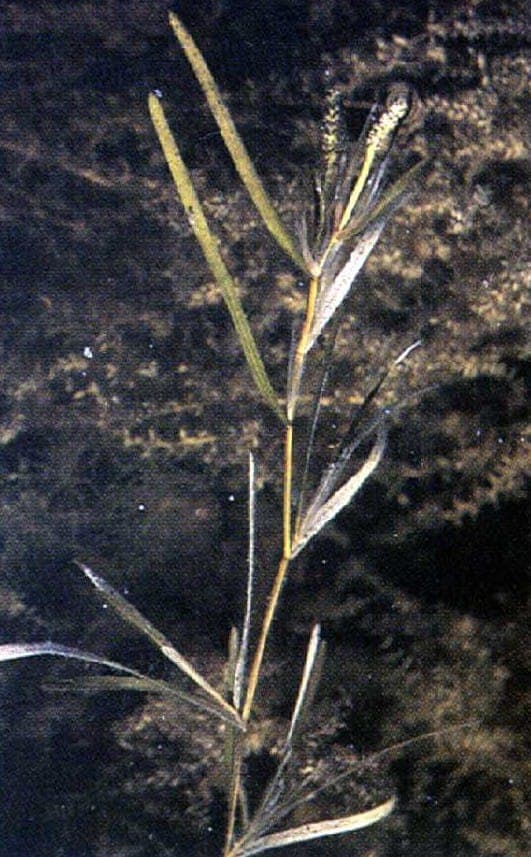
Robert H. Mohlenbrock / Public domain, via Wikimedia Commons
Flatstem pondweed: complete guide
Potamogeton zosteriformis
Want to see Flatstem pondweed: complete guide in your garden?
1 minute, no credit card
Overview
Potamogeton zosteriformis, known in English as flatstem pondweed, flat-stemmed pondweed or eelgrass pondweed, is a fully submerged freshwater plant in the family Potamogetonaceae. First formally described by the botanist Fernald in 1932, it is native to a broad stretch of North America, from Alaska and Yukon south to the northern-central United States, including states such as Minnesota, Wisconsin, Nebraska, Kansas and even into Maryland and New Jersey. The species name 'zosteriformis' reflects the resemblance of its ribbon-like leaves to the marine eelgrass Zostera. In its natural habitat it colonises the beds of clear lakes, ponds and slow-moving rivers, providing oxygen, shelter and spawning habitat for fish and aquatic invertebrates. If you are planning a naturalistic freshwater feature, gardenworld.app offers design tools to help you select and arrange aquatic plants by water depth and ecology.
Appearance and bloom cycle
The defining feature of Potamogeton zosteriformis is the distinctive flattening of its stems - a trait that sets it apart from most of its relatives in the Potamogeton genus, which have round or only slightly compressed stems. The stems can extend 50 to over 150 cm through the water column, branching freely. Leaves are ribbon- to lance-shaped, 2 to 4 mm wide and up to 15 cm long, with a visible midrib running their length. Leaf colour is a clear to medium green, and the texture is medium - less delicate than the filiform leaves of Potamogeton robbinsii, but more graceful than the broad leaves of floating pondweed species. Flowers are small, green and inconspicuous, appearing on short spikes that barely break the water surface between June and August. After flowering, small green fruits develop on the spike. Growth is rapid in clear, cool to moderately warm water with adequate light.
Ideal location
Flatstem pondweed thrives in still to gently flowing fresh water. An optimal planting depth is 30 to 120 cm; at shallower depths the plant grows less vigorously, while very deep water restricts photosynthesis. The species requires at least four hours of direct sunlight daily. In overly shaded ponds, stems elongate and become limp in search of light, weakening the overall plant. In nature, it is found across a broad climatic range, from the subarctic to the temperate interior of North America, but performs best in cool to moderately warm water conditions that mirror Northern European summers. It is rated for USDA zones 3 to 9. Water clarity is non-negotiable: turbid, algae-rich water prevents light from reaching the submerged leaves and will eventually kill the plant.
Soil
In a pond setting, Potamogeton zosteriformis prefers a sandy to fine-silty, nutrient-poor substrate with a pH between 5.8 and 7.0 - slightly acid to neutral conditions. Use unfertilised aquatic planting compost or washed sand in a planting basket, covered with coarse gravel to prevent the substrate from clouding the water. Avoid enriched composts or garden soil: the nutrients released will trigger algal blooms that shade the plant. In larger naturalistic ponds with a natural sandy or gravelly bottom, the plant can also establish itself without a basket, rooting directly in the lake bed.
Watering
As a fully submerged aquatic plant, Potamogeton zosteriformis obtains all the water and dissolved nutrients it needs directly from its surrounding water body, making conventional watering entirely unnecessary. The key factor is water quality: the pond must remain clear enough for sunlight to penetrate to the growing tips of the plant. Maintain stable water levels; during dry summer months, top up the pond with rainwater in preference to tap water, since tap water contains chlorine and calcium that gradually affect water chemistry. In a well-balanced pond ecosystem with a healthy mix of aquatic plants, micro-organisms and fish, flatstem pondweed will thrive without any additional inputs from the gardener.
Free design
Want to see Flatstem pondweed: complete guide in your garden? Make a free design now.
Pruning
Flatstem pondweed does not need routine pruning, but its vigorous spread can allow it to crowd out neighbouring aquatic plants in a small pond. In late spring or early summer, trim back any stems that are encroaching on other planting zones using sharp pond scissors. Remove all cuttings from the water at once - decaying plant material degrades water quality and fuels algal growth. Overcrowded root masses can be divided by hand: gently pull apart a section of the root mat, cut cleanly if needed, and replant the divided portion elsewhere in the pond. This is also an easy and free way to propagate the plant and share it with other pond gardeners.
Maintenance calendar
March-April: water warms, new shoots emerge from the overwintered root mass; remove any dead or decayed material from the previous season. May-June: fastest growing period; monitor spread and trim if needed to maintain balance with other plants. July-August: flowering period; inconspicuous green spikes at the water surface. September: growth slows as days shorten and water cools; carry out any final division or thinning. October-November: above-water growth dies back naturally; clear out dead stems if desired. December-February: dormancy at the pond bottom; no action required provided water depth is sufficient. For a full seasonal planting plan tailored to your garden, use the planning tools at gardenworld.app.
Winter hardiness
Potamogeton zosteriformis is highly cold-tolerant. Across its native range it survives under ice in lakes that freeze solid for months on end, from the Yukon and Alaska (USDA zone 2-3) to the upper Midwest and Northeast of the United States. It is rated for USDA zones 3 to 9, tolerating minimum temperatures of around -40 degrees Celsius. In Western European garden ponds it overwinters reliably at the pond bottom provided the water does not freeze right through to the substrate. In ponds shallower than 40 cm, move planting baskets to the deepest section or overwinter them in a bucket of water in a frost-free location such as an unheated garage or shed.
Companion plants
Flatstem pondweed pairs excellently with other submerged oxygenators: rigid hornwort (Ceratophyllum demersum), water violet (Hottonia palustris) and Robbins' pondweed (Potamogeton robbinsii) all make natural companions. At the water margin, use emergent plants that reinforce the naturalistic character: yellow flag iris (Iris pseudacorus), bogbean (Menyanthes trifoliata), water mint (Mentha aquatica) and branched bur-reed (Sparganium erectum). For surface coverage, white water-lily (Nymphaea alba) or yellow water-lily (Nuphar lutea) complement the submerged growth below. Fish species such as rudd, tench and bitterling benefit from the dense cover as shelter and spawning habitat. Specialist aquatic plant retailers and water garden centres can often supply Potamogeton species, or check the water plant sections at dedicated UK aquatic nurseries.
Closing
Potamogeton zosteriformis - flatstem pondweed - is an underrated but ecologically valuable addition to any clear freshwater garden pond. Its distinctively flattened stems, ribbon-like foliage and strong cold tolerance combine to make it a reliable, low-maintenance choice for naturalistic pond plantings. Provide clear water, a lean substrate, adequate depth and reasonable sunlight, and this pondweed will reward you with a thriving underwater colony year after year. To explore how flatstem pondweed fits into a complete water garden design, visit gardenworld.app and discover personalised garden plans with ponds and aquatic planting.
Want to see Flatstem pondweed: complete guide in your garden? Make a free design now.
Upload a photo, pick a style, and get a photorealistic design with plant list in under a minute.
10,000+ gardens designed already
No credit card required

