
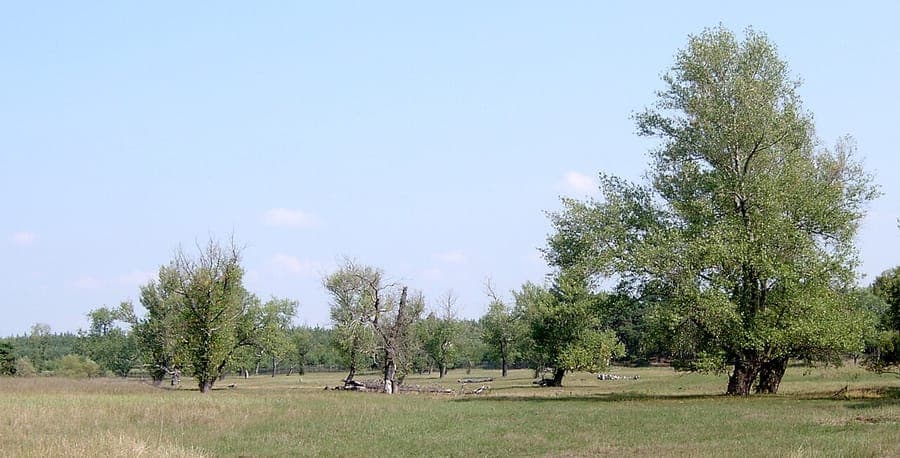
Kenraiz / CC BY-SA 3.0, via Wikimedia Commons
Lombardy poplar: complete guide
Populus nigra
Want to see Lombardy poplar: complete guide in your garden?
1 minute, no credit card
Overview
The Lombardy poplar (Populus nigra) is a dramatic tree that commands attention with its striking vertical shape. Native to parts of Europe and western Asia, it's been widely planted across temperate regions for centuries. Reaching up to 30 meters tall but rarely more than 4 meters wide, it's one of the few trees that offers height without taking up much horizontal space. That makes it a go-to for quick screening, windbreaks, or creating strong visual lines in large gardens.
On gardenworld.app, you can map out a planting scheme that uses Lombardy poplars in rhythmic rows along property lines or driveways. Because they grow so fast - up to 1.5 meters per year - they deliver results quickly, but they're not a long-term solution. Most only live 50 to 70 years, and older trees can become brittle. Still, for instant impact, few trees compare.
Appearance & bloom cycle
This poplar is instantly recognizable: a tight, columnar crown with upward-angled branches that create a spire-like silhouette. The bark is dark grey to nearly black, deeply fissured into diamond-shaped patterns on mature trees. Leaves are diamond-shaped, 4–8 cm across, with coarse teeth and a bright green upper surface. They tremble in the slightest breeze thanks to flattened petioles - a classic poplar trait.
Flowering happens in late winter to early spring (February–April), before leaf-out. Like all poplars, it's dioecious: male and female flowers grow on separate trees. Female trees produce cottony seeds that can create mess in gardens; male clones (like 'Italica') are preferred for this reason. If you're planting more than one, stick to male varieties.
Ideal location
Plant in full sun - a solid 8 out of 10 on the light scale. This tree won't tolerate deep shade. Give it plenty of vertical and underground space. Keep at least 5 meters from buildings, drains, and paved areas. Roots are aggressive and can infiltrate pipes or lift patios. Avoid planting near septic systems.
Best uses include field borders, large front gardens, or as a single specimen in open parkland. It's not suited for small urban yards. Use gardenworld.app to simulate how a row of Lombardy poplars would affect light and space in your garden layout.
Soil requirements
This tree is adaptable. It thrives in clay, loam, sand, and even compacted soils as long as the pH stays between 5.0 and 8.5. It prefers moist, well-drained ground but tolerates occasional flooding. Avoid extremely dry, sandy sites unless you commit to regular watering in the first few years.
Free design
Want to see Lombardy poplar: complete guide in your garden? Make a free design now.
Watering
Young trees need consistent moisture for the first 2–3 years. Water deeply once a week with at least 20 liters during dry spells. Use a root feeder or slowly running hose to encourage deep root development. Mature trees are fairly drought-tolerant but may drop leaves early in severe summer droughts. Mulch with wood chips to retain moisture and suppress competing vegetation.
Pruning
Little pruning is needed. The tree's shape is naturally narrow and upright. Only remove dead, damaged, or crossing branches - do this in late winter. Avoid summer pruning, which can trigger excessive regrowth. Older trees may develop weak branch unions; inspect annually for signs of splitting, especially after storms.
Maintenance calendar
- January: Inspect for storm damage; remove broken branches
- February: Watch for catkins; male trees start flowering
- March: Apply balanced granular fertilizer near the drip line if soil is poor
- April: Water young trees during dry periods
- May: Monitor for aphids or rust; treat if severe
- June: Check for early leaf drop due to drought stress
- July: No pruning; birds may be nesting
- August: Water deeply during extended dry spells
- September: Begin mulching around the base
- October: Rake and compost fallen leaves
- November: Final inspection before winter
- December: Check staking on young trees; remove if no longer needed
Winter hardiness
Hardy in USDA zones 3–8 (-40°C to -12°C). It handles cold winters without protection. Young trees may benefit from tree wrap to prevent rodent damage in rural areas. The tree is fully deciduous, losing all leaves by late November. Bare branches show their architectural form in winter.
Companion plants
Underplanting is tricky - the root system is shallow and competitive. Stick to drought-tolerant, shade-loving ground covers like Pachysandra terminalis, Vinca minor, or Carex elata 'Aurea'. Avoid deep-rooted perennials. Grass often dies out beneath the canopy. Consider using gravel or bark mulch instead.
Closing
The Lombardy poplar delivers fast height and strong visual lines, but it's not a forever tree. It grows fast, peaks early, and declines by mid-life. Plant it where you want quick results, not generational legacy. Buy male clones from reputable garden centres to avoid seed fluff. Space trees at least 4–5 meters apart. While not low-maintenance forever, with proper placement and care, it can be a powerful design tool. For inspiration, check planting layouts on gardenworld.app that pair poplars with hedges or evergreens for layered screening.
Want to see Lombardy poplar: complete guide in your garden? Make a free design now.
Upload a photo, pick a style, and get a photorealistic design with plant list in under a minute.
No credit card required


Similar plants
Grey poplar: complete guide
Populus x canescens
Everything about Populus x canescens - a fast-growing hybrid poplar with silver-grey foliage, ideal as a windbreak or specimen tree in large gardens.
Populus adenopoda: complete guide
Populus adenopoda
Chinese aspen: a fast-growing tree for large gardens. Cultivation tips, pruning, and use as windbreak or shade tree.
Populus fremontii: complete guide
Populus fremontii
Fremont's cottonwood is a majestic American tree with rapid growth and drought tolerance. Read our guide for cultivation tips and garden integration.