
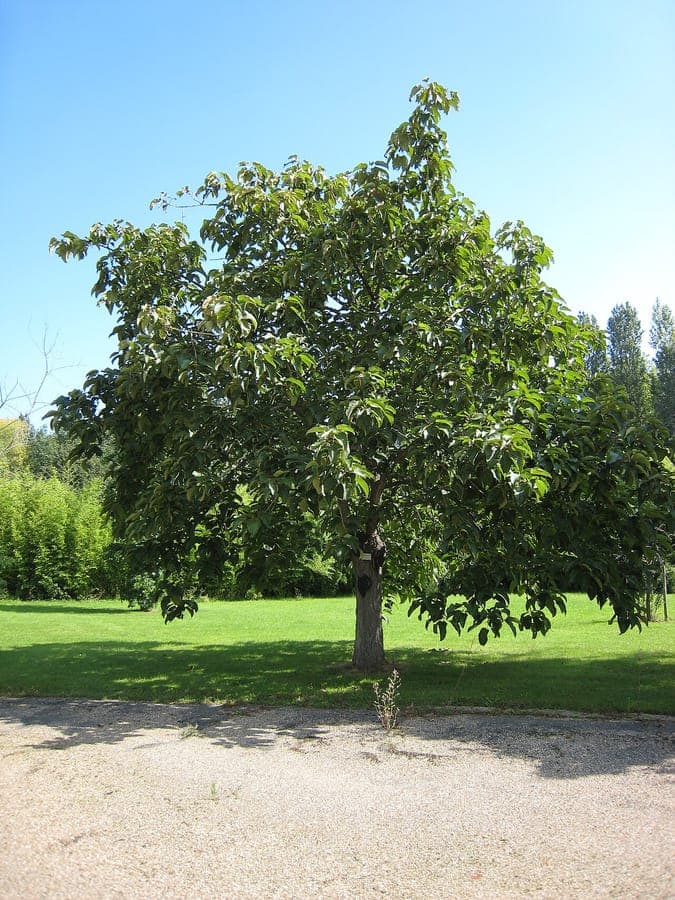
This photo has been taken by Matthieu Sontag (User:Mirgolth) and released under the licenses stated below. You are free to use it for any purpose as long as you credit me as author, Wikimedia Commons as site and follow the terms of the licenses. Could you be kind enough to leave me a message on this page to inform me about your use of this picture. / CC BY-SA 3.0, via Wikimedia Commons
Chinese necklace poplar: complete guide
Populus lasiocarpa
Want to see Chinese necklace poplar: complete guide in your garden?
1 minute, no credit card
Overview
Populus lasiocarpa, commonly known as the Chinese necklace poplar, isn't your average garden tree. It's a bold, fast-growing deciduous giant that thrives in open, moist landscapes. Native to central and southern China, this poplar demands space - think 20 to 30 meters at maturity, with a spread of up to 12 meters. It's not for the average suburban plot, but if you've got the room, it offers a rare combination of scale, texture, and seasonal drama.
What sets it apart? Enormous leaves, often 20–30 cm wide, with a soft, downy underside, and long, dangling female catkins that persist through winter - hence the 'necklace' nickname. Unlike many poplars that feel brittle or messy, this one has a dignified presence. On gardenworld.app, you can simulate how this tree fits into your landscape over time, factoring in shade coverage and root spread. It's also a great place to test companion plants before committing to a planting spot.
Appearance & bloom cycle
This tree makes a statement year-round. In spring, clusters of small flowers emerge as catkins. Male and female flowers grow on separate trees (dioecious), and it's the female trees that produce the long, hanging fruiting catkins - up to 20 cm - which remain on the branches well into winter, creating visual interest when most trees are bare.
Leaves are heart-shaped to round, deeply veined, and covered in fine hairs underneath, giving them a silvery underside. They emerge bright green in spring, deepen in summer, and turn a soft golden yellow in autumn. The bark starts smooth and gray, developing furrows and ridges with age. Growth rate is rapid: expect 60–100 cm per year under good conditions. You'll have a substantial tree in under a decade.
Ideal location
Full sun is non-negotiable. Aim for at least 6 hours of direct sunlight daily. While it can tolerate light shade, the crown will be sparse and less vigorous. Avoid planting near buildings, driveways, or underground utilities - the root system is aggressive and can lift paving or clog drains within 3–4 meters of the trunk.
Plant it as a specimen tree in a large garden, meadow, or near a pond (but keep it 4 meters from the water's edge to prevent leaf litter overload). Wind exposure is a concern - young trees benefit from staking and a sheltered spot. In the UK and US, USDA zones 6b to 8 are ideal. Avoid urban cores with compacted soil and pollution stress.
Soil requirements
This poplar loves deep, moist, humus-rich loam. A pH between 5.5 and 7.5 works best. It tolerates clay but not pure sand unless heavily amended. The soil must retain moisture but not become waterlogged - standing water invites root rot. If your soil is sandy, mix in generous compost or well-rotted manure at planting.
Avoid dry, compacted, or highly alkaline soils. On gardenworld.app, you can upload a soil test to see if your garden conditions match this tree's needs. A little prep now saves years of struggle later.
Free design
Want to see Chinese necklace poplar: complete guide in your garden? Make a free design now.
Watering
Water deeply and regularly during the first two growing seasons. Give young trees 20 liters twice a week during dry spells. After year two, the tree becomes more drought-tolerant but still appreciates supplemental watering during prolonged droughts, especially in summer. Use a slow soaker hose or drip line to encourage deep root growth - shallow watering leads to weak anchoring.
Pruning
Minimal pruning is best. Remove only dead, broken, or crossing branches, ideally in late winter (January to early February) when the tree is dormant. Avoid heavy pruning - while it can regenerate, large cuts invite pathogens. This tree doesn't need shaping; its natural form is elegant and upright with a slightly spreading crown.
Leave the winter catkins - they're a key ornamental feature. Only remove them if they pose a hazard or break off naturally.
Maintenance calendar
- January: Light pruning, inspect for winter damage
- February: Finish pruning, apply mulch if not done
- March: Check for new growth, top up mulch
- April: Growth spurt begins - water if dry
- May: Monitor for aphids or leaf discoloration
- June: Deep watering in heatwaves, check crown density
- July: Continue watering during drought, inspect for pests
- August: No pruning, reduce watering if rain is regular
- September: Leaves start to yellow, no intervention
- October: Rake leaves if desired (but not necessary)
- November: Mulch root zone, inspect persistent catkins
- December: Final check for storm damage, no watering
Winter hardiness
Hardy in USDA zones 6b to 8 (down to -20.5°C). In colder zones, young trees may suffer dieback, so protect the trunk with burlap in exposed sites. Mature trees handle cold well but watch for windthrow in storms - their height and broad crown make them top-heavy. In areas with heavy snow, branches may bend but rarely break.
Companion plants
Under the canopy, choose shade-tolerant, moisture-loving plants:
- Carex elata 'Aurea' – bright yellow sedge, thrives in wet soil
- Astilbe chinensis – feathery plumes, blooms in summer
- Hosta spp. – reliable for shade, comes in many sizes
- Dryopteris filix-mas – hardy fern, adds texture
Avoid drought-tolerant or sun-hungry plants. Pair with red-stemmed dogwoods like Cornus alba for winter contrast.
Closing
The Chinese necklace poplar isn't low-maintenance, but it rewards ambition. It needs space, moisture, and patience - but gives back with unmatched presence. If you're designing a large-scale landscape, this tree deserves consideration. You can find young specimens at garden centres like those affiliated with Truffaut or Jardiland in Europe, but in the US and UK, availability is limited - check specialty nurseries. On gardenworld.app, you can simulate a 10-year growth projection to see how it'll shape your garden. It's not a tree for everyone, but for the right site, it's unforgettable.
Want to see Chinese necklace poplar: complete guide in your garden? Make a free design now.
Upload a photo, pick a style, and get a photorealistic design with plant list in under a minute.
No credit card required


Similar plants
Grey poplar: complete guide
Populus x canescens
Everything about Populus x canescens - a fast-growing hybrid poplar with silver-grey foliage, ideal as a windbreak or specimen tree in large gardens.
Populus adenopoda: complete guide
Populus adenopoda
Chinese aspen: a fast-growing tree for large gardens. Cultivation tips, pruning, and use as windbreak or shade tree.
Populus fremontii: complete guide
Populus fremontii
Fremont's cottonwood is a majestic American tree with rapid growth and drought tolerance. Read our guide for cultivation tips and garden integration.