
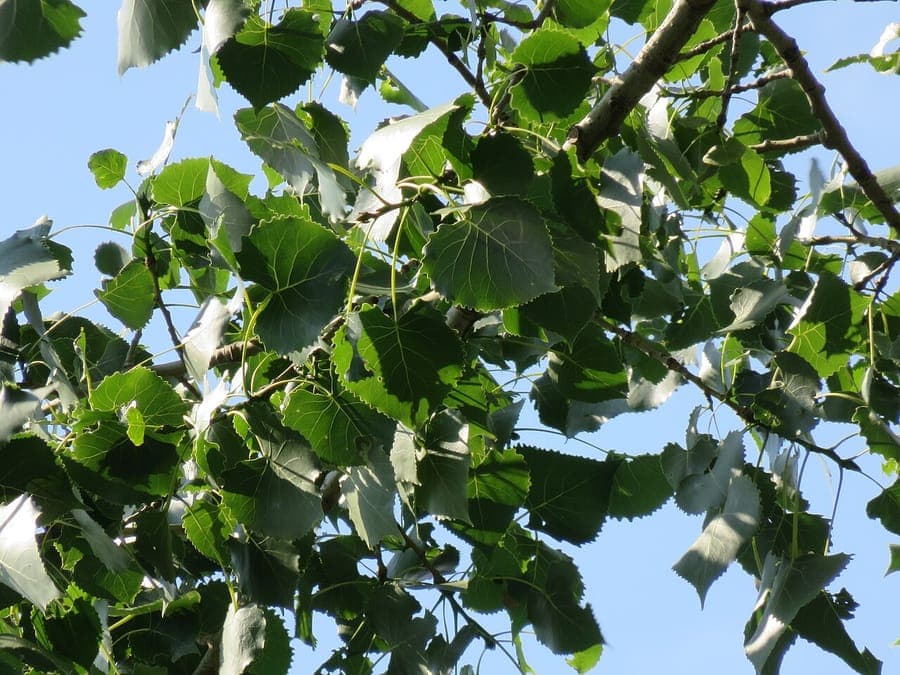
Laurent Bélanger / CC BY-SA 4.0, via Wikimedia Commons
Eastern cottonwood: complete guide
Populus deltoides
Want to see Eastern cottonwood: complete guide in your garden?
1 minute, no credit card
Overview
Populus deltoides, better known as the Eastern cottonwood, is a towering deciduous tree native to riverbanks and floodplains across eastern North America. It's one of the fastest-growing hardwoods you can plant, capable of adding up to 180 cm per year under ideal conditions. In the UK and northern Europe, it's rarely seen in residential gardens due to its massive size and aggressive root system, but in large rural plots or naturalized areas, it can be a real showstopper. Reaching heights over 30 meters with spreads up to 18 meters, this tree demands space. Its triangular leaves flutter in the breeze, creating a soft rustling sound, while female trees release cottony seeds in late spring - hence the name. On gardenworld.app, you can design a layout that accounts for its mature spread and shadow pattern, ensuring harmony with other elements in your yard.
Appearance & bloom cycle
Eastern cottonwood has large, deltoid (triangle-shaped) leaves that measure 7 to 15 cm across. The flattened petioles allow the leaves to quake in even the lightest wind - a feature shared with other poplars. In March and April, it produces greenish catkins before the leaves emerge. Male and female flowers grow on separate trees (dioecious), and only the female trees release the cotton-like seed fluff, which can be messy and problematic near patios or pools. The bark of young trees is smooth and silvery, turning dark grey and deeply furrowed with age. Foliage stays bright green through summer, turning pale yellow in autumn, though fall color is often unremarkable.
Ideal location
Plant this tree at least 10 meters away from buildings, driveways, and underground utilities. Its roots are invasive and can crack pipes or lift paving. Full sun (rated 8/10 for light) is essential for strong, upright growth. It tolerates partial shade but will grow lopsided and sparse. Best suited for open fields, riparian zones, or large estates, avoid planting near delicate garden features. Use gardenworld.app to simulate the tree's future canopy and check how it fits with existing structures and plants.
Soil requirements
Eastern cottonwood isn't picky about soil pH, thriving in a range from 5.2 to 7.3. It prefers moist, well-drained loam or clay but handles periodic flooding and saturated soils better than most trees. It struggles in dry, sandy soils unless irrigated. While adaptable, avoid highly compacted or saline soils. At planting, mix in compost to improve moisture retention, but don't over-fertilize - excess nitrogen leads to weak, brittle wood prone to breakage.
Free design
Want to see Eastern cottonwood: complete guide in your garden? Make a free design now.
Watering
Young trees need deep, regular watering - about 20 litres weekly during the first two to three growing seasons. Once established, they're drought-tolerant thanks to deep taproots, but they grow fastest with consistent soil moisture. During prolonged dry spells in summer, supplemental watering helps prevent leaf scorch and branch dieback.
Pruning
Prune only when necessary, and always during dormancy (late autumn to early winter). Remove dead, damaged, or crossing branches to encourage a strong central leader. Avoid summer pruning - open wounds attract canker diseases and borers. Use sharp, sterilized tools, and make clean cuts just outside the branch collar. Heavy pruning can stimulate rapid, weak regrowth, so go easy. For pruning visuals and timing, gardenworld.app offers seasonal templates tailored to fast-growing trees.
Maintenance calendar
- Jan: Inspect for storm-damaged branches
- Feb: Plan structural pruning
- Mar: Bloom begins; watch for seed cotton on female trees
- Apr: Monitor for late frost; water young trees
- May: Check soil moisture; apply organic mulch
- Jun: Watch for aphids or leaf beetles
- Jul: Monitor for drought stress
- Aug: Avoid pruning - high disease risk
- Sep: No action needed
- Oct: Leaves drop; collect organic debris
- Nov: Light shaping if needed
- Dec: Dormant period; no maintenance
Winter hardiness
Hardy in USDA zones 3 to 9, the Eastern cottonwood handles freezing winters well. In zone 7 and above, it rarely suffers winter damage. Young trees may experience sunscald on the south-facing bark - wrap trunks with tree guard for the first 3–5 years. Mature trees are generally stable, though high winds on wet soil can cause uprooting due to shallow lateral roots.
Companion plants
Under the dense canopy, few plants thrive. Stick to shade-tolerant, moisture-loving species like Carex vulpinoidea, Eutrochium maculatum, or Dryopteris marginalis. Avoid shallow-rooted perennials that compete for water. Along the drip line, consider native shrubs like Cornus sericea or Symphoricarpos albus. Avoid planting vegetables or sun-hungry flowers nearby.
Closing
The Eastern cottonwood is a bold choice for large landscapes. It grows fast, provides quick shade, and supports wildlife, but comes with trade-offs: messy seeds, invasive roots, and high water needs when young. Only plant it if you have the space and can commit to long-term planning. Garden centres in the UK occasionally stock young specimens in spring, but always confirm the sex if you want to avoid cotton drift.
Want to see Eastern cottonwood: complete guide in your garden? Make a free design now.
Upload a photo, pick a style, and get a photorealistic design with plant list in under a minute.
No credit card required


Similar plants
Grey poplar: complete guide
Populus x canescens
Everything about Populus x canescens - a fast-growing hybrid poplar with silver-grey foliage, ideal as a windbreak or specimen tree in large gardens.
Populus adenopoda: complete guide
Populus adenopoda
Chinese aspen: a fast-growing tree for large gardens. Cultivation tips, pruning, and use as windbreak or shade tree.
Populus fremontii: complete guide
Populus fremontii
Fremont's cottonwood is a majestic American tree with rapid growth and drought tolerance. Read our guide for cultivation tips and garden integration.