
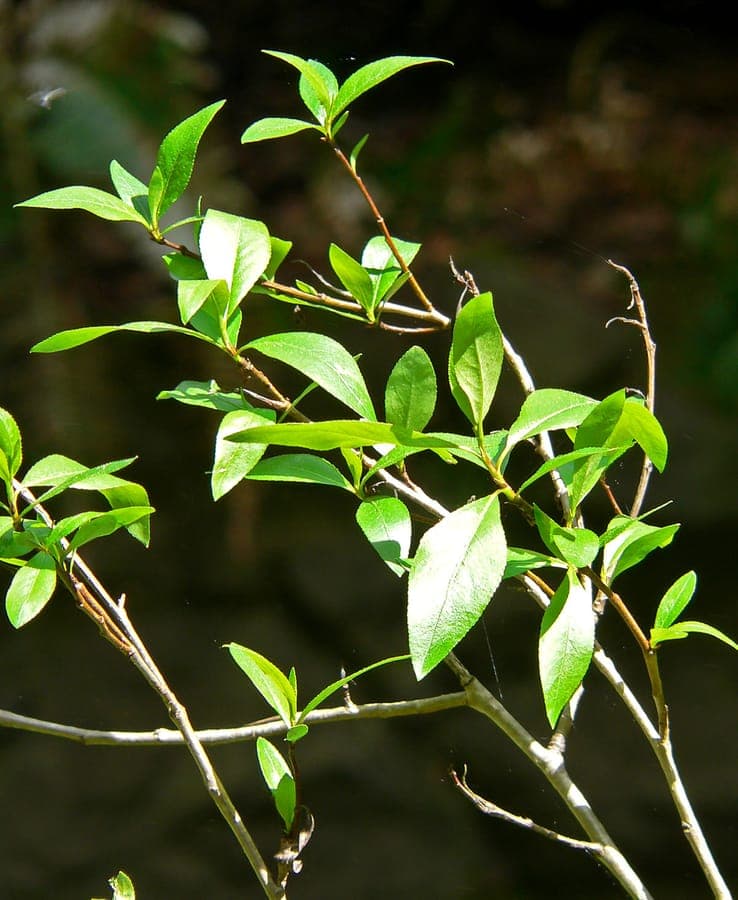
Stan Shebs / CC BY-SA 3.0, via Wikimedia Commons
Mountain cottonwood: complete guide
Populus angustifolia
Want to see Mountain cottonwood: complete guide in your garden?
1 minute, no credit card
Overview
Populus angustifolia, commonly known as mountain cottonwood or narrow-leaf cottonwood, is a fast-growing tree from the Salicaceae family. This tree originates from North America (from Canada to Mexico) and grows naturally along mountain streams and in valley corridors. With its elegant, narrow leaves and rapid growth, this tree forms an architecturally interesting element in large gardens and landscape design. The tree tolerates diverse soils and climates, making it highly versatile for various planting situations.
Appearance and growth
Populus angustifolia is an impressive tree that grows rapidly to 15 to 25 meters in height. The trunk is relatively straight with gray bark. The leaves are remarkably narrow and lance-shaped, green during the growing season with possible yellow fall coloration. The tree develops a somewhat columnar form, distinguishing it from other poplars. Female trees produce catkins in spring, which are characteristic decorative elements. In summer, the leaves rustle softly in the wind, creating a pleasant effect.
Ideal location
Mountain cottonwood thrives best in sunny locations with full sun exposure. The tree can grow in light shade but grows fastest and most vitally in full sun. Plant in locations where sufficient space for growth is available, as the tree reaches mature large dimensions. The tree is suitable for wind-exposed areas and tolerates strong winds well. In mountainous landscapes, the tree is exceptionally suitable for drainage situations.
Soil requirements
Populus angustifolia is highly flexible regarding soil composition. The tree grows on diverse soils, from sandy to loamy and even clay-containing soils. A pH between 6.0 and 7.5 is ideal. The tree tolerates moderately dry to dry soils well, especially once established. In very nutrient-poor sand, supplemental compost or fertilizer can be beneficial. Good drainage is important, especially during winter periods.
Watering
Newly planted mountain cottonwoods should be watered regularly during the first growing season to establish roots. Once established, the tree tolerates dry conditions much better. Water especially during prolonged drought periods. The tree prefers moist conditions during the growing season but can also thrive on dry sites. Drainage is important - waterlogging must be avoided.
Free design
Want to see Mountain cottonwood: complete guide in your garden? Make a free design now.
Pruning and maintenance
Populus angustifolia requires minimal pruning once established. Young trees can be pruned to encourage a desired shape. Dead or damaged branches can be removed year-round. Avoid heavy pruning on mature trees, as this can disturb the natural form. The tree naturally develops an attractive shape, and much pruning is not needed.
Maintenance calendar
Spring (March-May): Check for winter damage. Dead wood can be removed. Young trees can be shaped through pruning. Begin regular watering as growth starts.
Summer (June-August): Water regularly, especially in the first year. Enjoy the rapid growth. The tree can reach increasing heights. Minimal maintenance needed.
Fall (September-October): Fall color may be yellow. Gradually reduce watering. Prepare for winter. Fallen leaves can remain or be raked.
Winter (November-February): Minimal watering. The tree is bare without leaves. Damaged branches can be removed. Protection from heavy snow may be needed for young trees.
Winter hardiness
Populus angustifolia is very cold hardy and can withstand temperatures down to approximately -25 degrees Celsius. In all temperate climates and many colder regions, the tree overwinters outdoors without protection. The tree is adapted to mountain climates with severe winters and strong wind exposure. Young planted trees can benefit from some trunk protection in extreme frosts.
Companion plants
For large landscape designs, combine Populus angustifolia with other fast-growing trees such as Betula species (birches) and Larix species (larches). For underplanting, suitable are low shrubs such as Salix species (willows) and herbaceous plants. This combination creates a diverse mountainous landscape with different textures and seasonal effects.
Closing thoughts
Populus angustifolia is an excellent choice for large gardens, landscape projects, and situations where rapid growth is desired. The tree offers elegant narrow leaves, rapid growth, and adaptability to diverse growing conditions. With minimal maintenance, this mountain cottonwood will provide decorative utility for many years. Explore gardenworld.app for more inspiration on using trees in landscape design. Check back regularly for additional plant guides on gardenworld.app.
Want to see Mountain cottonwood: complete guide in your garden? Make a free design now.
Upload a photo, pick a style, and get a photorealistic design with plant list in under a minute.
No credit card required


Similar plants
Grey poplar: complete guide
Populus x canescens
Everything about Populus x canescens - a fast-growing hybrid poplar with silver-grey foliage, ideal as a windbreak or specimen tree in large gardens.
Populus adenopoda: complete guide
Populus adenopoda
Chinese aspen: a fast-growing tree for large gardens. Cultivation tips, pruning, and use as windbreak or shade tree.
Populus fremontii: complete guide
Populus fremontii
Fremont's cottonwood is a majestic American tree with rapid growth and drought tolerance. Read our guide for cultivation tips and garden integration.