
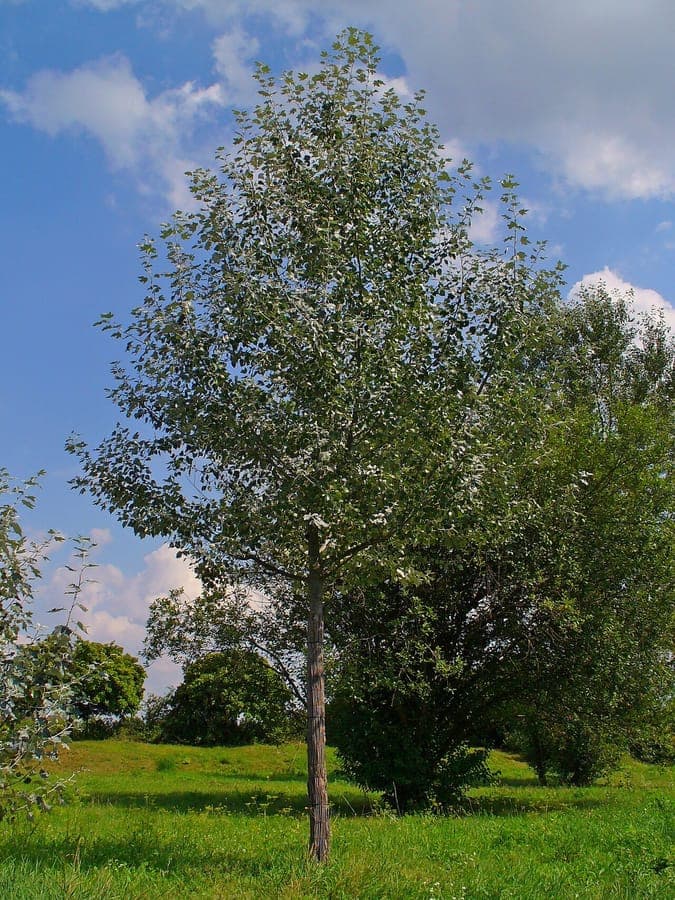
H. Zell / CC BY-SA 3.0, via Wikimedia Commons
Silverleaf poplar: complete guide
Populus alba
Want to see Silverleaf poplar: complete guide in your garden?
1 minute, no credit card
Overview
The silverleaf poplar (Populus alba) is a striking tree known for its rapid growth and shimmering foliage. If you're after a tree that delivers quick shade and visual drama, this species deserves serious consideration. Native to regions like Albania, Bulgaria, Afghanistan, and parts of Central Europe, it thrives across a wide range of climates - from dry inland zones to moist riverbanks.
On gardenworld.app, you can design a garden layout that perfectly accommodates this fast-growing giant. Reaching 15 to 20 meters in height with a spread of 10 to 12 meters, the silverleaf poplar needs ample space. It's not suited for small urban yards but shines in large rural or semi-rural gardens. It demands high light - a solid 8 out of 10 - meaning full sun to light shade. Without enough light, growth slows and the crown becomes sparse.
Appearance & bloom cycle
What sets the silverleaf poplar apart is its foliage. The upper side of the leaves is green, but the underside is densely covered in white, felt-like hairs, creating a dazzling silver effect when the wind stirs the canopy. Leaves are palmately lobed, typically with five pointed segments, resembling maple leaves - hence one of its French names: peuplier à feuille d'érable.
Flowering occurs in spring, usually starting in April. The species is dioecious, so male and female flowers grow on separate trees. Male trees produce yellowish catkins that release pollen, while females develop greenish catkins that later release cottony seeds. This seed fluff, released in May and June, can be a nuisance in residential areas. To avoid this, opt for a male cultivar like 'Pyramidalis', which won't produce flying fluff.
Ideal location
Full sun is essential. Plant your silverleaf poplar in an open area where it has room to expand without crowding structures. Keep it at least 8 meters from buildings, driveways, or underground pipes - its aggressive root system seeks moisture and can damage foundations or sewer lines. While it tolerates urban conditions, avoid planting near patios or walkways where roots might heave paving.
In exposed sites, young trees may need staking for the first 2–3 years. Wind-rock can destabilize shallow root systems. Choose a sheltered spot initially or use a sturdy stake. Once established, the tree handles wind well, especially in USDA zones 4 to 8.
Soil requirements
This poplar isn't fussy about soil type. It grows in sandy, loamy, or clay soils as long as drainage is adequate. Avoid waterlogged or saline soils. The ideal pH range is 4.9 to 7.0, so mildly acidic to neutral soils work best. Don't add compost or fertilizer to the planting hole - it encourages root rot. Let the tree adapt naturally before any soil amendments.
Free design
Want to see Silverleaf poplar: complete guide in your garden? Make a free design now.
Watering
Young trees need consistent watering, especially during dry summers. Supply 10–15 liters per week for the first two growing seasons. Mature trees are drought-tolerant thanks to deep roots, but occasional deep watering during prolonged dry spells improves vitality. Avoid overhead irrigation, which increases the risk of foliar diseases like rust or canker.
Pruning
Pruning isn't usually necessary unless you're removing dead or damaged wood. The best time is late winter - January or early February - when the tree is dormant. Avoid summer pruning; it triggers excessive sap flow and weakens the tree. Use sharp, sterilized tools and make clean cuts just outside the branch collar to prevent disease entry.
Maintenance calendar
- January: Prune dead wood, inspect for pests
- February: Ideal time for planting bare-root specimens
- March: Loosen soil around base, check for rodent damage
- April: Growth begins; watch for aphids and leaf curl
- May: Female trees release seed fluff; consider cleanup if needed
- June: Monitor for fungal spots during humid weather
- July: Water deeply during drought; inspect leaf health
- August: Final deep watering if summer remains dry
- September: Let fallen leaves decompose as natural mulch
- October: Check root expansion near hardscapes
- November: Protect young trunks with tree wrap
- December: Observe structure, plan next year's care
Winter hardiness
The silverleaf poplar is hardy in USDA zones 4 through 8. It survives winter lows down to -34°C. In the UK and most of North America within this range, it's fully hardy. Young bark is vulnerable to frost cracks and rodent chewing. Use a spiral guard or tree wrap for the first few winters to prevent damage.
Companion plants
Dense shade beneath mature trees limits underplanting, but some shade-tolerant species can thrive at the edges. Try Carex varieties, Helleborus orientalis, or Epimedium in the outer drip zone. Avoid planting shrubs or trees with high water needs - they'll compete with the poplar's deep, thirsty roots. Groundcovers like Galium odoratum handle dry shade reasonably well.
With gardenworld.app, you can test companion combinations that balance aesthetics and root competition.
Closing
The silverleaf poplar is a bold, fast-growing tree with undeniable presence. But it demands space and careful planning. Plant it away from structures, choose male cultivars to avoid fluff, and give it time to establish. For healthy young trees, visit local garden centres in the UK or North America - these spots often stock quality Populus alba specimens. With the right start, you'll enjoy decades of shimmering silver foliage and reliable shade.
Want to see Silverleaf poplar: complete guide in your garden? Make a free design now.
Upload a photo, pick a style, and get a photorealistic design with plant list in under a minute.
No credit card required


Similar plants
Grey poplar: complete guide
Populus x canescens
Everything about Populus x canescens - a fast-growing hybrid poplar with silver-grey foliage, ideal as a windbreak or specimen tree in large gardens.
Populus adenopoda: complete guide
Populus adenopoda
Chinese aspen: a fast-growing tree for large gardens. Cultivation tips, pruning, and use as windbreak or shade tree.
Populus fremontii: complete guide
Populus fremontii
Fremont's cottonwood is a majestic American tree with rapid growth and drought tolerance. Read our guide for cultivation tips and garden integration.