
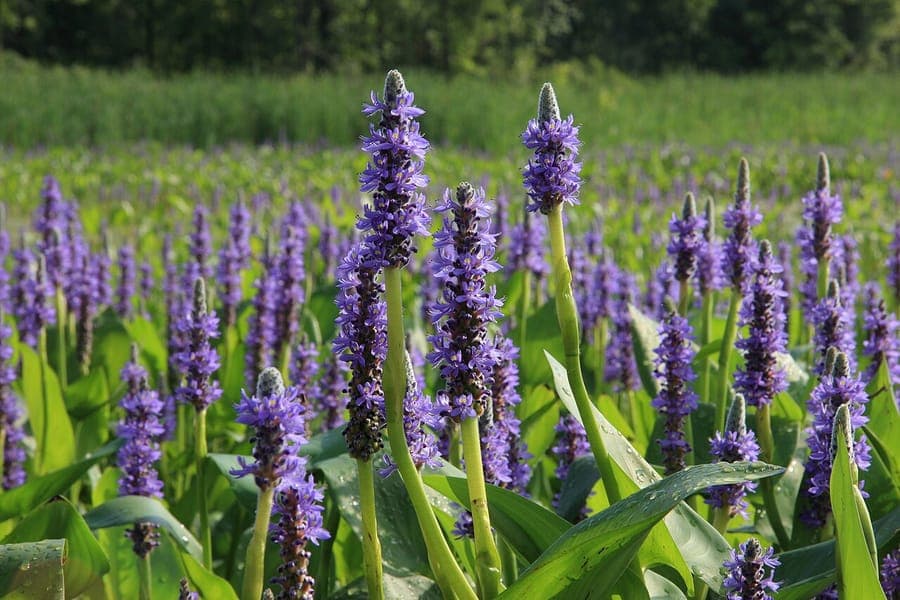
Cephas / CC BY-SA 3.0, via Wikimedia Commons
Pickerel-weed: complete guide
Pontederia cordata
Want to see Pickerel-weed: complete guide in your garden?
1 minute, no credit card
Overview
Pickerel-weed (Pontederia cordata) is a striking marginal aquatic plant native to wetlands across the southeastern United States and parts of South America, including Brazil, Bolivia, and Argentina. It thrives in shallow water and moist soils, making it a favorite for pond edges, rain gardens, and bog beds. With its heart-shaped leaves and vibrant purple flower spikes, it brings both structure and color to water features from midsummer into early autumn. It's also a valuable plant for pollinators, attracting bees, butterflies, and hoverflies. On gardenworld.app, you can design a water garden layout that features Pickerel-weed alongside complementary moisture-loving species for year-round interest.
Appearance & bloom cycle
Pickerel-weed forms dense clumps of glossy, heart-shaped leaves that range from 10 to 20 cm in width. The leaves grow on sturdy, erect stems rising 60 to 90 cm above the water or soil. From July to September, it produces showy flower spikes of intense violet-blue flowers. Each spike contains dozens of small, star-shaped blooms that open progressively from the base upward. The flowering period lasts 6 to 8 weeks, depending on warmth and sunlight. After blooming, the flower stalks turn brown and can be removed, but foliage remains green well into autumn, sometimes persisting into mild winters. Seed capsules may form but rarely germinate in cooler climates.
Ideal location
Plant Pickerel-weed in full sun to partial shade. For best flowering, provide at least 6 hours of direct sunlight daily. It grows best in shallow water, 5 to 30 cm deep, at the margins of ponds or in bog gardens. It can be grown in aquatic baskets or directly in the pond substrate. Use a heavy soil mix to anchor the roots and prevent floating. Avoid windy areas or strong currents, as the broad leaves can tear. On gardenworld.app, you can simulate different pond configurations to find the perfect spot for Pickerel-weed in your garden, even in compact urban spaces.
Soil requirements
This plant isn't fussy about soil as long as it stays consistently wet or submerged. Use a heavy loam, clay-based mix, or commercial aquatic compost. Avoid peat-based or overly rich potting soils, as they can promote algae growth and destabilize water chemistry. When planting in a basket, use a 20x20 cm container filled with dense soil and top with 2–3 cm of gravel to prevent erosion. One plant per basket is sufficient, and division is only needed every 2–3 years when the clump becomes congested.
Free design
Want to see Pickerel-weed: complete guide in your garden? Make a free design now.
Watering
Since Pickerel-weed grows in water, regular watering isn't necessary. The key is maintaining constant moisture: roots must stay submerged or in saturated soil. Allow no drying out, as this leads to rapid wilting. During hot, dry summers, top up water levels to ensure the crown stays covered. Use rainwater or dechlorinated tap water to avoid chemical imbalances. In fish ponds, Pickerel-weed helps control nutrient levels by absorbing excess nitrates and phosphates, reducing algae blooms.
Pruning
Pruning needs are minimal. In late autumn or early spring, cut back dead foliage and spent flower stalks to ground level. This keeps the plant looking tidy and prevents debris from decomposing in the water. If the clump spreads beyond 60 cm in diameter, divide it in spring before new growth starts. Gently lift the root mass, split into 2–3 sections with a knife, and replant immediately. Discard any soft or rotten centers.
Maintenance calendar
Jan: Check root health; remove leaf litter. Feb: No action; plant dormant. Mar: Divide and replant if needed. Apr: New shoots emerge; monitor water depth. May: Watch for snails or algae on leaves. Jun: Prepare for bloom; ensure support if needed. Jul: Peak flowering; maintain water level. Aug: Continue bloom; deadhead if desired. Sep: Flowers fade; leave foliage intact. Oct: Cut back dead stems. Nov: No maintenance; plant entering dormancy. Dec: Protect baskets from deep freeze.
Winter hardiness
Pickerel-weed is hardy in USDA zones 5–10. In zones 5–6, ensure the roots are submerged below the frost line - at least 30 cm of water depth protects the crown. In containers, sink baskets to 40 cm depth or move to an unheated greenhouse with moist soil. In milder zones (7+), the plant may retain some evergreen foliage. Top growth dies back in winter, but roots survive to regrow in spring.
Companion plants
Pair Pickerel-weed with other marginal aquatics like Blue Flag Iris (Iris versicolor), Arrowhead (Sagittaria latifolia), or Pickerel-rush (Isaca macrophylla). Include floating plants like Water Hyacinth for contrast, and deeper-water species like Water Lilies (Nymphaea) for layered effect. Avoid invasive species such as Parrot's Feather that can choke out slower growers. Arrange plants by height: low floaters in front, medium like Pickerel-weed in the middle, taller reeds at the back.
Closing
Pickerel-weed is a reliable, low-maintenance perennial that adds bold color and ecological value to water gardens. Once established, it returns year after year with minimal care. Start with one healthy clump and let it spread, or contain it in a basket to manage growth. It's available at most garden centres in the UK and North America. With proper placement and consistent moisture, you'll enjoy its vibrant blooms and lush foliage for seasons to come. For personalized planting plans, visit gardenworld.app and design a custom wetland garden featuring Pontederia cordata.
Want to see Pickerel-weed: complete guide in your garden? Make a free design now.
Upload a photo, pick a style, and get a photorealistic design with plant list in under a minute.
No credit card required


Similar plants
Acer pycnanthum: complete guide
Acer pycnanthum
Acer pycnanthum, the Japanese swamp maple, is a fast-growing tree with early red flowers and brilliant autumn color, ideal for damp garden settings.
Freeman maple: complete guide
Acer × freemanii
Everything about the Freeman maple (Acer x freemanii): a fast-growing shade tree with spectacular autumn colour for large gardens.
Silver vine: complete guide
Actinidia polygama
Discover silver vine (Actinidia polygama): a hardy climbing plant with silvery foliage, loved by gardeners and cats alike.