
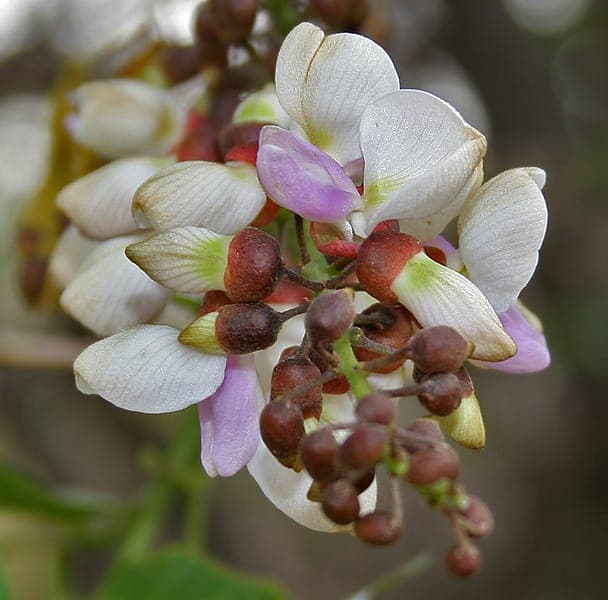
J.M.Garg / CC BY 3.0, via Wikimedia Commons
Pongamia pinnata: complete guide
Pongamia pinnata
Want to see Pongamia pinnata: complete guide in your garden?
1 minute, no credit card
Overview
Pongamia pinnata, known as Indian beech, karanj, pongam oil tree or poonga-oil tree, is a versatile tropical tree from Asia. Native to southern India, Sri Lanka, Myanmar, Thailand and throughout Southeast Asia, this tree is highly important in traditional agricultural and agroforestry systems. The tree is celebrated for its abundant purple flowering and oil-rich seeds. This oil is used in India for lamps and traditional medicines, and today also for biofuel. This is a tree for sustainable, tropical gardens.
Appearance and bloom
The Indian beech grows as a medium-sized tree to approximately 15-20 meters height, with a broad, attractive crown. The leaves are compound, pinnate (feather-shaped) and elegant. The tree flowers abundantly with purple to violet flowers, grouped in loose paniculate clusters. These flowers appear very abundantly in the dry season (November to March) and attract bees. Following flowering, flat, brown pods develop, 1-2 cm long with light ochre seed pattern.
The tree grows rapidly in tropical conditions and can remain productive for decades.
Ideal location
Pongamia pinnata grows best in full sunlight, though the tree tolerates moderate shade. The tree is highly heat-tolerant and feels most at home in very warm, dry locations. Sea wind is tolerated, so the tree is suitable for coastal gardens. The tree can also grow in somewhat more humid climates, though it prefers dry conditions.
In temperate climates, the tree must be greenhouse-grown due to its warmth requirements.
Soil
The Indian beech grows on varied soils, from sand to clay. The tree tolerates even low-lime, lateritic soils well. Soil pH can range from acidic to neutral. The tree has no special feeding requirements and grows reasonably well in poor soil.
Well-draining soil is however preferred. Waterlogging is harmful to roots.
Free design
Want to see Pongamia pinnata: complete guide in your garden? Make a free design now.
Watering
Once established, this tree tolerates drought excellently. Regular water during the growing season aids growth, but excessive water must be avoided. In very dry areas, occasional watering in dry season may be helpful. In pots, water moderately.
Ensure water drains well. Waterlogging can cause root rot.
Pruning
Pruning is not necessary. The tree grows naturally in an open form. Dead branches can be removed. At young stages, light pruning can improve tree architecture.
Pruning wounds heal quickly.
Maintenance calendar
Spring (March-May): Check growth, remove dead branches. Plant begins growing season.
Summer (June-October): Minimal maintenance. Water only in extreme drought.
Autumn-Winter (November-February): Flowering reaches peak. Plant at its most beautiful. Seeds ripen and fall.
Dry season: Tree is almost dormant in very dry areas.
Winter hardiness
Pongamia pinnata is frost-sensitive and sustains damage at temperatures below 10 degrees Celsius. The tree does not grow outside tropical and subtropical zones. In temperate climates, greenhouse cultivation is needed. The tree cannot tolerate nighttime temperatures below approximately 5 degrees Celsius.
Companion plants
Other tropical fruit trees such as Mangifera indica (mango), Anacardium occidentale (cashew) and Artocarpus altilis (breadfruit) fit well nearby. Tropical flowering shrubs such as Ixora and Lagerstroemia add color. Legumes such as Sesbania and Albizia improve soil.
Light-loving herbs can grow beneath the crown.
Closing remarks
The Indian beech is a highly valuable addition to tropical and subtropical gardens, both for ecological and practical purposes. With minimal care, this tree grows in maturity and productivity. The combination of beauty, sustainability and utility makes this an ideal choice for sustainable gardens in warm climates.
Available in tropical areas through local nurseries. Seeds are available online. gardenworld.app advises on sustainable garden designs for tropical climates. gardenworld.app also supports agroforestry and food self-sufficiency projects.
Want to see Pongamia pinnata: complete guide in your garden? Make a free design now.
Upload a photo, pick a style, and get a photorealistic design with plant list in under a minute.
No credit card required


Similar plants
Tall Silky Lupine: complete guide
Lupinus elatus
Tall silky lupine is a fast-growing Californian perennial with silvery foliage and blue-purple flower spikes, ideal for a prairie-style garden.
Garfield Lupine: complete guide
Lupinus garfieldensis
The Garfield lupine is a rare, fast-growing American perennial for alkaline, dry grassland gardens, with striking blue flower spikes.
Lupinus elegans: complete guide
Lupinus elegans
Lupinus elegans, the elegant lupine, is a spectacular blooming plant from Mexico with blue flower spikes. Care, cultivation and garden use.