
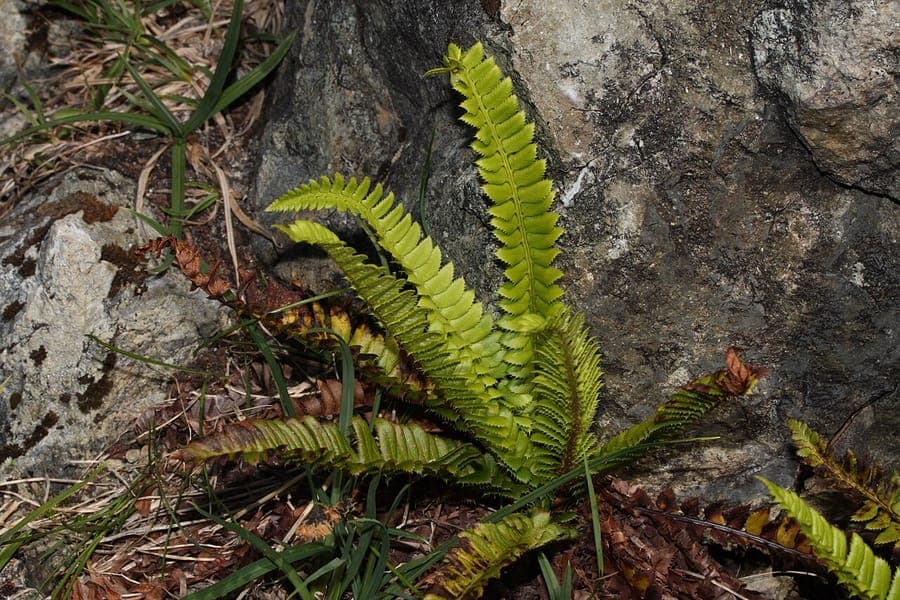
Walter Siegmund (talk) / CC BY-SA 3.0, via Wikimedia Commons
Northern hollyfern: complete guide
Polystichum lonchitis
Want to see Northern hollyfern: complete guide in your garden?
1 minute, no credit card
Overview
Polystichum lonchitis, commonly known as Northern hollyfern, is a tough, evergreen fern that thrives in cool, shaded spots with well-drained soil. Native to mountainous and northern regions across Europe, Asia, and North America, it's perfectly adapted to rocky crevices and forest undergrowth. In the garden, it brings year-round structure with its upright, lance-shaped fronds and glossy dark green foliage. Unlike many ferns, it tolerates limestone soils, making it a smart choice for gardens with alkaline conditions.
This isn't a showy bloomer, but it doesn't need to be. Its strength lies in steady, elegant presence. On gardenworld.app, you can design a shaded rock garden layout that highlights Northern hollyfern's natural growth pattern and texture.
Appearance & bloom cycle
Northern hollyfern doesn't produce flowers. Instead, it reproduces via spores that develop on the undersides of mature fronds. From May through October, you'll notice clusters of brown, dust-like sori arranged in neat rows along the pinnae. While not flashy, this process is a quiet marvel of nature.
The fronds grow in a tight, upright rosette, reaching 20 to 50 cm in length. They're pinnate with narrow, sharply pointed leaflets that give the plant a slightly rigid, architectural look. The stalks are dark brown to black, covered in fine, papery scales. New growth emerges in spring as tightly coiled fiddleheads, slowly unfurling into glossy, stiff fronds that persist for two to three years.
Ideal location
Choose a spot with partial to full shade-north- or east-facing walls, woodland edges, or under deciduous trees work best. Avoid hot, south-facing areas where summer sun can scorch the fronds. This fern loves cool, sheltered microclimates, especially in rocky settings or between stone steps.
It's perfect for rock gardens, retaining walls, and alpine beds. If you're designing a fern-rich shady border, try visualising the layout on gardenworld.app to test spacing and companion plant pairings before planting.
Soil requirements
Northern hollyfern prefers neutral to slightly alkaline soils (pH 6.5–7.8). It thrives in gritty, well-drained mixes rich in organic matter. A blend of loam, compost, and sharp sand or fine gravel mimics its natural habitat.
Avoid heavy clay or acidic soils unless amended with lime and leaf mould. In containers, use a mix of peat-free potting soil, perlite, and crushed limestone. Always ensure the pot has drainage holes-soggy roots mean quick decline.
Watering
Keep the soil consistently moist but never waterlogged. During dry spells in spring and summer, water weekly, especially if the plant is in a crevice or container. Mulch lightly with leaf litter or compost to retain moisture and regulate soil temperature.
In winter, reduce watering but don't let the rootball dry out completely during prolonged cold snaps without snow cover. Rainwater is ideal, as tap water high in chlorine or fluoride can damage sensitive fronds over time.
Free design
Want to see Northern hollyfern: complete guide in your garden? Make a free design now.
Pruning
Pruning is minimal. In early spring (March), remove any damaged, ragged, or browned fronds by cutting them close to the base. Be careful not to disturb the central crown or emerging fiddleheads. Older fronds may naturally persist for a second season-only cut them if they're fully dead.
Never trim healthy green fronds; they photosynthesise through winter and support new growth.
Maintenance calendar
- January: Check root moisture if frozen ground lacks snow cover; water lightly if dry.
- February: Protect young plants with bracken or horticultural fleece during extreme cold.
- March: Remove old fronds; apply a thin layer of compost around the base.
- April: Monitor for new fiddlehead emergence; avoid disturbance.
- May–August: Water during dry periods; keep soil evenly moist.
- September: Stop feeding; allow plant to harden off for winter.
- October–December: Minimal care needed; leave dead fronds until spring unless unsightly.
Winter hardiness
Northern hollyfern is fully hardy in USDA zones 4 to 8, tolerating temperatures down to -30°C. In the UK and most of the US, it needs no winter protection. The fronds remain evergreen, providing visual interest even under snow. In exposed, windy gardens, a light mulch of pine needles can help shield the crown from desiccating winds.
Companion plants
Pair with plants that share similar needs-cool roots, shade, and good drainage. Excellent companions include:
- Hellebores – early flowers contrast with ferny texture
- Epimedium spp. – shade-tolerant groundcover with delicate blooms
- Heuchera – colourful foliage adds contrast
- Saxifraga – thrives in crevices, complements rocky look
- Asarum europaeum – evergreen groundcover with subtle charm
Avoid invasive spreaders like mint or lily-of-the-valley, which can crowd out slower-growing ferns.
Closing
Northern hollyfern is a reliable, elegant choice for shaded corners where other plants struggle. Its low maintenance, resilience, and year-round appeal make it a standout in woodland and rock gardens. With the right conditions, it can thrive for decades.
You'll find Polystichum lonchitis at garden centres across the UK and US, especially those specialising in ferns or alpine plants. Look for healthy specimens with firm, green fronds and moist (not soggy) rootballs. When planning your shady planting scheme, use the design tools on gardenworld.app to visualise how Northern hollyfern fits into your overall layout.
Want to see Northern hollyfern: complete guide in your garden? Make a free design now.
Upload a photo, pick a style, and get a photorealistic design with plant list in under a minute.
No credit card required


Similar plants
Dryopteris sieboldii: complete guide
Dryopteris sieboldii
Discover Dryopteris sieboldii (Siebold's Buckler Fern), an elegant evergreen fern from Asia. Growing tips, care, and uses in shade gardens.
Dryopteris tyrrhena: complete guide
Dryopteris tyrrhena
Discover Dryopteris tyrrhena (Mediterranean Buckler-fern), a rare and exquisite fern species. Growing tips, care, and shade garden design.
Dryopteris villarii: complete guide
Dryopteris villarii
Dryopteris villarii, known as rigid buckler fern, is a shade-loving fern form from the Alps. Discover how to grow and maintain this elegant alpine fern in your garden.