
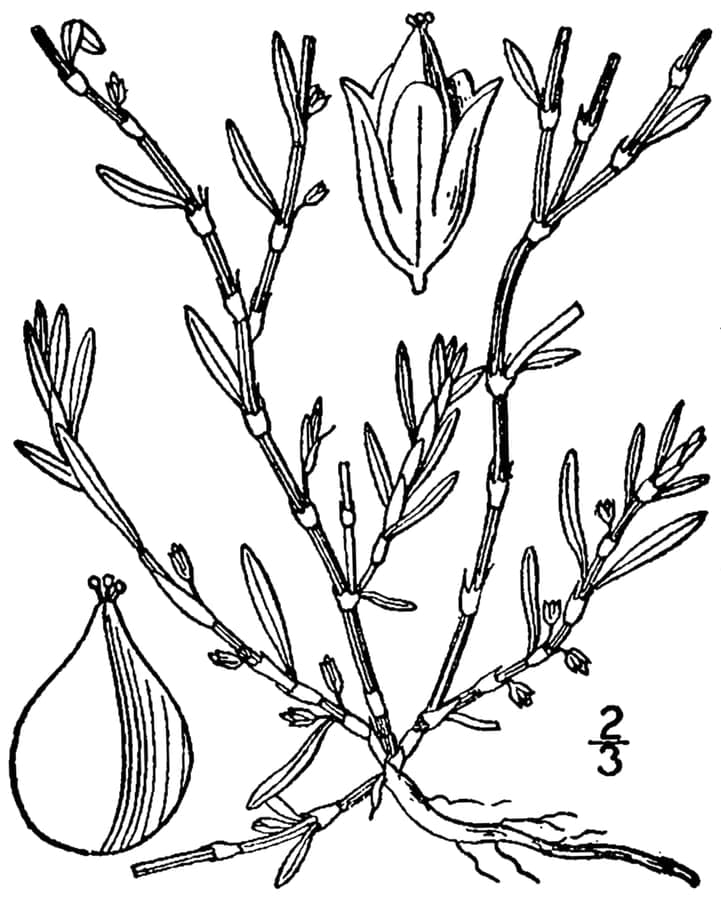
Britton, N.L., and A. Brown. 1913. / Public domain, via Wikimedia Commons
Seaside Knotweed: complete guide
Polygonum glaucum
Want to see Seaside Knotweed: complete guide in your garden?
1 minute, no credit card
Overview
Seaside Knotweed, scientifically Polygonum glaucum, is a remarkable yet underutilized North American plant perfectly suited to coastal garden conditions. This hardy species grows wild along the Atlantic Coast from Florida to Massachusetts, thriving where salt spray and relentless wind would deter most ornamental plants. With its compact growth habit, fine textured foliage, and exceptional environmental tolerance, Seaside Knotweed offers European gardeners a unique opportunity to establish authentic coastal landscapes with minimal ongoing maintenance.
Appearance and bloom
Seaside Knotweed is a subshrub to herbaceous plant reaching 30-60 cm in height with a naturally dense, mounded form. The distinctive feature is its narrow, blue-green tinged leaves that grow tightly together, creating a fine-textured, almost sculptural silhouette. During summer months (June-August), small white to pale pink flowers cluster along the stems, providing subtle colour and valuable nectar for wind-pollinated insects and butterflies. While not showy, these flowers attract beneficial pollinators essential for healthy garden ecosystems. In autumn, foliage takes on purplish-white undertones, adding unexpected seasonal interest.
Ideal location
Seaside Knotweed thrives in full sun to part-shade conditions, performing best with 5-6 hours of direct sunlight daily. In coastal zones, it tolerates full sun exposure without leaf scorch. For maximum compact growth and salt tolerance, locate plants in full sun positions on south to southwest-facing sites. This plant is exceptionally salt-tolerant and actually performs better in salt-spray environments than in sheltered inland locations. Avoid planting in dense shade or competing with large trees.
Soil
This coastal specialist demands very well-draining, relatively poor soils. Sandy to gravelly substrates (pH 5.5-7.5) are ideal. The plant evolved in sandy beach environments with minimal organic matter, so resist the urge to amend heavily with compost. Rich soils promote excessive foliage at the expense of structural integrity and hardiness. If your garden soil is clay-heavy, incorporate 40-50% coarse sand or perlite to improve drainage. Waterlogging is the plant's primary killer.
Free design
Want to see Seaside Knotweed: complete guide in your garden? Make a free design now.
Watering
Once established, Seaside Knotweed is remarkably drought-tolerant thanks to its deep root system. Water thoroughly once weekly during the first growing season (May-September), particularly if rainfall is infrequent or during prolonged dry spells exceeding 2 weeks. After 18 months, water needs decline dramatically. In European climates with consistent rainfall, summer watering is often unnecessary. In winter (November-March), reduce watering to minimal levels. The plant prefers to dry somewhat between waterings.
Pruning
Seaside Knotweed requires minimal pruning. Conduct an annual spring refresh in early March by cutting 15-25 cm back to healthy foliage, encouraging bushier growth and preventing legginess. Remove dead or storm-damaged wood immediately. In exposed coastal sites with heavy wind, prune more aggressively (cut 30 cm back) to maintain a compact form. Avoid pruning after September.
Maintenance calendar
January-March: Annual spring pruning. Apply thin mulch layer of coarse sand or fine gravel. April-May: Growth season begins. Establish weekly watering if rainfall is absent. June-August: Peak blooming and growth period. Maintain consistent watering schedule. September-October: Reduce watering as autumn rains return. November-December: Minimal maintenance. Plant is dormant.
Winter hardiness
Seaside Knotweed is winter hardy to USDA Zone 5b-6a (-12 to -10 degrees C). Throughout the Netherlands, Belgium, and northern France (Zones 7-8), the plant survives winters completely unprotected. Even in harsher regions (German highlands, southern Scandinavia), the plant rarely requires protection.
Companion plants
Seaside Knotweed pairs beautifully with other salt-tolerant, drought-resistant plants: Thesium pyrenaicum (Meadow Flax) for fine-leaf texture, Valeriana supina (Dwarf Valerian) for matching moisture and nutrient requirements, Syringa josikaea (Hungarian Lilac) for contrasting leaf structure, Sedum species for drought tolerance, and Marram Grass (Ammophila) for authentic coastal ground cover. Avoid pairing with moisture-loving plants like Primula rosea.
Closing
Seaside Knotweed represents a genuine garden gem for coastal gardeners seeking authentic, low-maintenance plantings. With its exceptional salt tolerance, drought resistance, and compact form, it's ideally suited to xeriscape and coastal garden designs. Once established, the plant demands virtually no intervention beyond annual pruning and occasional summer watering. Using gardenworld.app, explore how to integrate Seaside Knotweed into comprehensive coastal garden designs with complementary plantings and professional plant positioning.
Want to see Seaside Knotweed: complete guide in your garden? Make a free design now.
Upload a photo, pick a style, and get a photorealistic design with plant list in under a minute.
No credit card required


Similar plants
Crosby's wild buckwheat: complete guide
Eriogonum crosbyae
Full guide to growing Eriogonum crosbyae: ideal site, soil, watering, winter hardiness and companion plants for this rare western wild buckwheat.
Spreading buckwheat: complete guide
Eriogonum effusum
Full guide to growing Eriogonum effusum: ideal site, soil, watering, winter hardiness and companion plants for this prairie subshrub from the American West.
Tall woolly buckwheat: complete guide
Eriogonum elatum
Full guide to Eriogonum elatum: siting, soil, watering, pruning and companion plants for this elegant white-flowered buckwheat from the western United States.