
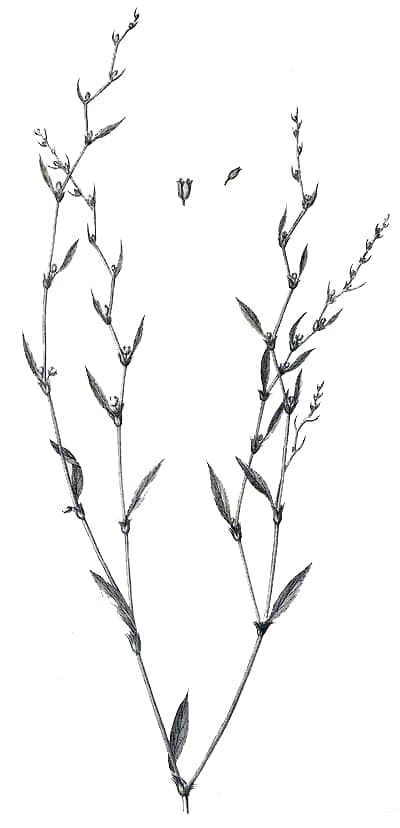
C. Allioni / Public domain, via Wikimedia Commons
Polygonum bellardii: complete guide
Polygonum bellardii
Want to see Polygonum bellardii: complete guide in your garden?
1 minute, no credit card
Overview
Polygonum bellardii, commonly known as narrowleaf knotweed, is a fascinating herbaceous annual from the Polygonaceae family. This plant grows naturally from the Mediterranean region to Siberia and has naturalized across Africa and Asia. Gardeners appreciate it for its remarkable ability to thrive in poor soils and challenging conditions where many other plants struggle.
The plant forms a compact, herbaceous habit with numerous small flowers appearing primarily from June to September. This extended flowering period makes it ideal for gardeners seeking structural plants that provide interest throughout summer. While not showy, it brings subtle elegance to semi-wild garden areas and naturalized planting schemes.
Appearance and bloom
Polygonum bellardii is a small to medium herbaceous plant reaching approximately 15 to 45 centimeters in height. The plant features narrow, linear leaves typical of the Polygonum genus, displaying bright green coloring with clear leaf margins.
The flowers are inconspicuous, appearing greenish-white to pale yellow in dense flower spikes. Rather than relying on showy blooms, this plant's charm lies in its elegant, minimalist appearance. The small flowers attract valuable insects and provide nectar for bees. After flowering, the plant produces tiny brown seeds enclosed in characteristic knotweed seed vessels.
Ideal location
Polygonum bellardii thrives in sunny to partially shaded positions. The plant tolerates full sun and performs reasonably well in less favorable light conditions. For optimal growth and extended blooming, choose a location receiving at least six hours of direct sunlight daily.
The plant integrates well with other herbaceous plants in wildflower borders and along pathways. Its modest size suits small gardens and container cultivation. It combines beautifully with Mediterranean and steppe plants, requiring minimal space and competing effectively for resources.
Soil
One of Polygonum bellardii's greatest strengths is its tolerance for diverse soil types. The plant grows on sandy, calcareous, and even moderately fertile soils. It requires minimal feeding and thrives on poor, dry substrates where many garden plants struggle.
The plant tolerates soil pH ranging from 7.0 to 7.5 or higher, indicating compatibility with neutral to slightly alkaline soils. Good drainage is essential to prevent root rot. Amend clay-heavy soils with sand or gravel to improve drainage.
Free design
Want to see Polygonum bellardii: complete guide in your garden? Make a free design now.
Watering
Once established, Polygonum bellardii demonstrates exceptional drought tolerance, making it ideal for water-wise gardens and dry locations. During the first growing season, regular consistent watering aids establishment, but excessive moisture must be avoided.
Under normal conditions, supplemental watering is rarely necessary, even during hot, dry summers. The plant tolerates significant drought without decline, making it excellent for rocky borders and other challenging dry zones.
Pruning
Polygonum bellardii requires minimal maintenance regarding pruning. The plant naturally maintains compact growth and needs no aggressive cutting back. For neater appearance and improved flowering, you can gently remove faded flowers and trim vigorous shoots.
After flowering, seeds may self-disperse. If preventing self-sowing, prune before seeds mature. However, many gardeners appreciate the natural form and welcome self-seeded plants.
Maintenance calendar
- March-April: Sow seeds directly or under glass
- May-June: Plant seedlings after frost danger passes
- June-September: Monitor for flowering and self-seeding
- October: Collect seeds for next season
- November-February: Plant dies back; prepare soil
Winter hardiness
Polygonum bellardii is an annual plant and cannot survive frost. In temperate climates, the plant dies when autumn frost arrives, which is entirely natural. The plant will self-seed next season if seeds remain.
In warmer regions, overwintering is possible but typically concludes after one season. For continued presence, sow new seed each spring or allow natural self-seeding.
Companion plants
Polygonum bellardii works excellently with other Mediterranean herbs including:
- Achillea (yarrow)
- Dianthus (pink)
- Lychnis (campion)
- Eryngium (sea holly)
- Foeniculum (fennel)
- Anthemis (chamomile)
These combinations create cohesive, natural planting schemes and share similar water and soil requirements.
Closing
Polygonum bellardii deserves recognition as an undervalued plant offering significant contributions to modern garden design. Its minimal maintenance requirements, exceptional drought tolerance, and extended flowering period make it invaluable for dry, sunny garden areas. Both amateur gardeners and professional designers appreciate its adaptive capabilities and subtle elegance. With GardenWorld, integrate this fascinating plant into your garden design and discover how it brings unique charm to your outdoor spaces.
Visit our platform to explore more garden plants and learn how intelligent design creates beautiful, sustainable front yards.
Want to see Polygonum bellardii: complete guide in your garden? Make a free design now.
Upload a photo, pick a style, and get a photorealistic design with plant list in under a minute.
No credit card required


Similar plants
Crosby's wild buckwheat: complete guide
Eriogonum crosbyae
Full guide to growing Eriogonum crosbyae: ideal site, soil, watering, winter hardiness and companion plants for this rare western wild buckwheat.
Spreading buckwheat: complete guide
Eriogonum effusum
Full guide to growing Eriogonum effusum: ideal site, soil, watering, winter hardiness and companion plants for this prairie subshrub from the American West.
Tall woolly buckwheat: complete guide
Eriogonum elatum
Full guide to Eriogonum elatum: siting, soil, watering, pruning and companion plants for this elegant white-flowered buckwheat from the western United States.