
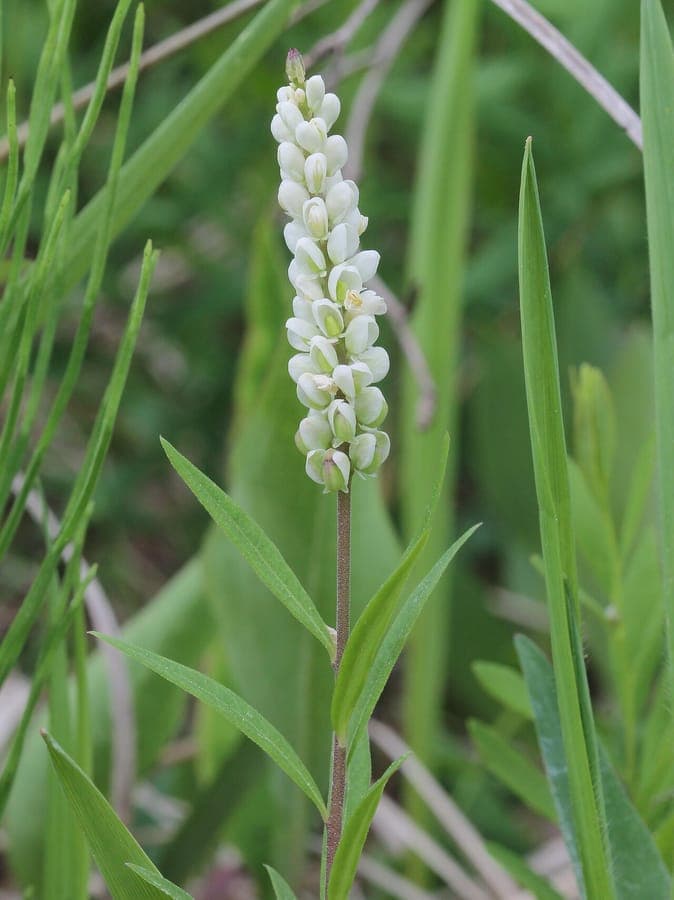
Rob Routledge, Sault College, Bugwood.org / CC BY 3.0 us, via Wikimedia Commons
Polygala senega: complete guide
Polygala senega
Want to see Polygala senega: complete guide in your garden?
1 minute, no credit card
Overview
Polygala senega, commonly known as Seneca snakeroot or senega-root, is a graceful North American native herb from the Polygalaceae family. This perennial plant grows from Canada through the eastern United States and carries a rich ethnobotanical history. Native Seneca tribes have used this plant medicinally for centuries, hence its popular name.
This compact plant reaches only 20 to 40 centimeters in height and spreads minimally, making it ideal for front-yard borders and mixed garden borders. Polygala senega is renowned for its long flowering period from May to July and its ability to thrive in partial shade and moist conditions.
Appearance & Bloom
Polygala senega grows as a compact, upright plant with slender, lance-shaped leaves. Foliage is glossy green and grows alternately along stems reaching 20 to 40 centimeters tall. The plant creates no dense foliage mass but rather an open, airy impression.
Flowers are this plant's characteristic feature. They appear in dense, ascending flower spikes at stem tips. Blooms are small, approximately 3 to 4 millimeters, and range from white to light purple with finely toothed margins. The flowering period extends from May to July, with possible repeat blooms in autumn if the plant is deadheaded.
Ideal Location
Polygala senega is a flexible plant regarding light conditions. It thrives in full sun to partial shade, provided soil remains adequately moist. Minimum 4 to 6 hours of direct sunlight promotes flowering.
This plant shows no strong wind-shelter preference and can be planted relatively openly. In Dutch gardens, it particularly thrives in semi-shaded locations with adequate soil moisture. For indoor cultivation in containers, position near a window with indirect light.
Soil
Polygala senega prefers moist to moderately wet soils and shows surprising tolerance for various soil types. An acidic to neutral soil pH (6.0 to 7.0) is ideal, though the plant also tolerates less-than-ideal conditions.
Ensure adequate organic matter in soil through annual addition of compost or garden manure. The plant tolerates wet soils better than dry ones, so ensure good moisture retention. For container cultivation, use moisture-rich potting soil with added peat substitute.
Free design
Want to see Polygala senega: complete guide in your garden? Make a free design now.
Watering
Water Polygala senega regularly, especially during dry periods. Keep soil consistently moist but not waterlogged. During the growing season (spring and summer), water 1 to 2 times weekly depending on rainfall.
In winter, soil can be drier, though never allow it to completely dry out. For potted plants in dry households, more frequent watering may be necessary. Preferably water at the plant's base.
Pruning
Polygala senega requires minimal pruning. Remove spent flower spikes in July after primary bloom to encourage possible autumn rebloom. This also helps keep the plant more compact.
Remove dead or damaged stems in spring. After spent blooms, the entire plant can be cut back to about 5 centimeters to encourage new growth.
Maintenance Calendar
January-March: Plant grows slowly. Prevent dry feet by keeping soil moisture minimal.
April-May: Active growth begins. Water regularly. Perform seeding.
June-July: Bloom peaks. Remove spent flowers. Water regularly.
August-September: After bloom, possible pruning. Autumn bloom possible.
October-November: Winter preparation. Stems can be cut back.
Winter Hardiness
Polygala senega is extremely winter hardy in temperate regions and can remain in-ground without protection. The plant dies back to soil level and reappears each spring from underground roots. This is a natural strategy for winter survival.
The plant requires no winter protection in mixed borders. Leave dried stems standing through spring for extra root insulation.
Companion Plants
Polygala senega fits well in mixed borders with other native herbs and perennials. Combine with other partial-shade-loving perennials such as Thalictrum, Anemone, and Helleborus. Plant low-growing groundcovers like Veronica underneath.
In wetter ground areas, combine with marsh plants and perennials tolerating boggy conditions.
Closing Remarks
Polygala senega is a refined, easy-to-maintain plant perfect for gardens everywhere. With its long flowering period, moisture tolerance, and winter hardiness, it offers years of visual interest. This could be a valuable element in your garden design. Visit gardenworld.app for more information on garden planning. Let gardenworld.app create your perfect garden design incorporating native plants.
Want to see Polygala senega: complete guide in your garden? Make a free design now.
Upload a photo, pick a style, and get a photorealistic design with plant list in under a minute.
No credit card required


Similar plants
Rock milkwort: complete guide
Polygala rupestris
Everything about Polygala rupestris, the Mediterranean rock milkwort, for dry rock gardens and warm sunny spots with well-drained alkaline soil.
Alpen-Kreuzblume: complete guide
Polygala alpestris
Discover the elegant Alpen-Kreuzblume (Polygala alpestris), an alpine mountain plant with blue flowers perfect for rock gardens and alpine borders.
Polygala nicaeensis: complete guide
Polygala nicaeensis
Discover the charming Polygala nicaeensis, a Mediterranean gem with white, blue and purple flowers. Perfect for sunny front garden borders.