SKsiddhartthan / CC BY-SA 4.0, via Wikimedia Commons
Tuberose: complete guide
Polianthes tuberosa
Want to see Tuberose: complete guide in your garden?
Full design in HD: €7.99
Look after your Tuberose with the GardenWorld app
Identify plants with your camera and get a care calendar with reminders for this plant.


Overview
Tuberose (Polianthes tuberosa) is arguably the most powerfully scented flower you can bring into bloom in a temperate garden. A single spike will fill a whole patio on a summer evening with a sweet, creamy fragrance reminiscent of jasmine and orange blossom. It has been a prized ingredient in perfumery for centuries, and in India and Mexico the flowers are still threaded into garlands and used in arrangements.
The plant belongs to the asparagus family (Asparagaceae), in the same group as the agaves, and some botanists now classify it as Agave amica. It originates in Mexico, although it is no longer known in the wild: tuberose has been propagated purely in cultivation since Aztec times. It grows from a tuber-like rootstock and needs a long, warm summer, so in north-west Europe it is best grown in a pot started indoors early in spring.
If you are wondering where fragrant plants would work best in your garden, so that you actually enjoy them in the evening, gardenworld.app can create a garden design that brings seating areas and scented planting together.
Appearance and bloom cycle
The tuber produces a rosette of narrow, strap-like leaves 30 to 45 cm long, fresh green and sometimes flecked with reddish spots at the base. Once the plant has built up enough strength, a straight, unbranched flower stem shoots up in late summer, reaching 60 to 100 cm and occasionally more with good care.
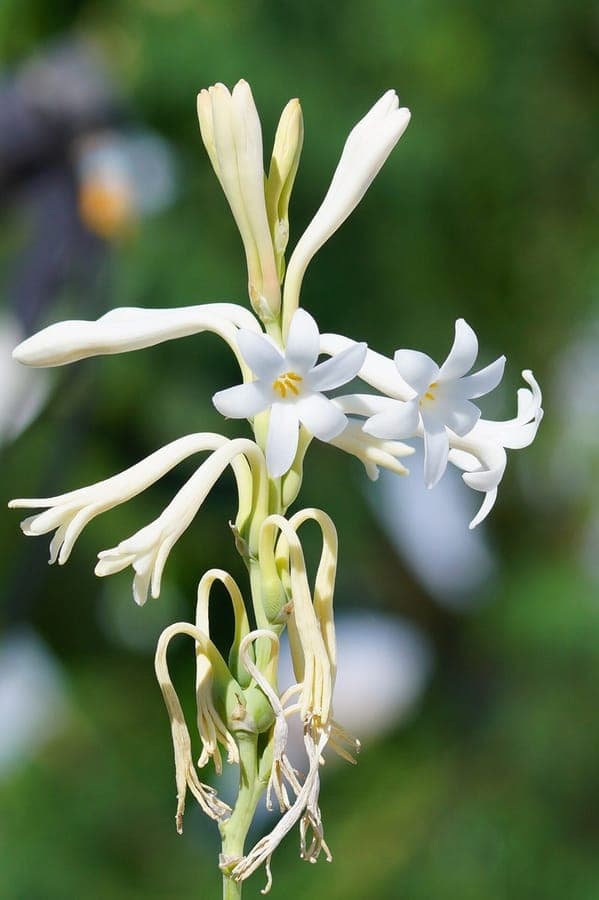
At the top sits a spike of waxy white flowers arranged in pairs. Each bloom is a tube 4 to 6 cm long opening into six star-shaped lobes. The buds are long and slender, sometimes with a faint pink blush. Flowers open from the bottom upwards, so a single stem carries buds, open blooms and faded flowers at the same time, just as in the photograph. The scent is strongest in the evening and at night.
In our climate tuberose usually flowers from August into October, depending on when you started the tubers and how warm the summer is. Besides the single form there is the double cultivar 'The Pearl', with fuller, rosette-like flowers. One point worth knowing from the start: a tuber that has flowered will not flower again. It does produce offsets, but these need two to three years before they bloom themselves.
Ideal location
Tuberoses want full sun and warmth. A sheltered, sunny south or south-west facing patio is ideal, preferably close to where you sit in the evening. The warmer the summer, the earlier and more generous the flowering. Below roughly 15 °C growth almost stops.
They can be grown in the open ground in a warm, sheltered border, but pots are more practical: you can start them indoors early, move them to the warmest spot and bring them in easily in autumn. Allow a pot of about 15 cm per tuber, or group three tubers in a container 25 to 30 cm across.
Soil requirements
Tuberose likes a fertile, humus-rich soil that holds moisture well yet drains freely. Standing water around the tuber is the quickest route to rot. In pots, use a good multipurpose compost with some added garden compost and about a fifth grit or perlite, with a layer of clay pebbles at the bottom.
In the ground, improve heavy clay with grit and organic matter. Enrich sandy soil with well-rotted compost so the plant does not dry out in summer. Slightly acidic to neutral soil suits it best.
Planting the tubers
Choose firm tubers with an intact growing point; shrivelled, hollow or soft ones will not flower. Start them indoors in March or April. Set each tuber with its tip at or 2 to 3 cm below the surface of the compost. Water once, moderately, and place the pot somewhere warm and bright, ideally 18 to 22 °C. A sunny windowsill above a radiator or a heated conservatory works well. Do not water again until the first leaves appear.
Once night temperatures no longer drop below about 10 °C, usually from late May, the pot can go outside. If you are planting in the ground, put out the started plants at that point, with the tuber 5 cm deep and 15 to 20 cm apart.
Free preview
Want to see Tuberose: complete guide in your garden? Make a free preview of your design.
Watering
While in growth, tuberose is a thirsty plant. Keep the soil evenly moist, but let the top centimetre dry briefly between waterings. In hot weeks a pot may need watering every day. It will not tolerate sitting in a saucer of water.
From June, feed every two weeks with a liquid fertiliser for flowering plants. Once the flower stem appears, regular water and feeding matter even more. After flowering, reduce both gradually.
Pruning
No real pruning is required. Cut the flower stem down once all its blooms have faded. For a vase, cut a stem when the lowest two flowers are open; the remaining buds will open indoors in water. Leave the foliage until it yellows. In warm, dry weather aphids and red spider mite can appear, so hose the leaves down and check the undersides.
Maintenance calendar
March–April: Start tubers indoors in pots somewhere warm and bright.
May: Water sparingly as the leaves grow. Move outdoors at the end of the month.
June–July: Water regularly and feed every two weeks.
August–October: Flowering. Enjoy the evening scent and cut stems for the house if you like.
October: After flowering, reduce watering and bring the pot in before the first frost.
November–February: Store tubers or offsets dry and warm.
The plant calendar on gardenworld.app is a useful reminder of when each of these jobs comes round.
Winter hardiness
Polianthes tuberosa is not hardy. The tubers do not survive frost, and even prolonged cold around freezing point can damage them. In our climate the plant must spend winter indoors, dry and frost-free. Only in the warmest parts of southern Europe can it stay outside all year.
Overwintering
Bring the pot in before the first night frost, usually in October. Let the foliage die back, cut it off and lift the tubers. A tuber that has flowered can go on the compost heap; keep the young offsets around it. Let them dry for a few days, then store them in a paper bag or a box of dry sand or vermiculite.
Tuberoses prefer warmer storage than most summer bulbs, ideally between 10 and 18 °C. A cold garage is therefore a poor choice; a dry cupboard indoors is better. In spring, pot up the offsets. They spend their first years building up size and only flower after two to three years. If you want flowers every summer, buy a few flowering-size tubers each year.
Companion plants
Tuberose is at its best among other warmth-loving, scented plants. Place it next to regal lily (Lilium regale) for an earlier wave of fragrance, or pair it with the white, scented Gladiolus murielae, which flowers at much the same time. Heliotrope (Heliotropium arborescens) with its vanilla scent and the evening-fragrant flowering tobacco (Nicotiana alata) turn a patio into a true scent garden. A large pot of African lily (Agapanthus praecox) provides a blue counterpoint to the white flowers.
Final thoughts
Tuberose needs a little planning: start it early indoors, give it warmth and bring it back in for autumn. Do that, and late summer rewards you with a fragrance like no other. Little reliable information exists on its toxicity; the sap can irritate sensitive skin, and as with most bulbs it is wise to keep pets from chewing the tubers or leaves. Start three tubers in a pot this spring and set it beside your garden chair in August.
Frequently asked questions about Tuberose
Is Tuberose winter hardy?
Polianthes tuberosa is not hardy. The tubers do not survive frost, and even prolonged cold around freezing point can damage them.
When and how do you prune Tuberose?
No real pruning is required. Cut the flower stem down once all its blooms have faded.
How much water does Tuberose need?
While in growth, tuberose is a thirsty plant. Keep the soil evenly moist, but let the top centimetre dry briefly between waterings.
Where does Tuberose grow best?
Tuberoses want full sun and warmth. A sheltered, sunny south or south-west facing patio is ideal, preferably close to where you sit in the evening.
What soil does Tuberose need?
Tuberose likes a fertile, humus-rich soil that holds moisture well yet drains freely. Standing water around the tuber is the quickest route to rot.

See it in your garden
See Tuberose in your garden
One photo of your garden and a few questions. You see the result in about a minute.
Try it with a photoIdentify this plant in your own garden. Identify a plant
Similar plants
Gladiolus murielae: complete guide
Gladiolus murielae
Discover how to successfully grow Acidanthera with this comprehensive guide. From planting tips to winter protection and care advice - everything you need to know.
Lilium regale: complete guide
Lilium regale
The regal lily is the queen of lilies with pure white flowers and purple backs. Discover how to grow this classic lily in your garden.
Heliotropium arborescens: complete guide
Heliotropium arborescens
Heliotropium arborescens, the garden heliotrope, is a fragrant shrub with purple flowers and delightful vanilla scent, perfect for sunny borders.
