
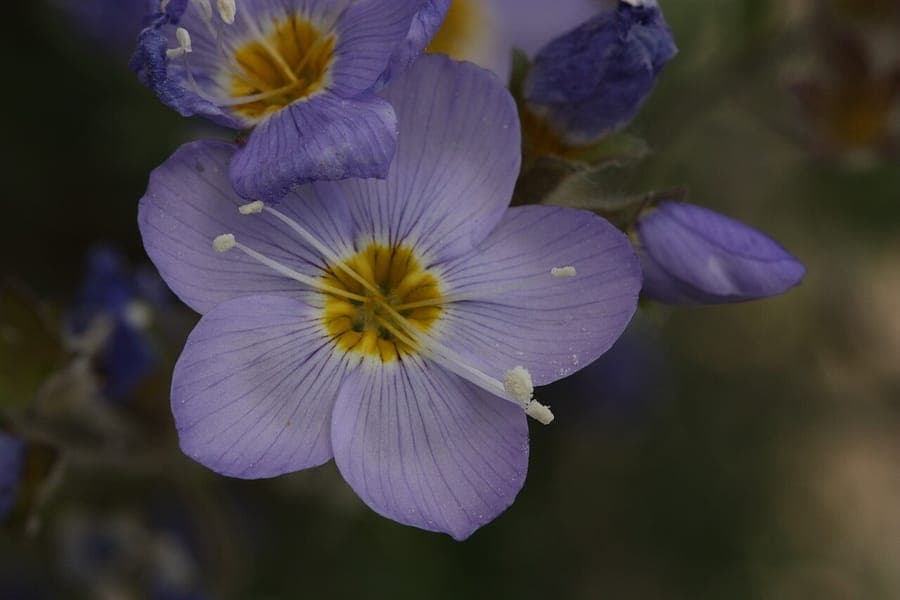
Walter Siegmund (talk) / CC BY-SA 3.0, via Wikimedia Commons
Boreal jacob's-ladder: complete guide
Polemonium boreale
Want to see Boreal jacob's-ladder: complete guide in your garden?
1 minute, no credit card
Overview
Polemonium boreale, known as Boreal jacob's-ladder, Northern jacob's-ladder, or Polarflokk, is a hardy alpine plant from subarctic regions. This species grows naturally in Alaska, northern Canada, Greenland, Norway, and various parts of Russia and Siberia. The plant is adapted to extreme cold and grows in open alpine and arctic tundra environments where few other plants can survive. Although a wild plant of high latitudes, it also grows excellently in Dutch alpine gardens and rock gardens, especially in cool locations with good drainage. The plant is very valuable for bees and other pollinators due to rich nectar production. In its natural habitat, this plant grows on northern mountain slopes where snow can persist late into the season.
Appearance and Bloom
Boreal jacob's-ladder is a herbaceous plant reaching 15 to 30 centimeters tall, though sometimes slightly taller under ideal conditions. The plant forms thick, reddish-margined leaves in a rosette-like base close to the ground. The leaves are much larger than in many other alpine plants. From June to August, lovely, five-petaled blue flowers appear in dense spikes at the tops of stiff stems. The flowers are approximately 1 to 1.5 centimeters in diameter and have yellow stamens that provide contrast. The flowers grow in cluster-like plumes. The plant has a pleasant fragrance that attracts many pollinators. After flowering, seed pods form containing many tiny seeds.
Ideal Location
This plant thrives best in sunny location with minimum 6 hours direct sunlight daily for optimal blooming. It can also grow in part shade, especially in hot climates where afternoon shade can be beneficial. In the Netherlands, full sun is ideal for optimal blooming. Plant in elevated location or rock gardens where water drains well and no stagnation occurs. The plant grows better in cool locations with good air circulation. In very hot summers, the plant may struggle with warmth, so a cool north-facing side can be beneficial.
Soil
Polemonium boreale prefers well-draining soil with minimal nutrition. The plant grows in poor, stony soils in its natural habitat. A mix of soil with gravel, perlite, and sand in ratio 1:1:1 is ideal. Drainage must be excellent; planting in raised beds is recommended. The plant is very tolerant of poor soils and can even grow on pure gravel. Feeding usually produces more leaf than flower.
Free design
Want to see Boreal jacob's-ladder: complete guide in your garden? Make a free design now.
Watering
During growing season, this alpine plant needs moderate water, especially in very hot summers. Soil should remain moist but not wet. After flowering, water can be reduced somewhat. The plant tolerates drought much better than excess moisture. Prevention of stagnant water is essential and will cause root rot. In very wet years, the plant may have drainage problems.
Pruning
Remove spent flowers as soon as they fade to extend blooming and prevent excessive seeding. After blooming season, the plant can be cut back close to ground to encourage new growth. This prevents the plant from becoming too thin and leggy. Many gardeners pinch the plant halfway through growth to get more compact, fuller plants.
Maintenance Calendar
April through May: sow seeds or plant young plants in prepared rock gardens. June through August: blooming period, abundant flowers appear. September through October: plant becomes dormant, less water. November through March: winter rest period without activity. Plant is fully winter-hardy. In spring, young growth provides food for insects.
Winter Hardiness
Polemonium boreale is fully winter-hardy in the Netherlands to USDA zone 3 and can tolerate extreme cold. The plant grows better in cold climates and can survive at temperatures below -30 degrees Celsius. In hot summers, the plant may sometimes struggle with warmth, so a cool location is preferred. The plant tolerates frost and snow without problem.
Companion Plants
Boreal jacob's-ladder combines well with other alpine plants such as Saxifraga, Armeria, Draba, Pulsatilla, and Sempervivum. The plant attracts bees, bumblebees, and butterflies and is valuable for arctic gardens and alpine rock gardens. The plant is also suitable for alpine troughs and rockeries.
Closing
Polemonium boreale is an excellent choice for those wanting a truly arctic alpine plant in the garden. With good drainage and minimal feeding, this plant grows reliably and produces beautiful blue flowers year after year. A must-have for lovers of Nordic flora and extreme alpine horticulture. The plant is also relatively easy to grow from seed.
Want to see Boreal jacob's-ladder: complete guide in your garden? Make a free design now.
Upload a photo, pick a style, and get a photorealistic design with plant list in under a minute.
No credit card required


Similar plants
Phlox alyssifolia: complete guide to Alyssum-leaf Phlox
Phlox alyssifolia
Alyssum-leaf phlox is a compact alpine pink bloomer from North America. Discover care, location and all growing requirements.
Phlox richardsonii: complete guide to Richardson's Phlox
Phlox richardsonii
Richardson's phlox is an arctic bloomer exceptionally robust. Learn cultivation in extreme conditions and complete care guide.
Polemonium foliosissimum: complete guide
Polemonium foliosissimum
Polemonium foliosissimum is a vigorous Rocky Mountain perennial with blue-purple summer flowers that attract pollinators and thrive in borders.