
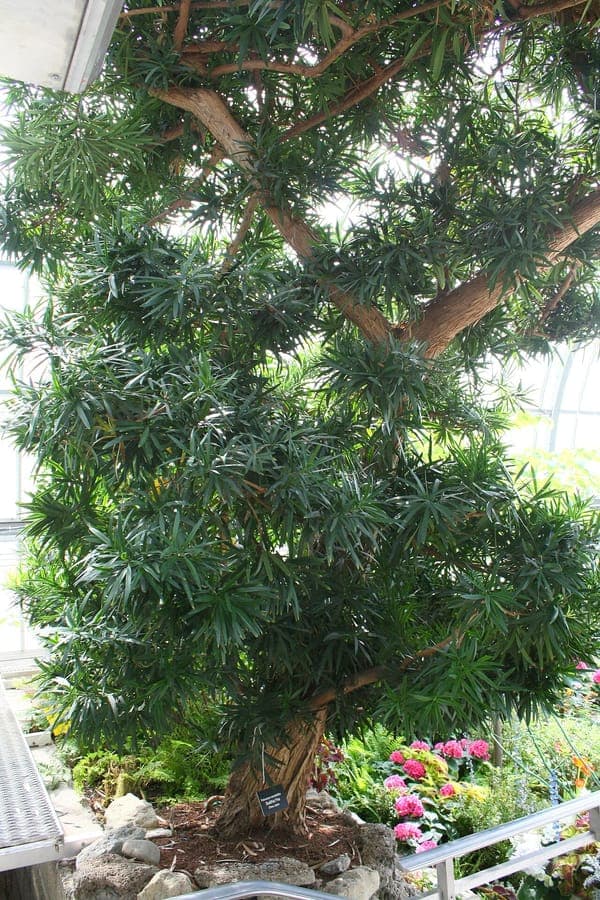
Greg Hume / CC BY-SA 3.0, via Wikimedia Commons
Podocarpus macrophyllus: complete guide
Podocarpus macrophyllus
Want to see Podocarpus macrophyllus: complete guide in your garden?
1 minute, no credit card
Overview
Podocarpus macrophyllus, known as Buddhist pine, Japanese yew or big-leaf podocarp, is an elegant conifer from East Asia. Native to southern China, Taiwan, Japan and Myanmar, this tree is celebrated for its large, glossy dark-green needles and compact growth habit. Despite its name, it is not a true yew or pine, but a member of the Podocarpaceae family. The plant is very popular in Japanese gardens and often used as a specimen tree or in groups. This is a plant for enthusiasts of oriental garden art.
Appearance and bloom
The Buddhist pine grows in a pyramid to columnar form, reaching heights up to 10 meters under optimal conditions, though cultivars remain more compact. The needles are large (up to 7 cm), linear and dark-green, much coarser than in other conifers. The bark is smooth, gray-brown and somewhat weathered with age. The tree bears small yellow male flowers and female cones that develop into purple, fleshy seed receptacles. These fruits are highly decorative and persist into winter.
Ideal location
Podocarpus macrophyllus grows best in partial shade to full sunlight, though heavy afternoon sun in very warm areas may be avoided. A location with morning sun and afternoon shade is ideal in southern locations. The tree tolerates sea wind well and is therefore suitable for coastal gardens. Avoid very dry, windy positions where evaporative water loss is high.
This tree can grow in containers and is therefore suitable as a screening solution for patios and terraces.
Soil
The Buddhist pine is not fussy about soil and grows in varied soils. Well-draining soil is however preferred. A mixture of garden compost, sand and leaf mold provides optimal conditions. Soil pH can vary between 5.5 and 7.0. The tree tolerates both dry and moist groundwater, though regularly moist soil is preferred.
Incorporate organic material when planting. This helps especially in poor soils. No special feeding is needed provided well-prepared soil.
Watering
After planting, water regularly during the growing season until the tree is well established (1-2 years). Once established, this tree tolerates drought reasonably well. In container culture, water regularly without allowing water to stagnate. Twice weekly is generally sufficient. In winter, less water.
Ensure well-draining soil. Waterlogging is more harmful than any drought.
Free design
Want to see Podocarpus macrophyllus: complete guide in your garden? Make a free design now.
Pruning
Pruning is mainly for shape and dense growth. This tree can be cut very well and tolerates heavy pruning well. In Japan, this tree is regularly pruned into artistic forms (niwaki). For informal use, light spring pruning may be sufficient. Remove only dead branch cores.
Pruning wounds heal quickly. The tree forms new growth rapidly after pruning.
Maintenance calendar
Spring (March-May): Check for winter damage, light pruning for shape. Beginning of growth period.
Summer (June-August): Regular watering, no special care needed. Growth peak reached.
Autumn (September-October): Gradually reduce watering. Decorative purple fruits present.
Winter (November-February): Minimal maintenance needed. Check moisture content of container plants.
Winter hardiness
Podocarpus macrophyllus is reasonably frost-hardy to approximately -12 to -15 degrees Celsius. This enables survival in many temperate climates. In areas with regular frost to -18 degrees, protection is advisable in severe winters.
In the first year after planting, protection against shade scald is helpful by wrapping the trunk with burlap. Mulch around the base with 10 cm of leaf mold. Once established (after 2-3 years), protection is usually unnecessary.
Companion plants
Shade-loving underplanting fits well beneath Buddhist pine. Hedera helix (ivy) forms a green carpet. Liriope muscari fills gaps. Hostas bring architecture and seasonal color.
In sunny positions, Buddhist pine combines well with other conifers. Thuja occidentalis or Chamaecyparis lawsoniana add diversity. Evergreen shrubs such as Ilex aquifolium provide contrasting structure.
Avoid very competitive growers nearby that could choke the tree.
Closing remarks
The Japanese yew is a very versatile and decorative conifer that has its place in both modern and traditional gardens. With minimal care, this tree grows over decades into a mature specimen of architectural quality. The combination of fine needles, compact growth and frost hardiness makes it a standard choice for designers seeking quality.
Available at most garden centers, particularly major chains, in various sizes. Larger specimens (1.5+ m) are also available online. gardenworld.app advises on integration of conifers in front yard designs. gardenworld.app also offers niwaki tutorials for traditional Japanese forms.
Want to see Podocarpus macrophyllus: complete guide in your garden? Make a free design now.
Upload a photo, pick a style, and get a photorealistic design with plant list in under a minute.
10,000+ gardens designed already
No credit card required


Similar plants
Prumnopitys andina: complete guide
Prumnopitys andina
Plum-fruited yew from the Andes. Read about cultivation, preference for cool climates and adaptation to mountain regions.
Podocarpus neriifolius: complete guide
Podocarpus neriifolius
Brown Pine is a subtropical conifer with elegant needle-like foliage resembling oleander leaves. Ideal for protected, warm locations with excellent drainage.
Podocarpus nubigenus: complete guide
Podocarpus nubigenus
Cloud Podocarp is an elegant, frost-sensitive conifer from the Andes with fine needle structure. Perfect for sheltered gardens with moderate winter cold.