
Melburnian / CC BY 3.0, via Wikimedia Commons
Podocarpus lawrencei: complete guide
Podocarpus lawrencei
Want to see Podocarpus lawrencei: complete guide in your garden?
1 minute, no credit card
Overview
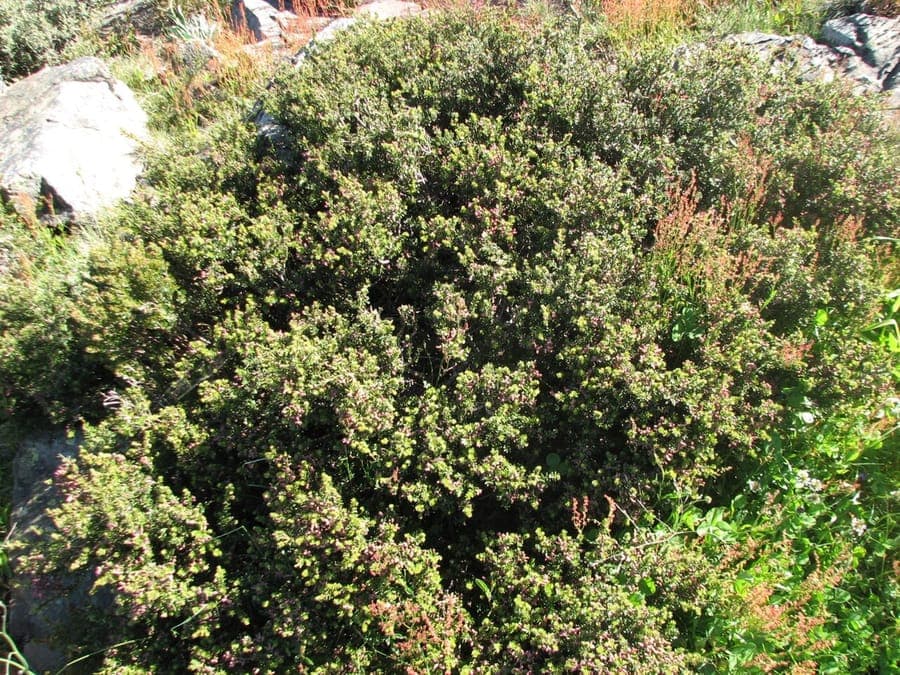
Podocarpus lawrencei, commonly known as mountain plum pine, alpine plum pine, or mountain yew, is a rare and compact conifer from the Podocarpaceae family. This plant originates from the mountainous regions of southeastern Australia, growing wild at elevations of 1000-2000 meters in cold mountain forests. The plant is celebrated for its extremely compact growth, fine needles, and unique structure.
Mountain plum pine is a fascinating choice for gardens seeking something special and rare. This is no ordinary conifer; it is a collector's plant for lovers of alpine and mountainous conifers. The tree grows extremely slowly (usually only 5-10 cm per year) and reaches mature heights of 3-6 meters in garden conditions, though it can remain much smaller.
Appearance and Growth
Mountain plum pine displays an extremely compact, densely grown appearance. The needles are small (0.5-1 cm), linear, and dark green. They grow radially around the branches. The tree naturally assumes a conical to rounded form, depending on growing conditions.
The bark is smooth to slightly fissured in grayish-brown color. The tree produces small, unique seed structures (arils) that are red-orange in color and highly decorative. These seeds are not edible but provide bird food.
Growth is extremely slow. A small plant of 30 cm may require several years to reach 60 cm. This is advantageous for small gardens as the tree retains its form for years. The tree is very long-lived and can reach one hundred years or more.
Ideal Location
Mountain plum pine performs best in locations with good (4-6 hours daily) to abundant sunlight. The tree tolerates partial shade reasonably well, though full sun is preferable. In full shade the tree grows slowly and becomes less compact.
The tree is very hardy and tolerates strong wind, though protection in early years is beneficial for young plants. Plant in a protected location on east-west to south-facing aspect, where the tree won't suffer winter sunscald from extreme temperature fluctuations.
Important: Mountain plum pine originates from cold mountain climates and dislikes warm, humid summers. In northern Europe it grows well; in very warm climates it can struggle. It is really a plant for temperate to cool climates.
Soil
Mountain plum pine prefers well-draining, acidic to neutral soil (pH 5.0-7.0). The tree grows in sandy, clay, and loamy soils provided drainage is excellent. For best results add compost or peat moss when planting.
The tree does not tolerate waterlogging well. Add perlite or sand to heavy clay soils. A drainage layer is essential in low-lying areas. After planting apply a mulch layer, but ensure it doesn't contact the trunk directly.
Important: This is a mountain plant and prefers cooler, well-drained soils. In warm climates with wet soils it will not thrive.
Free design
Want to see Podocarpus lawrencei: complete guide in your garden? Make a free design now.
Watering
Watering is important, especially in the early years after planting. Water regularly to keep soil moist but not soggy. Once established, mountain plum pine is moderately drought tolerant.
During dry summers water especially in morning and evening for cooling. A thick mulch layer (7-10 cm) of straw around (but not against) the stem helps moisture retention and soil cooling. This is especially important in the first growing year.
During very dry periods (longer than 3 weeks without rain), extra watering may be needed. Winter watering is rarely needed in temperate climates with regular precipitation. In very dry winters watering can be beneficial.
Pruning and Maintenance
Mountain plum pine requires minimal maintenance. The tree naturally grows in a beautiful, compact form and doesn't require pruning. You can remove damaged or diseased branches in early spring. Always cut before the branch collar, never through the wood.
The natural growth pattern is very attractive and compact. Pruning is actually not recommended as it damages the unique form. Simply let the tree grow at its own pace and in its own form.
During winter frosts young shoots can suffer damage. This is rarely a problem, but if it occurs, simply cut back damaged sections in early spring.
Maintenance Calendar
January-February: Check winter protection, prepare for growing season. March: Remove damaged branches, begin watering. April-May: Growing period, regular watering, supplement mulch. June-August: Continued growth, watering important during dry periods. September-October: Growth slows, prepare for winter. November-December: Winter preparation, protect young trees.
Winter Hardiness
Mountain plum pine is reasonably winter hardy and tolerates temperatures down to approximately -15 to -20 degrees Celsius. This is a plant for temperate mountain climates. In much of Europe it grows well, though very cold regions (north of zone 6) require more care.
Young plants can suffer from extreme winter frost damage. Protect young trees with jute wraps or screens in December-February. Older trees are much hardier.
Winter sunscald can occur. Plant in a location with east-side protection. This is rarely fatal but can be unsightly.
Companion Plants
Mountain plum pine combines beautifully with:
- Japanese maples - complementary structure and texture
- Dwarf conifers - similar compact growth
- Helleborus - blooming beneath tree
- Hosta - large leaves in shade
- Ferns - delicate structure
- Rhododendrons - colorful blooming
- Heathers - underplanting
- Ornamental grasses - texture contrast
Conclusion
Mountain plum pine is a unique, rare choice for gardens seeking something special. Its extremely slow growth and compact form make it a plant for patient gardeners. This is not a plant for quick results, but for long-term beauty and collection building.
Perfect as a focal point or specimen plant in small to medium gardens. Its rarity and unique structure make it a true eye-catcher. Plant mountain plum pine where it receives proper drainage, lighting, and protection. This is really a plant for experienced gardeners who love alpine and mountain plants.
Mountain plum pine is not easily found everywhere. Search for specialized growers of alpine and rare conifers. GardenWorld can advise on the best locations in your garden for this fascinating plant.
Want to see Podocarpus lawrencei: complete guide in your garden? Make a free design now.
Upload a photo, pick a style, and get a photorealistic design with plant list in under a minute.
No credit card required


Similar plants
Prumnopitys andina: complete guide
Prumnopitys andina
Plum-fruited yew from the Andes. Read about cultivation, preference for cool climates and adaptation to mountain regions.
Podocarpus neriifolius: complete guide
Podocarpus neriifolius
Brown Pine is a subtropical conifer with elegant needle-like foliage resembling oleander leaves. Ideal for protected, warm locations with excellent drainage.
Podocarpus nubigenus: complete guide
Podocarpus nubigenus
Cloud Podocarp is an elegant, frost-sensitive conifer from the Andes with fine needle structure. Perfect for sheltered gardens with moderate winter cold.