
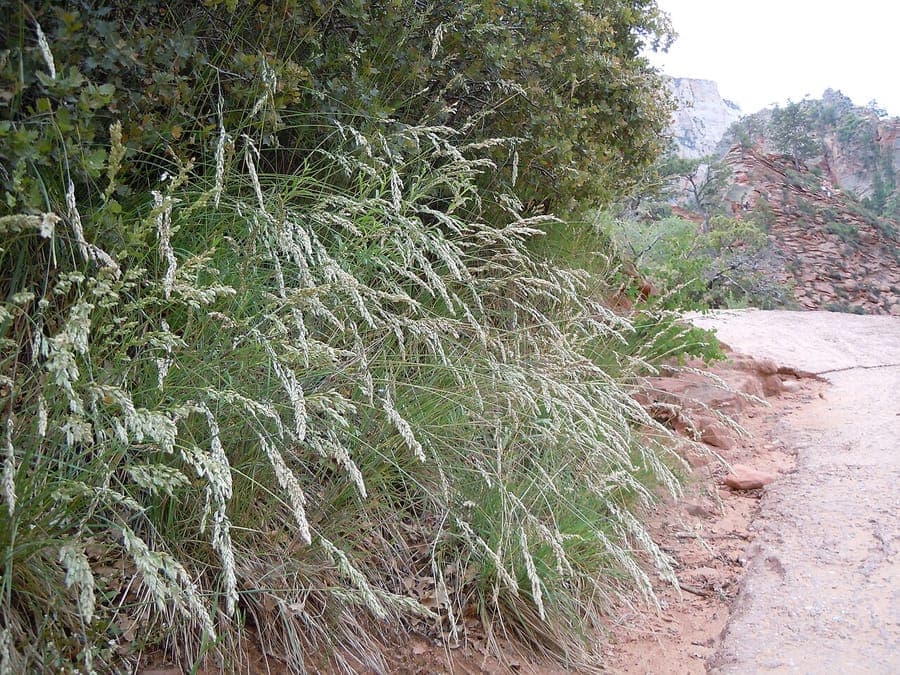
Matt Lavin / CC BY-SA 2.0, via Wikimedia Commons
Mutton grass: complete guide
Poa fendleriana
Want to see Mutton grass: complete guide in your garden?
1 minute, no credit card
Overview
Poa fendleriana, commonly known as mutton grass or muttongrass, is a clump-forming grass from the family Poaceae native to the semi-arid mountain regions of western North America. The species was formally described in 1893 by Vasey, based on earlier work by Steudel. Other names include Fendler's bluegrass and Vasey's muttongrass, named after Augustus Fendler, the 19th-century botanical collector who documented many plants from the American Southwest.
This grass ranges from western Canada south through the Rocky Mountain states of Montana, Wyoming, Colorado, Utah, Idaho, Nevada, New Mexico, and into northern Mexico. In its native habitat it colonises dry, open slopes at elevations of roughly 1,500 to 3,500 metres. For gardeners seeking a robust, self-sufficient grass that needs minimal intervention, this species is a compelling choice. Explore planting inspiration for your garden at gardenworld.app.
Appearance and bloom cycle
Poa fendleriana forms dense, compact tufts in the characteristic graminoid manner of the Poa genus. The leaves are fine in texture and green in colour, giving the clump a tidy, fresh look throughout most of the growing season. The narrow, pointed blades lend an airy, graceful structure to any planting.
The flower plumes emerge in late spring to early summer, typically in May and June. The panicles are attractive enough to add structure but not showy - this is a plant of understated elegance. Flowers are, as is typical for grasses, small and yellowish in tone. After flowering, brown seeds form and are dispersed by the wind. In autumn, the clump retains its form well, continuing to provide texture and structure even outside the main growing season.
The clump-forming growth habit means the plant does not spread via rhizomes or stolons. It stays where you put it, making it easy to combine with perennials without constant management.
Ideal location
Mutton grass performs best in full sun to lightly dappled shade. In its origin regions, it grows in full sunshine on open, steppe-like plains and mountain slopes. In the garden it thrives with at least six hours of direct sunshine per day.
The plant tolerates heat well and is notably resistant to drought, making it suitable for spots that are difficult to irrigate, such as slopes, rock gardens, and gravel plantings. It is less suited to shaded corners or areas where water can pool for extended periods.
In USDA hardiness zones 4 through 8, this grass can overwinter reliably in the open ground. In north-west European gardens, which typically fall into zones 7 to 8, no special winter protection is needed.
Soil
Poa fendleriana asks little of the soil, provided it drains freely. In nature it grows on dry, infertile soils with a pH of around 6 to 8 - slightly acid to slightly alkaline. Lean, mineral-rich ground suits it far better than rich, heavily amended garden soil.
Heavy clay is less suitable because water remains too long near the roots, risking rot. Light, sandy or loamy soil is ideal. If necessary, you can work some coarse sand or fine grit into the planting hole to improve drainage.
A distinct advantage of this grass is that it needs no compost or fertiliser. Excess nutrients can actually weaken the clump and make it more prone to flopping. Keep the soil lean for the best results.
Watering
Once well established, Poa fendleriana is highly drought-tolerant and requires very little supplemental water beyond normal rainfall. This is one of its most practical virtues: it copes well with extended dry spells without wilting or losing colour.
During the first one or two growing seasons after planting, regular watering is important to allow the roots to develop properly. Give a thorough drink once a week, but always allow the soil to dry out completely before watering again. Waterlogged conditions are harmful.
In summer, when the grass may enter a semi-dormant phase during a drought, leave it alone. Overwatering in summer creates more problems than it solves. In autumn and winter, no supplemental water is needed at all.
Free design
Want to see Mutton grass: complete guide in your garden? Make a free design now.
Pruning
This grass requires minimal cutting back. The main task is to comb through or lightly trim the clump at the end of winter, before new growth begins in February or March. Cut it back to roughly 10 to 15 cm above ground level to remove dead blades and make room for fresh new shoots.
Avoid cutting back in autumn, as the old foliage protects the crown against frost. During the season, remove only completely dead or brown blades that detract from the appearance. Leave the seed heads standing as long as possible - they add structure in autumn and attract seed-eating birds.
You will find suitable grass plants at specialist garden centres, where you can often find young pot-grown specimens ready for planting and easy initial trimming.
Maintenance calendar
January - February: Rest. No intervention needed unless a lot of dead foliage is smothering the clump.
March: Comb out dead material and lightly trim before new growth starts. Add a thin layer of coarse sand around the base if the soil is heavy.
April - May: Active growth. Divide the clump if it has become too large. First flower panicles appear toward the end of May.
June: Bloom time. Leave the panicles standing for pollinators and birds.
July - August: Possible semi-dormancy during drought. Do not water if the soil still retains some moisture.
September - October: The clump prepares for winter. Remove only clearly dead material.
November - December: Dormancy. No maintenance required.
Winter hardiness
Poa fendleriana is remarkably cold-tolerant. In its native range it endures severe mountain winters with deep frost and heavy snow. For European gardens, this means reliable overwintering in USDA zones 4 through 8, corresponding to minimum temperatures of around -34 degrees Celsius (zone 4) to -12 degrees Celsius (zone 8).
In the average north-west European garden (zone 7 to 8), no extra winter protection is needed. The clump remains visible above ground and continues to provide some structure even in winter. During extreme cold snaps, leaf tips may brown, but the clump recovers quickly in spring.
Avoid covering with thick layers of leaf mulch, which retains moisture around the crown and may encourage rot. A thin layer of coarse grit around the base is sufficient if you want to give the root crown a little extra protection.
Companion plants
Thanks to its compact clump-forming habit and preference for dry, infertile conditions, Poa fendleriana combines well with other species that share similar requirements.
Good companions include lavender (Lavandula angustifolia), creeping thyme (Thymus serpyllum), sea holly (Eryngium), purple coneflower (Echinacea purpurea), and gaura (Gaura lindheimeri). Low-growing species of Festuca and various dry-meadow sedges also fit naturally alongside it in a drought-tolerant planting scheme.
For a rock garden or gravel bed, the combination with Thymus, Dianthus, Sedum, and Sempervivum works beautifully. Avoid pairing it with plants that need moist, fertile soil - the cultural requirements are simply incompatible.
Visit gardenworld.app for more ideas on drought-tolerant planting combinations and garden design.
Closing
Poa fendleriana is an underappreciated grass that has a great deal to offer gardeners looking for a robust, low-maintenance, and decorative plant for dry, sunny spots. The clump-forming habit, fine leaf texture, subtle flower display, and excellent cold tolerance make it a reliable choice for modern, low-maintenance garden concepts.
This grass asks little of the gardener - no feeding, minimal watering, one trim in early spring - but returns the favour with a tidy, natural appearance throughout the year. For gardens that connect with the surrounding landscape, biodiversity planting, or gravel and rock designs, this species is a genuine asset.
Want to see Mutton grass: complete guide in your garden? Make a free design now.
Upload a photo, pick a style, and get a photorealistic design with plant list in under a minute.
10,000+ gardens designed already
No credit card required


Similar plants
Wheeler bluegrass: complete guide
Poa nervosa
Everything about Poa nervosa, the nerved bluegrass native to the Pacific Northwest of North America, for shaded and moist garden spots.
Ovina: complete guide
Festuca ovina
Everything you need to know about Festuca ovina: care, ideal conditions, soil, watering and plant combinations. Perfect for sunny, dry gardens. Find design ideas on gardenworld.app.