
Wikimedia Commons / Public domain, via Wikimedia Commons
Ovina: complete guide
Festuca ovina
Want to see Ovina: complete guide in your garden?
1 minute, no credit card
Overview
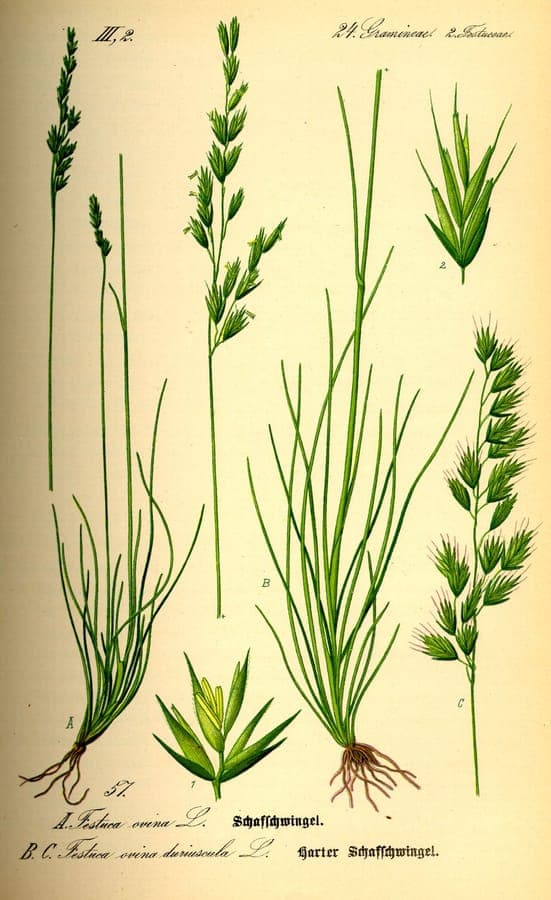
Festuca ovina, commonly known as Ovina or Sheep's Fescue, is a tough, tufted grass that brings elegance and resilience to the garden. Native to a wide range of regions including Alaska, British Columbia, Austria and the Baltic States, this grass thrives in challenging conditions where other plants might fail. It's a popular choice for modern, low-maintenance landscapes, especially in xeriscaping or gravel gardens. As a cool-season grass, it establishes quickly and forms dense, attractive clumps that provide year-round interest.
What sets Festuca ovina apart is its fine texture and silvery-blue foliage. It's not flashy, but it's dependable - the kind of plant that quietly holds a garden together. Whether you're filling gaps between paving stones or softening a rockery, this grass adds structure without demanding attention. On gardenworld.app, you can explore garden designs that integrate this grass seamlessly into dry, sunny schemes.
Appearance & bloom cycle
This graminoid typically grows 20–30 cm tall, spreading to about 25 cm wide. The leaves are narrow, needle-like, and form tight, cushion-like mounds with a striking blue-green to grey hue. In early summer - late June through July - delicate flowering stems rise to about 40 cm, bearing soft purple-tinged panicles that catch the light beautifully. The bloom is subtle, not showy, but adds movement and softness to the garden.
After flowering, the seed heads dry and persist into winter, offering visual interest during colder months. The foliage remains evergreen in mild winters, though tips may brown in prolonged cold or harsh conditions. It doesn't die back completely, making it a valuable plant for winter texture.
Ideal location
Festuca ovina thrives in full sun - aim for a light level of 8 or higher. That means south or west-facing spots with at least 6–8 hours of direct sunlight daily. It performs well in rock gardens, gravel beds, dry borders, and even in crevices between stepping stones. Avoid shady areas or spots under dense tree canopies, as the clumps will become loose and floppy without sufficient light.
This grass is perfect for modern, minimalist designs or naturalistic planting schemes. It tolerates reflected heat from walls and paving, making it ideal for urban gardens. If you're designing a sun-baked slope or a drought-prone corner, this is one of the best grasses to consider. On gardenworld.app, you can create a custom layout that maximizes sun exposure and complements this grass with compatible companions.
Soil requirements
Well-drained soil is non-negotiable. Festuca ovina prefers sandy, gritty, or loamy soils with a pH between 5.5 and 6.5. It struggles in heavy clay or waterlogged conditions, where root rot becomes a serious risk. If your soil is clay-heavy, amend it with sharp sand or fine gravel to improve drainage.
Interestingly, this grass actually performs better in poor, low-fertility soils. Rich soil or added compost can lead to weak, floppy growth and shorter-lived clumps. Avoid fertilizing altogether - it's unnecessary and often counterproductive.
Free design
Want to see Ovina: complete guide in your garden? Make a free design now.
Watering
Once established, Ovina is extremely drought-tolerant. During the first 4–6 weeks after planting, water weekly to help roots settle. After that, it rarely needs supplemental watering, even during dry spells. In the UK or similar climates (USDA zones 4–8), rainfall is usually sufficient.
Overwatering is a bigger threat than drought. Soggy soil, especially in winter, can kill the plant. Water deeply but infrequently during establishment, and avoid daily sprinkling. This grass is ideal for water-wise gardens and eco-conscious gardeners.
Pruning
Pruning isn't required for flowering, but light grooming in late winter or early spring keeps the plant looking sharp. In February or March, use hand shears or a garden comb to remove dead or tatty foliage, cutting back about one-third of the top growth. This encourages fresh, upright blades and prevents the center from becoming too dense.
Avoid using electric hedge trimmers - they crush the fine leaves. Hand tools give a cleaner cut and preserve the plant's natural form. Leave the dried flower stems over winter for visual appeal and habitat value.
Maintenance calendar
- Jan: check for frost damage, remove heavy snow gently
- Feb: light grooming, remove dead material
- Mar: complete tidy-up, divide if needed
- Apr: monitor new growth, no feeding
- May: watch for emerging flower stems
- Jun: peak bloom, minimal care
- Jul: check during heatwaves, water only if essential
- Aug: no extra water needed
- Sep: seeds mature, leave for birds
- Oct: leave standing for winter structure
- Nov: no pruning, let it stand
- Dec: observe, protect from waterlogging
Winter hardiness
Festuca ovina is hardy to USDA zone 4 (-34°C). It survives cold winters with ease, though extreme wetness is more dangerous than cold. In zone 8 and above, it remains evergreen. In colder zones, foliage may die back slightly but regrows vigorously in spring.
Companion plants
Pair Ovina with other sun-loving, drought-tolerant plants. Excellent companions include Sedum 'Autumn Joy', Lavandula angustifolia, Thymus serpyllum, and Echinacea purpurea. The soft blue tones contrast beautifully with purple or yellow flowers. Avoid aggressive spreaders like mint or ground ivy that can overwhelm the clumps.
For inspiration, use gardenworld.app to mix and match plants based on height, color, and water needs.
Closing
Festuca ovina is a quiet achiever in the garden - tough, beautiful, and low-maintenance. It doesn't need coddling, just a sunny spot and decent drainage. Once settled, it can last for years with little intervention. Buy it from local garden centres, plant it in spring or autumn, and let it do its thing. Whether you're designing a modern courtyard or a wildflower meadow edge, this grass earns its place. And with gardenworld.app, you can plan the perfect setting down to the last detail.
Want to see Ovina: complete guide in your garden? Make a free design now.
Upload a photo, pick a style, and get a photorealistic design with plant list in under a minute.
No credit card required


Similar plants
Sporobolus pungens: complete guide
Sporobolus pungens
Sporobolus pungens is a stoloniferous Mediterranean coastal grass with outstanding salt and drought tolerance, perfect for seaside and dry gardens.
Mediterranean aegilops: complete guide
Aegilops biuncialis
Everything about Aegilops biuncialis, a Mediterranean annual grass with ornamental spikes and outstanding drought tolerance for dry gardens.
Silver bluestem: complete guide
Bothriochloa saccharoides
Full guide to Bothriochloa saccharoides (silver bluestem): site, soil, watering, winter hardiness, pruning, and garden companions.