
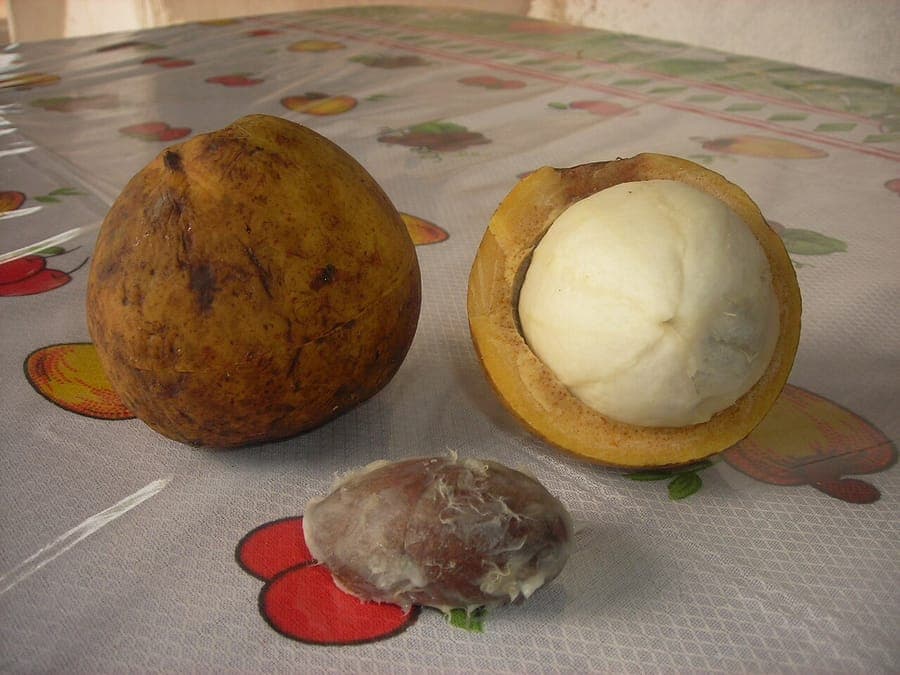
Hellen Perrone / Public domain, via Wikimedia Commons
Platonia insignis: complete guide
Platonia insignis
Want to see Platonia insignis: complete guide in your garden?
1 minute, no credit card
Overview
Platonia insignis, commonly known as bacury, bacouré or parcouri, is a fascinating tropical fruit tree native to South America. Indigenous to Venezuela, Guyana, Suriname and northern Brazil, this tree is celebrated for its large, oval fruits with yellow-orange flesh and a unique taste reminiscent of pineapple and banana. The tree grows in rainforest regions and reaches heights up to 20 meters in natural conditions. This is a plant for enthusiasts brave enough to tackle tropical exotica.
Appearance and bloom
The bacury tree develops a dense, broad-leaved crown with large, glossy green leaves. The leaves are oval to elongated and can reach 20-25 cm in length. The green bark is characteristic, smooth and gray-green in structure. The tree flowers with discrete cream-colored flowers that appear in clusters along the branches. These flowers produce fruits 8-12 cm in diameter, golden-yellow outside, with softer, paler flesh within.
Fruits ripen during the wet season and are highly sought for their nutritional value and flavor. The tree can remain productive for twenty to thirty years.
Ideal location
Bacury grows best in full sunlight in tropical and subtropical climates. The tree tolerates 2000-3000 mm annual rainfall well, making it suited to very warm, humid areas. In temperate climates, the tree must be grown indoors or in heated greenhouse conditions due to its year-round warmth requirements.
Provide protection from strong wind gusts when grown in outdoor tropical conditions. A position with diffuse afternoon shade may be beneficial in extremely hot environments. The tree can adapt to somewhat more shade, though productivity decreases.
Soil
Bacury thrives in well-draining, fertile soil with organic matter. A mixture of sand, clay and humus works well. Soil pH should be between 5.5 and 6.5. The soil must remain regularly moist without waterlogging. In container culture, adequate drainage holes are essential.
Prepare the planting site by incorporating compost and organic material. This promotes both water retention and aeration. In low-lime regions, iron supplementation may be useful to prevent chlorosis.
Watering
Bacury requires regular water, especially during growth and fruiting periods. In summer, water so the soil remains constantly moist but not wet. Two to three times weekly watering is generally sufficient under normal conditions. In cold periods, less water is given.
Ensure good drainage; waterlogging kills roots. In container culture, regular soil moisture monitoring is essential. Misting can be helpful in very hot and dry periods.
Free design
Want to see Platonia insignis: complete guide in your garden? Make a free design now.
Pruning
Pruning is mainly needed to maintain form and keep the tree open for air circulation. Remove dead branches and overlapping twigs. This promotes better interior light and improved fruit development. At young stages, main branches can be lightly pruned to encourage more branching.
Pruning wounds heal quickly in warm, humid conditions. Avoid heavy pruning during cold periods.
Maintenance calendar
Spring (March-May): Check growth progress, provide balanced fertilization. Remove dead branches. Begin watering.
Summer (June-August): Regular watering. Watch for harmful insects. This is the flowering and fruiting period.
Autumn (September-October): Maintain consistent moisture. Harvest ripe fruits when color shifts to golden-yellow.
Winter (November-February): Reduce feeding and water. Rest and preparation period.
Winter hardiness
Bacury is highly frost-sensitive and sustains damage at temperatures below 10 degrees Celsius. The tree is unsuitable for outdoor cultivation outside tropical and subtropical zones. Even in warmer temperate areas, this tree cannot tolerate nighttime temperatures below 5-8 degrees Celsius.
In temperate climates, the plant must be kept indoors or in heated greenhouse conditions. Winter protection is not applicable - permanently warm conditions are essential.
Companion plants
In tropical gardens, other fruit trees such as Mangifera indica (mango), Cocos nucifera (coconut) and Artocarpus altilis (breadfruit) serve well as neighbors. Beneath, smaller tropical plants such as Heliconia and Anthurium can be placed. Tropical flowering shrubs are prized for color.
Avoid very dry-becoming neighbors. Tropical climate regulation through plant groupings helps.
Closing remarks
Bacury is a dream for tropical exotica enthusiasts who want to grow their own food. Though frost-sensitive and demanding warm conditions, productivity and fruit flavor reward patience fully. With proper care, one can harvest years of food enjoyment from this tree.
Platonia insignis is not readily available in temperate regions as a cultivar. Available in tropical areas through local nurseries. gardenworld.app advises on tropical garden designs in warmer climates. gardenworld.app also supports self-sufficiency growing for adventurous gardeners.
Want to see Platonia insignis: complete guide in your garden? Make a free design now.
Upload a photo, pick a style, and get a photorealistic design with plant list in under a minute.
No credit card required


Similar plants
Mangosteen: complete guide
Garcinia mangostana
Mangosteen (Garcinia mangostana) is the tropical fruit tree prized as the queen of fruits. Full glasshouse growing guide for cool-climate enthusiasts.
Symphonia globulifera: complete guide
Symphonia globulifera
Discover boarwood, a tropical tree with medicinal heritage and beautiful flowers. Growing tips and care for tropical and subtropical gardens.
Garcinia indica: complete guide
Garcinia indica
Learn about Goa-butter - a tropical tree with medicinal fruit. Cultivation, maintenance and use of this food plant in gardens.