
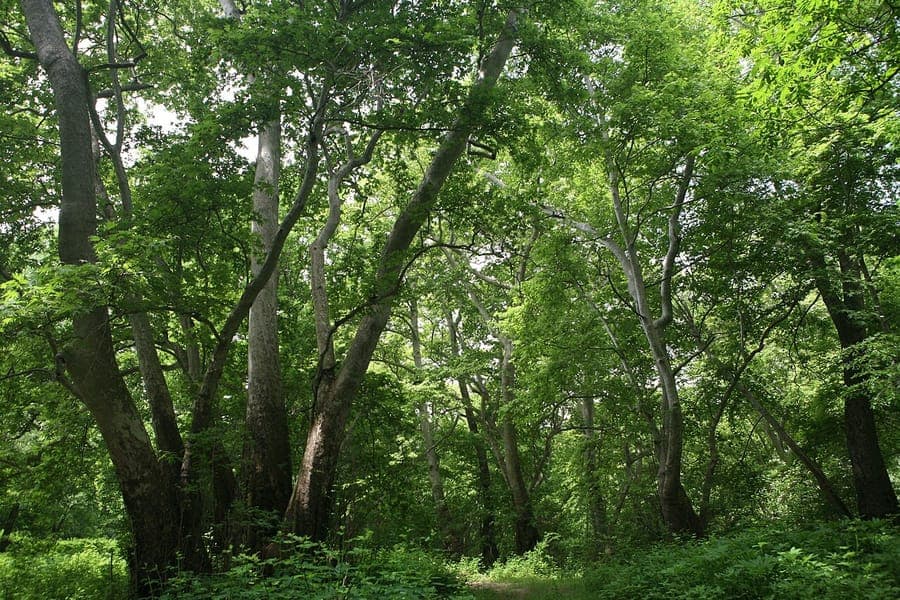
uncredited / CC BY-SA 3.0, via Wikimedia Commons
Oriental plane: complete guide
Platanus orientalis
Want to see Oriental plane: complete guide in your garden?
1 minute, no credit card
Overview
The Oriental plane (Platanus orientalis) is a grand, long-lived deciduous tree native to the Balkans, eastern Mediterranean, and western Asia. Reaching heights of 20 to 30 meters with a spread of up to 20 meters, it's not a tree for the faint-hearted or space-limited. In the UK and broader Europe, it's less common than the hybrid London plane, but its ornamental bark, bold foliage, and resilience make it a standout choice for spacious landscapes. It thrives in parks, large private gardens, or as a street tree in cities with room to grow. If you're considering one, use gardenworld.app to model how it will cast shade and expand over decades - essential when planting near buildings or drainage lines.
Appearance & bloom cycle
This tree is instantly recognizable by its mottled, exfoliating bark that peels in irregular patches, revealing creamy, olive, and grey-green tones beneath. The leaves are large - up to 25 cm across - palmately lobed with five deep divisions, resembling maple leaves but rougher in texture. They emerge bright green in spring, darken in summer, and turn a soft yellow-brown in autumn, offering subtle seasonal change. Bloom time is April to May, with green, inconspicuous flowers appearing in dangling clusters. Male and female flowers are on the same tree, and after pollination, round seed balls form, persisting through winter and providing visual interest when the tree is bare.
Ideal location
Plant the Oriental plane in full sun (light level 8–10) for optimal growth and structure. It tolerates light shade but may develop a lopsided crown. Because of its ultimate size, give it at least 8–10 meters of clearance from buildings, underground pipes, and pavements. It's an excellent choice for avenues, large estates, or as a specimen tree in open parkland. Avoid planting in small urban gardens - it will quickly dominate and cause structural issues. Use gardenworld.app to overlay mature tree dimensions on your garden plan and avoid future conflicts.
Soil requirements
The Oriental plane is adaptable to a wide range of soils - clay, loam, or sandy - as long as drainage is adequate. It prefers a pH between 6.5 and 7 (slightly acidic to neutral). Avoid waterlogged sites; prolonged saturation leads to root rot. It's tolerant of urban pollution, compaction, and occasional drought once established, making it suitable for city planting where soil quality is poor.
Free design
Want to see Oriental plane: complete guide in your garden? Make a free design now.
Watering
Young trees need consistent watering for the first 3–5 years. During dry spells, give 20–30 liters per week, soaking deeply to encourage deep root development. Established trees are highly drought-tolerant and rarely need supplemental water, except in extreme heatwaves. Overwatering is more dangerous than under-watering for mature specimens.
Pruning
Minimal pruning is required. Remove dead, damaged, or crossing branches in late winter or early spring. Avoid heavy pruning - the tree responds slowly and may become susceptible to fungal infections. Use clean, sharp tools and make clean cuts just outside the branch collar. Structural pruning should be done gradually over several years when the tree is young.
Maintenance calendar
- Jan: Inspect for broken branches; light pruning if needed.
- Feb: Check root zone for compaction; plan spring tasks.
- Mar: Ideal time to plant container-grown specimens.
- Apr: Flowering begins; avoid pruning.
- May: Monitor for aphids or powdery mildew on young leaves.
- Jun: No action needed for mature trees; water young ones in drought.
- Jul: Watch for leaf scorch in extreme heat.
- Aug: Continue monitoring young trees; deep water if soil is dry.
- Sep: Growth slows; no fertilizing.
- Oct: Leaves begin to fall; remove heavy leaf litter to prevent fungal issues.
- Nov: Dormancy begins; no care needed.
- Dec: Final check for storm damage; protect young trunks in harsh climates.
Winter hardiness
Hardy in USDA zones 7–9. In the UK (zone 8), it survives most winters without issue. Young trees may suffer sunscald on the south-facing trunk in freezing conditions - wrap the lower trunk with breathable tree wrap for the first three winters. The tree is fully deciduous and loses all leaves in late autumn.
Companion plants
Under the broad canopy, plant shade-tolerant ground covers like Vinca minor, Pachysandra, or ferns such as Dryopteris. Avoid planting moisture-hungry perennials near the trunk - the plane's extensive root system competes aggressively. For structure, consider holly (Ilex) or mahonia as understory shrubs. Keep mulch light and away from the trunk to prevent rot.
Closing
The Oriental plane is a legacy tree - plant it with foresight. It demands space and patience but rewards with decades of beauty and shade. Buy young, healthy trees from reputable garden centres, and ensure the planting hole is wide and well-prepared. Once established, it's remarkably low-maintenance. Use gardenworld.app to visualize how this tree will mature in your space, including root spread and seasonal shade patterns - a smart step before breaking ground.
Want to see Oriental plane: complete guide in your garden? Make a free design now.
Upload a photo, pick a style, and get a photorealistic design with plant list in under a minute.
No credit card required


Similar plants
Mexican Plane: complete guide
Platanus mexicana Moric.
Discover the Mexican Plane (Platanus mexicana), a magnificent shade tree with striking bark and broad canopy. Learn cultivation, care and landscape use.
Platanus racemosa: complete guide
Platanus racemosa
Discover California sycamore, a majestic tree with striking patterned bark. Growing guide for this native specimen.
Buttonball: complete guide
Platanus occidentalis
Platanus occidentalis is a colossal tree famed for its enormous leaves and distinctive marbled bark. Learn cultivation and maintenance tips for this giant specimen.