
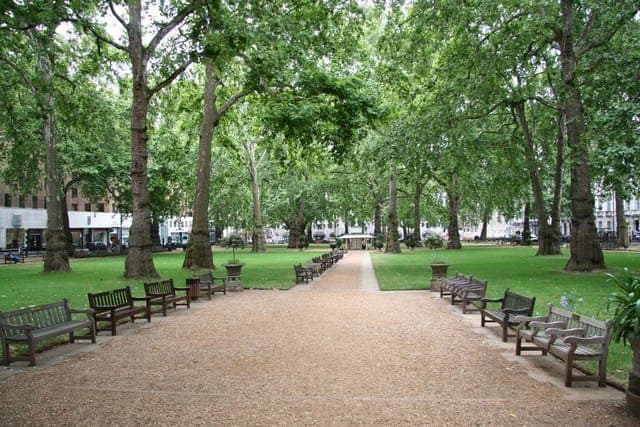
Richard Croft / CC BY-SA 2.0, via Wikimedia Commons
London planetree: complete guide
Platanus acerifolia
Want to see London planetree: complete guide in your garden?
1 minute, no credit card
Overview
The London planetree (Platanus acerifolia) is a dominant presence in cityscapes across Europe and North America. Though not native to the UK - despite its name - it has become a hallmark of urban greenery, lining avenues, parks, and public squares. This hybrid, believed to be a cross between the American sycamore and the Oriental plane, thrives in tough city conditions, tolerating pollution, compacted soil, and root disturbance. It's a long-lived tree, often reaching 200 to 300 years, and can grow up to 30 meters tall with a spread of 15 to 20 meters, making it unsuitable for small gardens but perfect for expansive landscapes.
Its bark is one of its most striking features - it flakes off in irregular patches, revealing a mottled pattern of cream, olive, and pale brown. This exfoliating bark not only adds visual interest year-round but also helps the tree resist fungal infections and pollution buildup. On gardenworld.app, you can design a layout that accounts for the tree's massive root zone and seasonal shade patterns, ensuring it integrates smoothly into your garden plan.
Appearance & bloom cycle
The leaves are palmate, deeply lobed with five to seven pointed segments, resembling those of a maple - hence the species name 'acerifolia'. They emerge bright green in spring, darken in summer, and turn a dull yellow-brown in autumn before dropping, often as early as October. The tree is deciduous, and leaf drop can be messy, so consider placement near walkways carefully.
Flowering occurs in spring, typically April to May. The blooms are inconspicuous, small spherical clusters hanging from long stalks. After pollination, these develop into seed balls - round, fuzzy fruits about 2.5 cm in diameter - that persist through winter and disperse by wind in late winter or early spring. These seed balls are a familiar sight dangling from bare branches.
Ideal location
Plant in full sun to light shade. The London planetree needs ample space - at least 8 meters from buildings, pavements, or other trees. Avoid planting near underground utilities, foundations, or drainage systems, as its roots are vigorous and can cause structural damage. It excels in large gardens, parks, and wide streetscapes. Good air circulation helps prevent anthracnose and powdery mildew, common issues in humid conditions.
Using gardenworld.app, you can simulate how a mature specimen will affect light and space in your garden, helping you plan for decades of growth.
Free design
Want to see London planetree: complete guide in your garden? Make a free design now.
Soil requirements
This tree is adaptable to a wide range of soils - clay, loam, sand, or mixed types - as long as drainage is adequate. It tolerates pH from slightly acidic (5.5) to slightly alkaline (8.0). While it withstands temporary drought and short periods of waterlogging, prolonged saturation can lead to root rot. For heavy clay soils, amend planting holes with coarse sand and organic compost to improve aeration.
Watering
Young trees need consistent watering during the first two to three growing seasons. Provide 20–30 liters per week during dry spells (less than 25 mm rainfall). Established trees are drought-tolerant thanks to deep, spreading roots, but benefit from supplemental watering during extended dry summers, especially if foliage wilts or scorches.
Pruning
Pruning is generally minimal. Remove dead, damaged, or crossing branches in late winter when the tree is dormant. Avoid heavy crown reduction, as the London planetree responds poorly to drastic cuts and is prone to disease entry. Always use clean, sharp tools and disinfect between cuts if disease is suspected. Structural pruning in early years can help shape a strong central leader.
Maintenance calendar
- January–February: Inspect for damaged wood; light pruning possible.
- March: Check trunk for bark damage or cankers.
- April–May: Flowering period; keep soil moist, especially for young trees.
- June–August: Monitor for leaf scorch, anthracnose, or powdery mildew.
- September–October: Leaves drop; rake and remove debris to reduce disease carryover.
- November–December: No active care needed; check root collar for girdling roots.
Winter hardiness
The London planetree is hardy in USDA zones 5 to 8. It tolerates winter temperatures down to -20°C. In milder zones, it remains fully dormant without damage. Young trees may suffer minor dieback in harsh winters but usually recover well in spring. The bark's flaking continues year-round, adding winter texture.
Companion plants
Under the dense canopy, light and moisture are limited. Choose shade-tolerant, drought-resistant groundcovers like barrenwort (Epimedium), lungwort (Pulmonaria), or wood anemone (Anemone nemorosa). Avoid aggressive spreaders. Grass often struggles under the tree due to root competition and shade.
Closing
The London planetree is a resilient, stately tree that brings grandeur and longevity to any large-scale planting. Its adaptability to urban stress makes it a top choice for city planners and gardeners alike. When planting, prioritize space and long-term impact. Young trees are available at garden centres like B&Q, Wyevale, and local independents, typically in 1.5–2m sizes. With proper siting and care, this tree can become a living landmark for generations. Plan wisely - your decisions today will shape the landscape for centuries.
Want to see London planetree: complete guide in your garden? Make a free design now.
Upload a photo, pick a style, and get a photorealistic design with plant list in under a minute.
No credit card required


Similar plants
Mexican Plane: complete guide
Platanus mexicana Moric.
Discover the Mexican Plane (Platanus mexicana), a magnificent shade tree with striking bark and broad canopy. Learn cultivation, care and landscape use.
Platanus racemosa: complete guide
Platanus racemosa
Discover California sycamore, a majestic tree with striking patterned bark. Growing guide for this native specimen.
Buttonball: complete guide
Platanus occidentalis
Platanus occidentalis is a colossal tree famed for its enormous leaves and distinctive marbled bark. Learn cultivation and maintenance tips for this giant specimen.