
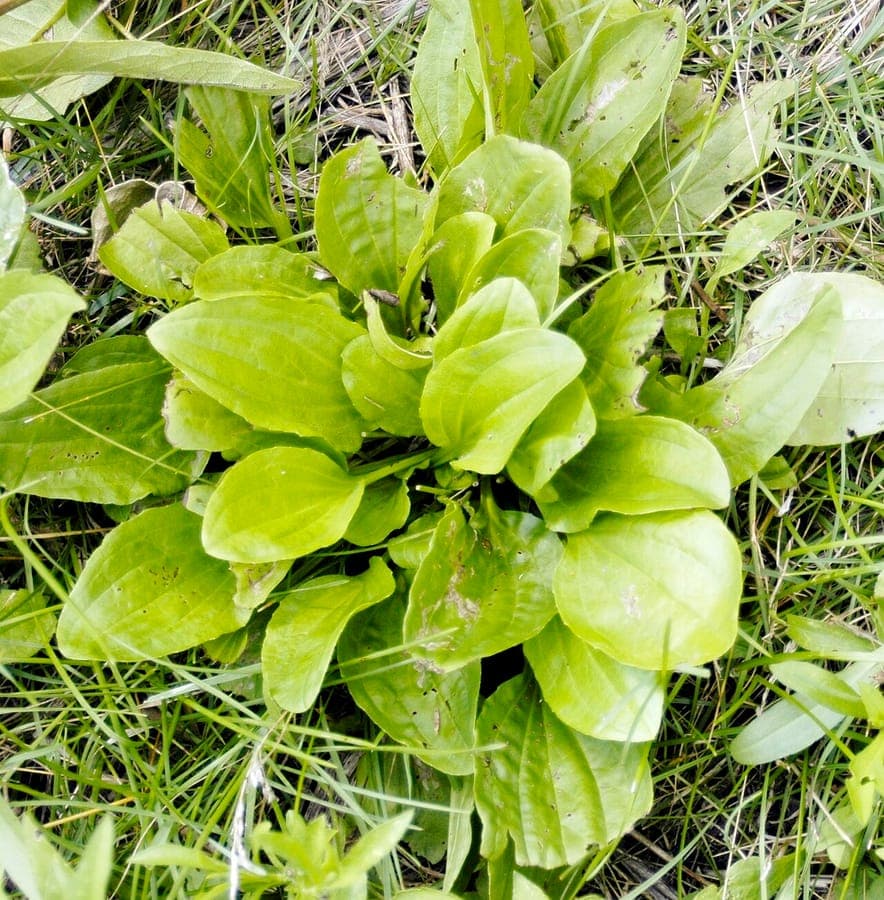
Frank Mayfield / CC BY-SA 2.0, via Wikimedia Commons
Rugel's plantain: complete guide
Plantago rugelii
Want to see Rugel's plantain: complete guide in your garden?
1 minute, no credit card
Overview
Plantago rugelii, commonly known as Rugel's plantain, red-stalk plantain, or American plantain, is a useful wild herbaceous plant from parts of North America that is now also naturalized in Europe. This compact plant reaches 15 to 45 cm in height and grows from a characteristic rosette of oblong leaves with red-violet tinted petioles. The plant blooms from May through October with small, inconspicuous flowers in dense, dark spikes that later produce seeds. This species is valuable both medicinally and ecologically as it provides food for numerous insects and birds.
Appearance and bloom
Rugel's plantain distinguishes itself from many other plantain species through its petioles that are often reddish or violet-tinted, making it easy to identify. Leaves are oblong-elliptic, approximately 5 to 15 cm long, with distinct veins and smooth edges. They grow in dense rosettes close to the ground. Flowers are very small, yellow-green to purple, in upright spikes 5 to 20 cm long. This flower structure is visually inconspicuous but ecologically valuable as it attracts numerous insects. Following bloom, small seed capsules form containing countless tiny seeds.
Ideal location
Rugel's plantain grows nearly everywhere but thrives best in full sun to light shade. This is a vigorous plant that adapts to virtually all environments: lawns, pathways, garden margins, and even in tile grout. In garden work, it is best to prevent uncontrolled spread through self-seeding by managing deliberately. Plant it intentionally in undergrowth or as an ecological plant in wild garden sections where sustainability is desired.
Soil
Plantago rugelii is not fussy about soil type and grows in nearly all soils. It tolerates poor, compacted grounds where many other plants cannot thrive. Acidic or alkaline soils are both acceptable. This plant works well in preliminary preparation or in site planting. No special soil improvement needed; indeed, overly fertile soils can lead to excessive growth.
Free design
Want to see Rugel's plantain: complete guide in your garden? Make a free design now.
Watering
Rugel's plantain is highly drought-tolerant and requires little water once established. During the first growing season, some regular moisture is beneficial; thereafter, the plant grows independently. In extremely dry periods, some watering may be desirable for optimal growth and leaf quality. This plant also tolerates wet terrain better than most grasses.
Pruning
Aside from removing seed flowers to control self-seeding, no pruning is actually necessary. Allow flower spikes to mature for self-seeding or trim them for neater appearance. The rosettes grow slowly and form naturally neat-looking forms.
Maintenance calendar
March-April: Check emergence of young plants from previous season. Allow natural spread or remove unwanted seedlings. May-October: Bloom period; enjoy flowers and insect activity. Trim seed flowers as desired. November-February: Plant grows more slowly; minimal activity needed. Simply observe and wait for spring.
Winter hardiness
Plantago rugelii is extremely cold hardy in zones 3 through 9 (-40 to -20 degrees Celsius). This is a winter annual in many areas, meaning seedlings overwinter and germinate early in spring. The plant requires no separate winter protection except in very extreme climates.
Companion plants
Rugel's plantain combines well with other ecological herb gardens. Other plantain species, delphiniums, clovers, and wild flowers create rich ecological environments. In borders, it works well with other low-growing herbs such as speedwell and chickweed. Avoid heavy competitors that would overshadow it.
Closing thoughts
Plantago rugelii offers many advantages: it is ecologically valuable, medically useful, edible (young leaves can be used in salads), and probably already present in many gardens as so-called "weeds." Recognizing and managing this plant fits perfectly into sustainable gardening practices. Discover more about ecological gardens on GardenWorld.
Want to see Rugel's plantain: complete guide in your garden? Make a free design now.
Upload a photo, pick a style, and get a photorealistic design with plant list in under a minute.
No credit card required


Similar plants
White Beardtongue: complete guide
Penstemon albidus
Discover white beardtongue (Penstemon albidus) - elegant perennial with white to cream flowers. Drought-resistant, perfect for prairie and dry gardens.
Longsepal Beardtongue: complete guide
Penstemon calycosus
Discover longsepal beardtongue (Penstemon calycosus) - beautiful perennial with lilac-blue flowers. For partial shade and moist soil. Ideal for naturalized.
Penstemon cusickii: complete guide
Penstemon cusickii
Discover Cusick's beardtongue, a compact alpine flowering plant with violet-pink blooms. Perfect choice for rock gardens and water-wise landscaping.