
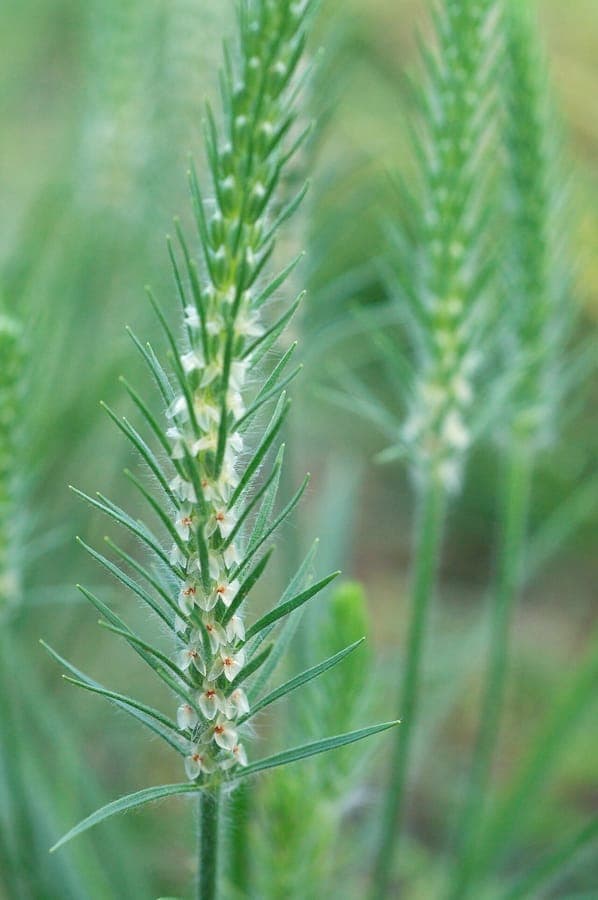
Eric Hunt / CC BY-SA 4.0, via Wikimedia Commons
Bracted plantain: complete guide
Plantago aristata
Want to see Bracted plantain: complete guide in your garden?
1 minute, no credit card
Overview
Plantago aristata, known as bracted plantain or buckhorn, is a distinctive North American herbaceous plant in the Plantaginaceae family. Native to much of North America from Southeast Canada to western US states, this plant is common in prairies, dry grasslands, and undisturbed vegetation. The plant is useful in wild gardens, prairie restoration, and xeriscaping projects because of its drought resistance and natural appearance.
Plantago aristata grows as an upright, unbranched plant of 6 to 24 inches tall with narrow leaves in a basal rosette. The plant produces characteristic, compact, densely bristly flower spikes that are very distinctive and interesting. Rather than colorful flowers, this plant produces very interesting structural elements offering long-term garden interest.
Appearance and bloom
Bracted plantain grows as an upright, unbranched plant with narrow, linear leaves grouped in a basal rosette. Leaves are 2 to 6 inches long and approximately 0.1 to 0.2 inches wide, linear, fairly rigid, and grayish-green. Leaves show distinct veining and sometimes have a slightly powdery surface.
The most distinctive features are the flower spikes (inflorescences). These grow upright from the center of the rosette, usually several to dozens per plant, reaching 4 to 12 inches tall. Each spike has a characteristic compact form with very dense small flowers covered with prominent, stiff, linear bracts that give it a very bristly or hairy appearance. The bracts are often 0.04 to 0.08 inches long and protrude distinctly. The small flowers themselves are subordinate to the bracts in appearance.
Blooming extends from May through October, with successive flowering episodes if conditions remain favorable. After blooming, plants produce small seed capsules filled with many tiny seeds dispersed by wind and animals.
Ideal location
Bracted plantain thrives in fully sunny locations with at least 6 hours of direct sunlight daily. The plant tolerates partial shade but grows thin and weak.
This plant is exceptionally drought-tolerant and thrives in very dry conditions. It prefers open, exposed locations with good air circulation. In very wet areas, it grows poorly.
Plantago aristata grows well in USDA zones 3-9 and can even overwinter in zone 10 in very dry areas. This is a plant that demonstrates considerable temperature tolerance and climatic flexibility.
Free design
Want to see Bracted plantain: complete guide in your garden? Make a free design now.
Soil
This plant thrives in very dry, infertile soils and tolerates poor soils much better than most plants. A pH between 5.0 and 8.0 is acceptable. The plant requires excellent drainage; waterlogging will quickly lead to rot.
Bracted plantain can grow in sand, gravel, clay, and mixtures. It is very plastic in soil requirements. Many growers use it in xeriscaping projects because it grows in very lean, poor soil.
Watering
Newly planted Plantago aristata need some initial moisture provision until established (usually 4 to 6 weeks). After establishment, very minimal supplemental water is needed except in very dry climates.
Once established, this plant can live without regular watering. In very dry regions, occasional summer irrigation can help but is not required.
Pruning
This plant requires no pruning. The plant naturally matures and produces frost-resistant seed capsules. Some growers remove spent spikes for neater appearance, though many leave them to natural degradation.
Maintenance calendar
APRIL-MAY: Sow directly outdoors or water newly planted seedlings. JUNE-SEPTEMBER: Plant grows and blooms. Minimal care required. OCTOBER-NOVEMBER: Seed maturation. Plant dies back. DECEMBER-MARCH: Dormant seeds in soil.
Winter hardiness
Plantago aristata is winter hardy in USDA zones 3-9 as a cool-season annual in many regions. In zones 3-5, the plant dies in winter and re-starts from seed the following spring. In zones 6-9, the plant can overwinter and persist into a second year (though usually treated as an annual/biennial because it has stronger flowering the first year).
Companion plants
Bracted plantain combines well with other prairie and drought-resistant wildflowers. Echinacea, Ratibida, Monarda, and Oenothera are excellent partners. The stiff, upright growth habit of bracted plantain pairs nicely against the more flowing growth of other wildflowers.
In xeriscaping, it is used together with other drought-resistant native plants, grasses, and rocks for interesting texture mixes.
Closing
Plantago aristata is a useful, interesting plant for prairie restoration, wild gardens, or xeriscaping. The plant's drought tolerance and natural appearance make it valuable for sustainable garden design. Quality wildflower suppliers throughout North America and Europe stock this species. Seeds are readily available from specialty seed companies and botanical institutions. With seeds collected from wild populations or cultivated seed, you can add a very interesting, sustainable plant component to your garden.
Want to see Bracted plantain: complete guide in your garden? Make a free design now.
Upload a photo, pick a style, and get a photorealistic design with plant list in under a minute.
No credit card required


Similar plants
White Beardtongue: complete guide
Penstemon albidus
Discover white beardtongue (Penstemon albidus) - elegant perennial with white to cream flowers. Drought-resistant, perfect for prairie and dry gardens.
Longsepal Beardtongue: complete guide
Penstemon calycosus
Discover longsepal beardtongue (Penstemon calycosus) - beautiful perennial with lilac-blue flowers. For partial shade and moist soil. Ideal for naturalized.
Penstemon cusickii: complete guide
Penstemon cusickii
Discover Cusick's beardtongue, a compact alpine flowering plant with violet-pink blooms. Perfect choice for rock gardens and water-wise landscaping.